Ninety exhibitor entries, three floors, and one theme short enough to fit on a banner: "AI for AI: Advanced Integration." That was LMCE 2026 at Grand Walkerhill Seoul, October 21 to 23, and this is our visitor's account of it.
LMCE (Laboratory Medicine Congress & Exhibition) is the trade exhibition held alongside the annual meeting of the Korean Society for Laboratory Medicine (KSLM). The 2026 edition was its 10th anniversary and ran with the 67th KSLM Annual Meeting. We went as visitors, not exhibitors, so everything below about other companies comes from the official exhibition guide and from what we saw in the lobby. We have no visitor counts to publish, and we have not invented any. Where we give an impression, we say so.
The Show in Numbers
The facts below are taken from the overview and booth list in the official exhibition guide.
- Dates and venue: October 21-23, 2026, Grand Walkerhill Seoul
- Host: Korean Society for Laboratory Medicine, supported by the Seoul Metropolitan Government
- Programme: plenary lectures, keynotes, symposia, education workshops, oral and poster presentations, plus the exhibition
- Exhibition hours: Wednesday 13:00-18:30, Thursday 08:00-18:30, Friday 08:00-15:30, about 23.5 hours in total
- Exhibitors: 90 entries, booth numbers 1 to 91 (no booth 80 is listed)
Our earlier article, Sekbio at LMCE & KSLM 2026 in Seoul, has the pre-show background.
Who Filled the Three Floors
Exhibitors are ranked by sponsorship level, and the pyramid is wide at the bottom. Silver and Bronze together make up two thirds of the list.
The layout follows the money. All ten Blue Diamond, Diamond and Platinum sponsors sat in Vista Hall on B2, booths 1 to 10. Booths 11 to 19 on the same floor were Gold. Grand Hall on B1 held booths 20 to 42, and Exhibition Hall on B3 held booths 43 to 91, together with the event booth.
What the Exhibitor List Says About Korea's IVD Industry
Reading ninety company profiles in a row shows patterns that a single booth visit does not. Three stood out.
Korean champions, including the labs themselves
Boditech Med took one of the two Blue Diamond slots, next to Roche. Seegene appeared twice, as Seegene Inc. (Diamond) and as Seegene Medical Foundation (Platinum). GC Labs, Samkwang Medical Lab, SCL and EONE Laboratories, all large reference laboratories, exhibited as Gold sponsors. Seegene Medical Foundation says it runs about 400,000 tests across roughly 4,500 test items a day, and its OPEN Healthcare arm now operates laboratories and clinics in Kazakhstan, the United States and Vietnam.
In other words, the customers and the suppliers share one exhibition hall, and some of them are the same company.
A strong distributor layer
A large share of the booths represent foreign brands through Korean partners. GeneX describes itself as the only authorized Korean distributor of Cepheid's GeneXpert. 1st Philekorea carries New England Biolabs, Oxford Nanopore and Bruker. ACCESSPHARM represents LGC Diagnostics & Genomics, EG Labwater represents ELGA, and ssmedipia brings Stago hemostasis systems. Kyung IL and JW Bioscience handle Tosoh and Sekisui instruments respectively.
Vertical integration as a selling point
Several domestic makers put "we make our own raw materials" at the top of their profile. Bioneer says it began in 1992 by localizing PCR enzymes and primers that were previously imported, and now manufactures oligos, enzymes, reagents and real-time PCR systems in-house. Genes Laboratories points to patented DNA enzyme manufacturing and a vertical line from raw material synthesis to finished kits. Kogenebiotech cites an automated manufacturing system to guarantee reagent supply. Supply security is clearly a marketing message in Korea now, and it matches what we described in Korea's biomanufacturing import dependency and dual sourcing.
Strong in POCT, but many of the export players were absent
Korea is very strong in rapid and point-of-care testing, with many capable companies. Boditech, SD Biosensor, Rapigen, OSANG and ezdiatech did exhibit. But many of the Korean POCT names we are used to meeting at international shows were not on the list.
This is our own reading, not something any exhibitor told us: those companies sell mainly to overseas markets, so a domestic congress is a lower priority for them. If that is right, LMCE shows the Korean market as served by laboratory-medicine vendors, and understates the country's export strength in rapid testing.
What the Big Names Brought
The headline products were bigger automation lines and more specialised biomarkers. Figures are the exhibitors' own claims from the guide.
| Company | Tier | What stood out in the guide |
|---|---|---|
| Roche Diagnostics Korea | Blue Diamond | cobas pro i 601 for routine LC-MS/MS; cobas 5800 molecular system (1.1 m² footprint); cobas pure integrated chemistry and immunoassay |
| Boditech Med | Blue Diamond | AFIAS-10 with 10 parallel channels; ALCIS-2 chemiluminescence analyzer (up to 200 tests/hour); AFIAS TDM for same-day infliximab and anti-drug antibody results |
| Siemens Healthineers | Diamond | ELF liver fibrosis test (HA, PIIINP, TIMP-1); FlexLab X laboratory automation; CN-3000/CN-6000 coagulation analyzers |
| Abbott Korea | Diamond | Alinity harmonized platform family; AlinIQ Insight "command center" software; GLP total laboratory automation |
| Seegene Inc. | Diamond | High-multiplex Allplex PCR assays; STARlet-AIOS automation; STAgora statistics platform for accumulated test data |
| Beckman Coulter Korea | Platinum | DxI 9000 immunoassay analyzer; DxA 5000 total lab automation with a 4-minute universal STAT centrifugation |
| Sysmex Korea | Platinum | XR-9000 modular hematology track; HISCL immunoassay with M2BPGi (liver fibrosis) and presepsin (sepsis) menu |
| SG BioScience | Platinum | Hitachi LABOSPECT 008α (2,000 tests/hour per module, 8,000 with four modules) and LABOSPECT TS automation |
Product Types on the Floor
We grouped what we read into seven families. We did not count products, so the order below is not a ranking.
- Total laboratory automation and pre-analytics. Hitachi, Siemens, Abbott, Beckman, Sysmex, Mindray (CLINILOG V4) and Stago all showed track systems. Wise Meditech showed a pre-analytical line with reception kiosks and a tube labeler rated at 1,440 tubes per hour.
- Immunoassay and point-of-care. Boditech, SD Biosensor (STANDARD i1000), Radiometer (AQT90 FLEX) and Sysmex covered both lab and near-patient formats. Cardiac panels such as troponin I, CK-MB, NT-proBNP and D-dimer recurred; Sekbio lists antibody pairs for cTnI, NT-proBNP and D-dimer.
- Molecular diagnostics. Syndromic PCR (Seegene, Invitros, Bioneer), sample-to-answer cartridges (SD Biosensor STANDARD M10, GeneXpert), NGS (Thermo Ion Torrent Genexus Dx, Dxome liquid biopsy, NGeneBio MRD panels) and long-read sequencing from Oxford Nanopore.
- Allergy and autoimmune multiplex. Invitros AlloScreen Max108, PROTIA Allergy-Q 192D (176 allergens in one assay), SUGENTECH Allergy PLUS 120, Thermo Phadia 250 and Euroimmun UNIQO 160. Component-resolved allergens were the common selling point.
- Hematology, hemostasis and blood gas. Sysmex, Stago, Werfen (ACL TOP 70), Siemens, Radiometer and Nova Biomedical.
- Microbiology. BD BACTEC FXI blood culture (claimed mean time to detection of 2.8-3.2 hours), Hufit HubCentra, Handok's MALDI Biotyper sirius, and QuantaMatrix dRAST for rapid antimicrobial susceptibility.
- Consumables and upstream materials. Blood collection tubes (Soyagreentec, AB Medical, BD), laboratory water (Merck, EG Labwater), dyes and beads (BioActs BM&S), and reagent components (Lucigen).
AI for AI: Where the Theme Showed Up in Products
A theme on a banner is easy. We looked for where AI actually appeared in the product descriptions, and found it in three places.
- Image-based morphology. UIMD's analyzers sort cells into 16 white blood cell, 23 red blood cell, 18 bone marrow and 3 platelet classes.
- Interpretation software. MedySapiens' MedyCVi uses AI to prioritise genetic variants and says it cuts a review that took weeks to a few hours. QuantaMatrix's AlzPlus applies a proprietary algorithm to four plasma biomarkers to assess amyloid pathology risk.
- Laboratory operations and data. Abbott's AlinIQ Insight, Werfen's HemoHub, Seegene's STAgora and the AI Research Institute inside Seegene Medical Foundation all sit on the data layer above the instrument.
Our honest impression is that the theme ran ahead of the products. We did not see an AI solution with a clear, deployed use case in a routine laboratory, and the descriptions we read were vendor claims without customer data behind them. Integration of AI into daily laboratory work still looks early.
We found no booth claiming AI in the reagent itself. That fits our view from the pre-show article: algorithms assume that a signal means the same thing from lot to lot, so reagent consistency comes before any analytics. For the reasoning, see antibody batch-to-batch consistency in IVD manufacturing.
Five Technology Trends We Take Home
These are our judgments from reading the guide and walking the lobby, not measured data.
- Automation is stretching in both directions. Tracks now begin at the patient reception desk and end at cold storage and digital review.
- Syndromic PCR keeps getting smaller and faster. Bioneer's IRON-qPCR claims up to 40 targets in 40 minutes in a 12 kg unit.
- Near-patient testing is chasing laboratory sensitivity. ezdiatech's VEUS platform quantifies GFAP and UCH-L1 for mild traumatic brain injury at pg/mL level in under 50 minutes.
- New biomarkers ride on new therapies. ELF and M2BPGi for liver fibrosis, presepsin for sepsis, plasma amyloid panels, donor-derived cell-free DNA for transplants and drug-level monitoring for biologics all appeared.
- Supply security is being sold as a feature. Local enzyme, oligo and reagent production came up repeatedly in the Korean profiles.
How Lively Was It?
We will not put a number on the crowd, but our impression is clear: LMCE is smaller and less lively than the large Chinese IVD exhibitions, and it also felt smaller than JACLaS EXPO in Japan, which we visited a week earlier (see our JACLaS EXPO 2026 recap). It is a congress-linked show of 90 exhibitors, not a trading fair. What the guide and the lobby do show is a well-organised, sponsor-driven event with real effort put into the anniversary atmosphere.
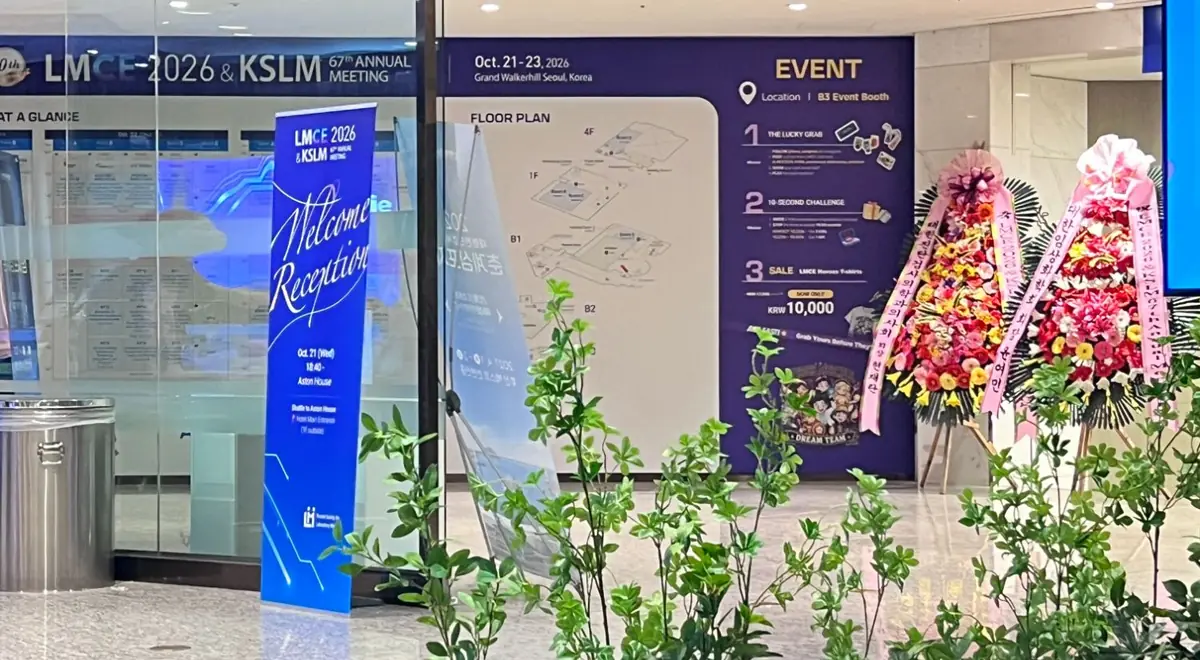
- A Welcome Reception on the evening of October 21 at Aston House, with a shuttle from the hotel's main entrance
- An event booth on B3 with three activities: a social-media "Lucky Grab" claw machine, a "10-Second Challenge" stopwatch game and LMCE T-shirts at KRW 10,000
- An E-Poster zone on B3 and a coffee counter on every exhibition floor
- Congratulatory flower stands lined up in the lobby, a Korean custom for marking an opening or anniversary
The tiers and event programme show how the show is organised, not how big it is. For the Korean laboratory-medicine community it is the main annual meeting point, but it is a domestic one.
Where Antibodies and Raw Materials Fit
We searched the full guide text for antibody, antigen, recombinant and reagent-component offers. Only one booth lists antibodies, antigens and recombinant protein as a focus area: Lucigen Reagent Components, shown by ACCESSPHARM at booth 78. BioActs BM&S (booth 82) offers fluorescent dyes and beads. Bioneer and Genes Laboratories make enzymes. The many other mentions of antibodies are test targets, such as MOG antibody assays or anti-drug antibodies, not supplies.
That tells us something about how antibody supply is sold in this market. It is largely a conversation held in meeting rooms between assay makers and their suppliers, not on exhibition stands. It also means a Korean IVD manufacturer with a failing antibody lot has few supplier names on the show floor to turn to.
Why a Second Antibody Source Matters More in Korea
When domestic makers advertise vertical integration, they are answering buyer worries about supply continuity. A recombinant antibody with an archived sequence lets an assay maker qualify a second source without redoing the whole validation. Our guide to recombinant antibody vs hybridoma for IVDR compliance covers the documentation side, and IVD raw materials market to 2031 covers who supplies what.
Several assays on show target markers where we already list antibody pairs, including serum amyloid A (GeneX), CRP (Radiometer's AQT90 FLEX menu) and sepsis markers such as procalcitonin. If you are building a similar assay, the next step is a short project description with target, format and expected volume.
Frequently Asked Questions
What was LMCE 2026 and when was it held?
LMCE 2026 was the Laboratory Medicine Congress & Exhibition, held together with the 67th Annual Meeting of the Korean Society for Laboratory Medicine at Grand Walkerhill Seoul, Korea, from October 21 to 23, 2026. It marked the 10th anniversary of LMCE and was supported by the Seoul Metropolitan Government.
How many companies exhibited at LMCE 2026?
The official guide lists 90 exhibitor entries across booth numbers 1 to 91, with no booth 80. By tier there were 2 Blue Diamond, 3 Diamond, 5 Platinum, 14 Gold, 27 Silver, 33 Bronze and 3 Venture sponsors, plus 3 unranked organizations.
What was the main theme of LMCE & KSLM 2026?
The main theme was "AI for AI (Advanced Integration)". In the product profiles, AI appeared mostly in cell image analysis, genomic interpretation software and laboratory data platforms, not in reagents. We did not see a convincing, deployed AI case in routine laboratory work.
Which product categories were on show at LMCE 2026?
We grouped the exhibits into seven families: total laboratory automation and pre-analytics, immunoassay and point-of-care testing, molecular diagnostics, allergy and autoimmune multiplex panels, hematology and hemostasis, microbiology, and consumables and upstream materials.
How does LMCE compare with IVD exhibitions in China and Japan?
In our impression LMCE is smaller and less lively than the large Chinese IVD exhibitions, and smaller than JACLaS EXPO in Japan. It has 90 exhibitors and is tied to the KSLM annual meeting, so it works best as a gathering of the Korean laboratory-medicine community.
Why were some Korean POCT companies missing from LMCE 2026?
We cannot say for certain. Our own analysis is that many Korean rapid-test and POCT makers sell mainly to international markets and therefore prioritise overseas exhibitions over a domestic congress. Some did exhibit, including Boditech, SD Biosensor, Rapigen, OSANG and ezdiatech.
Was there much for antibody and raw material suppliers at LMCE 2026?
Not on the floor. In the full exhibition guide only one booth, Lucigen Reagent Components at ACCESSPHARM, lists antibodies, antigens and recombinant protein as a focus area. Raw material sourcing in Korea seems to happen mostly in private meetings and through distributors.
Did Sekbio exhibit at LMCE 2026?
No. Sekbio is not in the exhibitor directory, and we attended as visitors to meet laboratory and IVD professionals. The company facts here come from the official exhibition guide and from the venue lobby.
I would like to discuss an antibody project after LMCE. How do I start?
Email info@sekbio.com with the target name, assay format, current antibody source and expected annual volume. We reply with a route and a timeline. The Sekbio platforms page lists recombinant antibody development, CHO and HEK293 expression and stable cell line services.
Seoul in Short
LMCE 2026 was a modest, domestic-leaning show, smaller and calmer than Chinese or Japanese exhibitions. It still showed a Korean IVD industry focused on automation, sample-to-answer molecular testing and new biomarkers, while the AI theme had few real deployments behind it. Upstream raw materials, including antibodies, had almost no presence on the floor, which makes a documented second source more valuable to the people who build the assays.
If you want to talk through an antibody problem, send us the details through the Sekbio contact page, or browse our IVD antibody pairs for the markers you work on.