Across 2024 to 2026, in vitro diagnostic (IVD) manufacturers selling into the European Union and the United States have been re-auditing every critical raw material in their assays. The trigger is regulatory: the EU In Vitro Diagnostic Regulation (IVDR) and the tightening of US review for laboratory developed tests have made the provenance of each antibody a documentation problem, not just a performance one. Ascites-derived hybridoma antibodies — animal-sourced, batch-variable, and usually sequence-unknown — have become the weak link in that documentation.
This article explains why multinational IVD companies are systematically replacing hybridoma and ascites material with sequence-defined recombinant monoclonal antibodies, what the regulations actually require, and how to plan a conversion for an existing assay. It closes with the biomarker families where the switch matters most — cardiac and inflammation markers — and how to obtain evaluation samples.
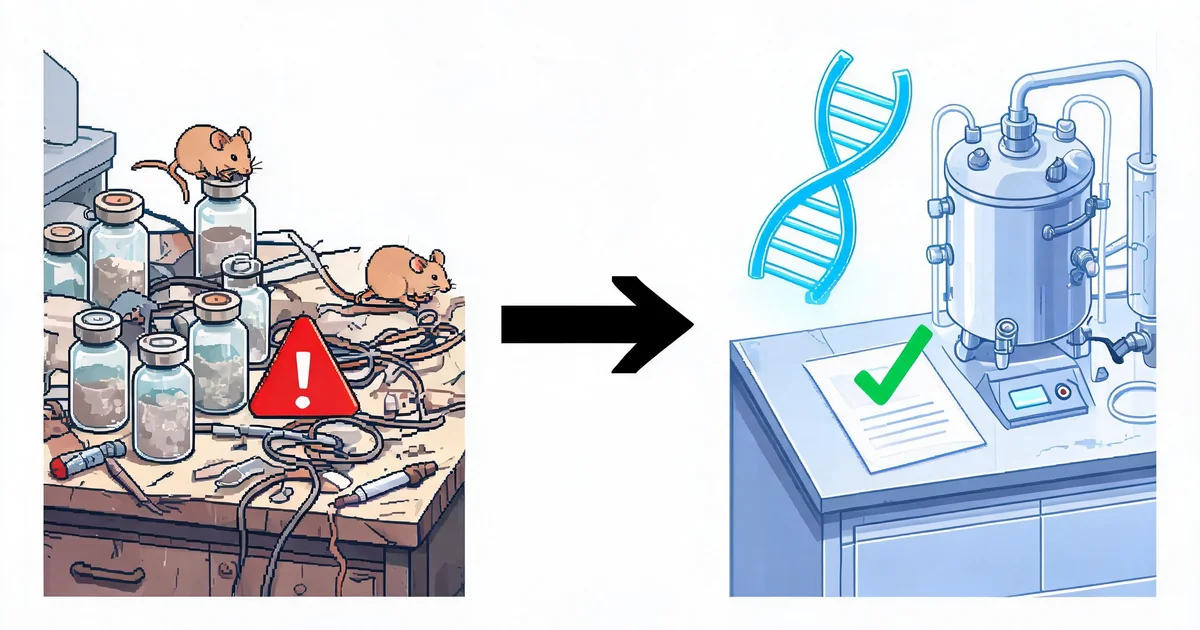
1. Why IVD Raw-Material Supply Chains Are Being Rebuilt
Two regulatory changes are reshaping the supplier base at the same time.
1.1 The EU IVDR
Regulation (EU) 2017/746 has applied since 26 May 2022 and replaced the older IVD Directive. Under the new risk classification, the large majority of assays move into Class B and Class C, which requires notified body involvement and a full performance evaluation with supporting technical documentation. That documentation must characterize and control critical raw materials, demonstrate traceability, and justify batch-to-batch consistency. Animal-derived materials additionally require a documented risk assessment for adventitious agents.
1.2 US review of laboratory developed tests
In 2024 the US FDA finalized a rule phasing out enforcement discretion for laboratory developed tests over a multi-year period, moving many previously unreviewed assays toward 510(k), De Novo, or PMA pathways. The practical effect mirrors IVDR: more assays face a formal review in which reviewers ask where each antibody came from, how it is controlled, and what happens to assay performance when a lot changes.
1.3 What reviewers now expect for a critical antibody
- A defined identity — ideally a documented amino acid sequence, not just a clone name
- Evidence of batch-to-batch consistency with quantitative acceptance criteria
- A controlled, characterized cell bank and a described manufacturing process
- An animal-origin risk assessment, and a plan to minimize animal-derived components
- A continuity-of-supply plan if the source material fails
Hybridoma and ascites antibodies struggle against every one of these expectations. That is why the supply chain is being rebuilt around recombinant material. For the 2026 transition deadlines and a document-by-document checklist to send your supplier, see our IVDR 2026 antibody supplier documentation guide.
2. What Is a Recombinant Antibody?
A recombinant antibody is a monoclonal antibody whose heavy- and light-chain variable region sequences have been cloned into an expression vector and produced in a defined mammalian host cell line — typically CHO (Chinese hamster ovary) or HEK293. The antibody is manufactured from a written genetic blueprint held in a characterized master cell bank, rather than being secreted by a living hybridoma clone or harvested from mouse ascites fluid.
Because the sequence is known and version-controlled, the molecule is:
- Traceable: the specification is the sequence itself, so any lot can be verified against it
- Reproducible: production can be paused, scaled, or resumed years later with the identical molecule
- Animal-origin-free at production: expressed in cell culture with chemically defined, animal-component-free media
- Engineerable: isotype, species framework, affinity, and format (IgG, Fab, scFv) can be adjusted deliberately and documented
By contrast, a hybridoma antibody depends on an immortalized mouse B-cell fusion whose genome can mutate over passages, silence or lose a light chain, or be lost entirely to contamination or freezer failure. Ascites production adds an animal step that many markets and ethics frameworks now discourage under the 3Rs principle (replacement, reduction, refinement).
3. The Compliance Liabilities of Hybridoma and Ascites Material
The problem is not that hybridoma antibodies perform badly — many are excellent binders. The problem is that they are hard to control and document to the standard IVDR and FDA reviewers now apply.
3.1 Undefined identity
If the variable region sequence was never determined, the only identity claim is "the antibody this clone happens to secrete today". When a regulator asks for the specification of a critical reagent, "clone 3F7" is a name, not a specification.
3.2 Genetic instability
Hybridoma lines are aneuploid and genetically unstable. Over extended passage they can accumulate mutations in the variable region, lose expression of a chain, or be outgrown by non-producing subclones. Each event changes binding behavior in ways that are difficult to detect until an assay lot fails release.
3.3 Batch-to-batch variability
Ascites and small-scale hybridoma culture introduce variability from animal to animal, harvest to harvest, and purification to purification. For a quantitative Class C assay, that variability propagates into calibration drift and widened lot-release ranges.
3.4 Animal-origin risk
Ascites production is an in vivo method. It carries adventitious agent considerations, is restricted or discouraged in several jurisdictions on animal welfare grounds, and adds an uncontrolled biological input to the technical file.
3.5 No equivalence pathway when a clone is lost
If a hybridoma is lost and no sequence exists, the replacement antibody is a new material requiring full re-characterization and, often, a new bridging study. With a recombinant clone, the sequence is archived and the molecule can simply be re-expressed.
Regulatory Note
Under IVDR, a change to a critical raw material can require notified body notification and supporting equivalence data. When the antibody sequence is the specification, "same molecule, new lot" is straightforward to demonstrate. When it is not, every source change becomes a mini-revalidation.
4. How Recombinant Antibodies Close the IVDR Gaps
Converting a critical antibody position to a recombinant format addresses the documentation gaps directly, dimension by dimension.
| Dimension | Hybridoma / Ascites | Recombinant Monoclonal |
|---|---|---|
| Sequence traceability | ✗ Often undetermined | ✓ Full VH/VL sequence on file |
| Batch-to-batch consistency | ✗ Animal- and harvest-dependent | ✓ Binding-activity CV typically < 10% |
| Animal-origin status | ✗ In vivo step (ascites) | ✓ Animal-component-free production |
| Genetic stability | ✗ Drift, chain loss over passage | ✓ Characterized, frozen master cell bank |
| Continuity of supply | ✗ Clone loss = material loss | ✓ Re-expressible from archived construct |
| Engineering control | ✗ Fixed isotype and format | ✓ Isotype, affinity, format adjustable |
| Technical file readiness | ✗ Gaps in identity and control | ✓ Specification, process, and control defined |
Independent work on antibody reproducibility has argued for years that sequence-defined recombinant reagents are the way to remove a major source of irreproducibility in bioscience; a widely cited 2015 Nature comment by Bradbury and Plückthun made the case for research antibodies. IVDR and FDA review are now applying the same logic to diagnostics, where the stakes are patient results.
"For an IVDR technical file, a recombinant antibody's sequence is its specification. That single fact resolves identity, equivalence, and continuity in one step."
5. Migrating an Existing Assay: A Practical Roadmap
Converting a validated assay from a hybridoma antibody to a recombinant equivalent is a defined project. The antibody work is fast; the analytical comparison is what sets the timeline.
- Secure the sequence. Sequence the incumbent hybridoma by degenerate PCR or mass spectrometry, or select a sequence-defined recombinant clone against the same target and epitope class.
- Express recombinantly. Clone the VH/VL into an expression vector and produce in CHO and HEK293 antibody expression platforms, then purify and confirm integrity.
- Confirm epitope and affinity. Use SPR or BLI for kinetics and epitope binning to verify the recombinant antibody engages the same region with comparable affinity.
- Re-verify the pair. Re-run capture/detection pairing and a checkerboard titration; recombinant candidates sometimes pair better than the original because affinity can be tuned.
- Run a bridging study. Perform a method comparison against the current assay across the clinical range, with Passing-Bablok regression and Bland-Altman analysis on native samples.
- Update documentation. Revise the raw-material specification, update the performance evaluation, and make any required notified body notification.
- Lock the cell bank. Establish and characterize the master and working cell banks so future supply is contractually and technically secured.
Planning Tip
Convert one antibody position at a time and keep the other half of the pair fixed during the bridging study. Changing both reagents at once makes it impossible to attribute any shift in assay performance, and regulators will expect that attribution.
6. Priority Targets: Cardiac and Inflammation Markers
Not every antibody position carries equal risk. The conversions that deliver the most compliance value are high-classification, epitope-sensitive, or high-volume assays.
6.1 Cardiac markers
High-sensitivity cardiac assays are epitope-critical and mostly Class C, so identity and consistency matter acutely:
- Cardiac troponin I antibody pairs — high-sensitivity assays depend on stable epitope recognition in the central stable region of cTnI
- NT-proBNP antibodies — glycosylation-aware epitope selection benefits from engineered, sequence-defined clones
- CK-MB, myoglobin, and h-FABP — early rule-in markers where lot consistency drives cutoff stability
6.2 Inflammation markers
Inflammation assays are typically high-volume, so batch-to-batch consistency directly controls manufacturing cost and lot-release yield:
- CRP antibody pairs for turbidimetric, CLIA, and lateral flow formats
- IL-6 antibody pairs for high-sensitivity sepsis and cytokine monitoring assays
- PCT and SAA — sequence-defined pairs reduce calibration drift across large production campaigns
Sekbio has opened an evaluation sampling channel for recombinant cardiac and inflammation antibodies through the site, so assay teams can benchmark a recombinant candidate against their incumbent hybridoma reagent before committing to a conversion. For a full hybridoma-to-recombinant project, see the ISO 13485 quality and compliance framework these reagents are manufactured under.
7. Frequently Asked Questions
What is a recombinant antibody?
A recombinant antibody is a monoclonal antibody whose heavy- and light-chain variable sequences have been cloned into an expression vector and produced in a defined mammalian cell line, usually CHO or HEK293. Because the full amino acid sequence is known and version-controlled, every batch is manufactured from the same genetic blueprint rather than from a living hybridoma clone or mouse ascites fluid. This makes the antibody fully traceable, animal-origin-free at the production stage, and reproducible indefinitely.
Why is IVDR pushing manufacturers away from hybridoma antibodies?
Regulation (EU) 2017/746 (IVDR) requires a full performance evaluation and technical documentation for each device, including characterization and traceability of critical raw materials. Hybridoma and ascites-derived antibodies often have an undefined sequence, meaningful batch-to-batch variability, and animal-origin risk. When a hybridoma clone drifts or is lost, the manufacturer cannot prove the replacement material is equivalent without extensive revalidation. Recombinant antibodies remove that uncertainty because the sequence itself becomes the specification.
Are recombinant antibodies required by IVDR?
IVDR does not name recombinant antibodies or ban hybridomas. It sets outcome requirements: raw materials must be characterized, controlled, traceable, and consistent, and animal-derived materials must be risk-assessed. In practice, recombinant production is the most direct way to satisfy those requirements, which is why large IVD manufacturers are converting critical antibody positions to recombinant formats ahead of notified body review.
What is the difference between a recombinant antibody and a hybridoma antibody?
A hybridoma antibody is secreted by an immortalized mouse B-cell fusion, or harvested from ascites, and its genetic sequence is usually unknown. Cell lines can mutate, lose a chain, or die. A recombinant antibody is produced from a cloned, sequenced expression construct in a stable CHO or HEK293 line. The sequence is documented, the master cell bank is frozen and characterized, and production can be scaled or resumed at any time with the same molecule.
How long does it take to switch an IVD assay from a hybridoma to a recombinant antibody?
For a single antibody position, sequencing the incumbent clone and expressing it recombinantly typically takes 8 to 12 weeks. The larger timeline driver is analytical work: epitope and affinity confirmation, antibody pair re-verification, and a method comparison bridging study against the current assay. A well-planned conversion for one biomarker usually runs three to six months from sequence to updated technical documentation.
Does recombinant production reduce batch-to-batch variability?
Yes. Because every lot is expressed from the same cloned construct and a characterized master cell bank, the primary source of drift in hybridoma material is eliminated. Combined with defined, animal-component-free media and standardized purification, recombinant antibody lots routinely reach batch-to-batch CV below 10 percent on binding activity, which stabilizes downstream assay calibration and lot release.
Does Sekbio offer recombinant antibodies for cardiac and inflammation markers?
Yes. Sekbio manufactures sequence-defined recombinant monoclonal antibodies and matched pairs for cardiac markers such as cardiac troponin I, NT-proBNP, CK-MB, myoglobin and h-FABP, and for inflammation markers such as CRP, IL-6, PCT and SAA. An evaluation sampling channel for these targets is open through the Sekbio site, and custom hybridoma-to-recombinant conversion is available through our Antibody Development Services.
8. Summary
- The driver is documentation: IVDR and tighter US review require critical antibodies to be characterized, controlled, traceable, and consistent — with an animal-origin risk assessment.
- Hybridoma and ascites material fall short on control: undefined sequence, clonal drift, batch variability, an in vivo production step, and no equivalence pathway when a clone is lost.
- Recombinant antibodies make the sequence the specification: this single change resolves identity, equivalence, batch consistency, and continuity of supply in one step.
- Conversion is a defined project: secure the sequence, express in CHO or HEK293, confirm epitope and affinity, re-verify the pair, run a bridging study, update the file, lock the cell bank — typically three to six months per biomarker.
- Start where risk concentrates: high-sensitivity cardiac assays and high-volume inflammation assays give the largest compliance and manufacturing return.
Sekbio develops and manufactures sequence-defined recombinant monoclonal antibodies for IVD and runs CHO and HEK293 antibody expression services for hybridoma-to-recombinant conversion. If you are preparing an assay for IVDR or FDA review and need to close the raw-material gap on a cardiac or inflammation marker, request evaluation samples through the Sekbio recombinant antibody sampling channel.