Seven-Clone Serum Amyloid A Antibody Panel Plus Recombinant Antigen for Acute-Phase Infection Triage IVD Development
Serum Amyloid A (SAA) is a family of small, evolutionarily conserved apolipoproteins synthesized predominantly by hepatocytes in direct response to pro-inflammatory cytokines — principally IL-6, IL-1, and TNF-alpha. Once secreted, SAA associates rapidly with high-density lipoprotein (HDL) particles, displacing apolipoprotein A-I and altering HDL's normal anti-inflammatory function during the acute-phase response. SAA is considered one of the most dramatic acute-phase reactants in human physiology: reported serum concentrations can rise as much as 1,000-fold above baseline within hours of an inflammatory trigger such as infection, trauma, surgery, or autoimmune flare, and fall back toward baseline once the stimulus resolves (Malle E, Steinmetz A, Raynes JG, Atherosclerosis 1993; Gabay C, Kushner I, N Engl J Med 1999).
SAA's kinetic profile is clinically distinct from CRP, the more familiar acute-phase marker: SAA typically begins rising within approximately 4–8 hours of stimulus onset, slightly ahead of CRP's roughly 6–12 hour rise, and SAA is also frequently elevated in viral infections where CRP often remains only mildly increased. This makes a combined SAA + CRP measurement more informative than either marker alone for early infection triage and for building a clinical picture that can help distinguish a viral-predominant inflammatory profile from a bacterial one, always in conjunction with clinical assessment (Gabay C, Kushner I, N Engl J Med 1999).
For IVD developers, Sekbio supplies a panel of seven independently derived mouse anti-SAA monoclonal clones — including two recombinant clones — for capture/detection pair screening, plus the recombinant human SAA antigen S01-HP141-1 (E.coli-expressed, 25.0 kDa) for calibrator and standard-curve use. All clones are manufactured under an ISO 13485 quality management system with documented batch traceability, and pair naturally with Sekbio's CRP, PCT, and IL-6 antibody pairs for combined inflammation panels.
Sekbio has also validated a finished SAA chemiluminescence bulk reagent (acridinium-ester two-step sandwich format) built from this antibody panel: in-house method comparison against a Roche reference platform across 39 paired samples (0.76–372.13 ng/mL) gave R²=0.98, and a Limit of Blank of 0.16 ng/mL confirms sensitivity at the low end of the clinical range. See the full analytical validation data below.
Seven independently derived mouse anti-SAA monoclonal clones for capture/detection pair screening, plus the recombinant antigen for calibration.
| Catalog No. | Clone | Description | Isotype | Typ. Conc. | Purity |
|---|---|---|---|---|---|
| S01-SAA-1M | 5B3M | Mouse anti-SAA mAb | IgG1 | 4.44 mg/mL | >90% SEC-HPLC |
| S01-SAA-2M | — | Mouse anti-SAA mAb | IgG1 | 4.92 mg/mL | >90% SEC-HPLC |
| S01-SAA-3MB | 4F5MB | Recombinant mouse anti-human SAA mAb | — | 4.12 mg/mL | >90% SEC-HPLC |
| S01-SAA-4MB | 5B6MB | Recombinant mouse anti-human SAA mAb | — | 4.49 mg/mL | >90% SEC-HPLC |
| S01-SAA-5M | 3D5M | Mouse anti-human SAA mAb | IgG1 | 4.50 mg/mL | >90% SEC-HPLC |
| S01-SAA-6M | 2E2M | Mouse anti-human SAA mAb | IgG1 | 4.20 mg/mL | >90% SEC-HPLC |
| S01-SAA-9M | 2B1M | Mouse anti-human SAA mAb | IgG1 | 4.34 mg/mL | >90% SEC-HPLC |
| S01-HP141-1 | — | Recombinant human SAA antigen (25.0 kDa) | — | 1.87 mg/mL | >90% SDS-PAGE |
All antibody clones supplied in 20mM PB, pH 7.4, 150mM NaCl; −20°C long-term / 2–8°C short-term storage. MOQ 1 mg per clone; gram-scale OEM quantities available. Contact info@sekbio.com for recommended capture/detection pairing, datasheets, and CoA.
Performance data for a two-step sandwich chemiluminescence (acridinium-ester) bulk reagent built from Sekbio's SAA antibody panel.
The SAA bulk reagent kit is a two-step sandwich format: dilute the sample 200×, add capture reagent and diluted sample, wash, add the acridinium-ester (AE) detection conjugate, wash, then read RLU after adding the trigger solutions.
| Component | Description | Storage |
|---|---|---|
| Ra | SAA reagent (magnetic bead, capture) | 2–8°C |
| Rb | SAA reagent (sample dilution solution) | 2–8°C |
| Rd | SAA reagent (AE-conjugated detection) | 2–8°C |
| Optional | SAA standard (lyophilized) | −20°C |
Protocol: dilute sample 200× in Rb, add 30µL Ra + 5µL diluted sample (incubate 10 min, wash), add 30µL Rd (incubate 5 min, wash), then add 100µL Pre-Trigger (A) + 100µL Trigger (B) and read RLU.
Ten replicates each of a low (~10.10 ng/mL) and high (~114.40 ng/mL) sample were tested, with concentration back-calculated from RLU against the calibration curve.
| Level | Nominal (ng/mL) | Mean Result (ng/mL) | SD | CV% |
|---|---|---|---|---|
| Low | 10.10 | 11.03 | 0.39 | 3.56% |
| High | 114.40 | 133.81 | 3.09 | 2.31% |
n=10 replicates per level. Limit of Blank (LoB), from 10 blank replicates: mean 0.08 ng/mL, SD 0.04, LoB (mean + 2SD) = 0.16 ng/mL.
Across 39 paired clinical samples spanning 0.76–372.13 ng/mL, the Sekbio SAA bulk reagent showed strong agreement with a Roche reference platform: linear regression y=1.0339x+2.3231, R²=0.98.
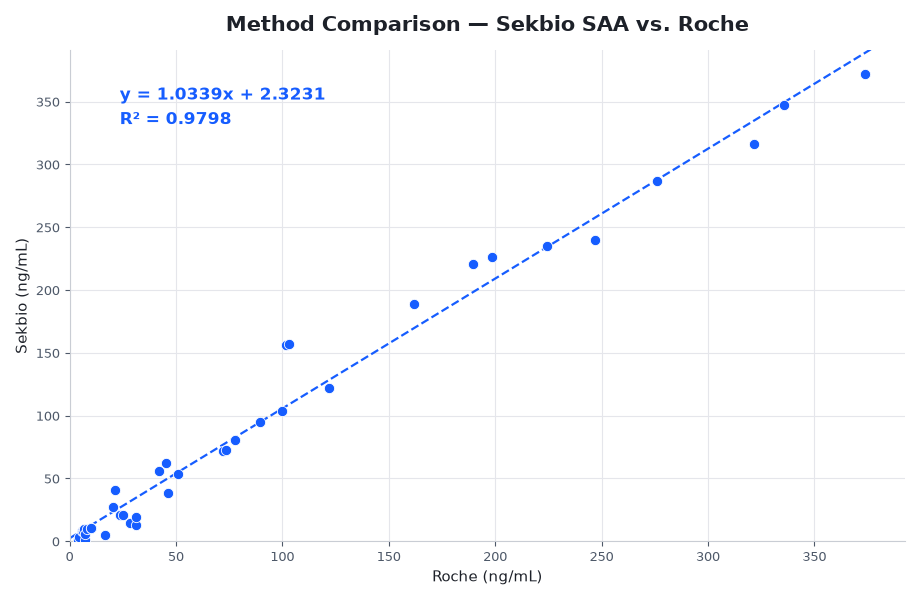
Sekbio SAA (ng/mL) vs. Roche (ng/mL), n=39. Linear regression: y=1.0339x+2.3231, R²=0.98.
Engineered for the speed, sensitivity, and multi-platform flexibility required in acute-phase infection and inflammation immunoassay development.
SAA's reported ability to rise up to 1,000-fold above baseline within 4–8 hours gives SAA-based assays a wide dynamic range and early sensitivity window for acute infection triage.
Independently derived clones — including two recombinant clones (S01-SAA-3MB, S01-SAA-4MB) — give developers real options for identifying the optimal capture/detection pair for their specific platform and sensitivity target.
The antibody panel and recombinant antigen are validated across POCT lateral flow (LFA), high-throughput CLIA/CMIA analyzers, and ELISA microplate formats — one raw material source for multiple product lines.
Matched for use alongside Sekbio's CRP, PCT, and IL-6 antibody pairs, enabling multi-marker infection and sepsis panels from a single supplier.
S01-HP141-1 (25.0 kDa, >90% purity by SDS-PAGE) provides a calibrator and standard curve reagent matched to the antibody panel, produced under the same ISO 13485 quality system.
ISO 13485-compliant manufacturing in Shenzhen, China, with full Certificate of Analysis documentation, MOQ 1 mg for R&D, and gram-scale OEM supply for production-volume kit manufacturing.
SAA antibody panel validated for infection triage, pediatric care, veterinary testing, and combined inflammation panel development.
SAA's fast, high-amplitude rise supports earlier detection of an inflammatory event than markers with slower kinetics, useful in emergency and primary-care point-of-care testing where a rapid LFA result guides the next clinical step.
Because SAA rises promptly and to a large fold-change, it is used alongside CRP in pediatric and neonatal infection workups, where early, sensitive detection can help guide antibiotic decisions. See our CRP Antibody Pair for the matching CRP raw materials.
Combining SAA with CRP and PCT on the same platform provides multiple independent kinetic signals, an approach used to help differentiate a viral-predominant inflammatory profile from a bacterial one alongside clinical findings.
Beyond the human panel above, Sekbio also supplies a Rabbit anti-dog SAA antibody (clone 8E2, ≥90% purity by SDS-PAGE) for veterinary SAA immunoassay development, validated for ELISA, CLIA, CMIA and rapid test (POCT) formats. Contact info@sekbio.com for veterinary SAA datasheets.
Technical and commercial questions from IVD R&D engineers and procurement teams.
Serum Amyloid A (SAA) is a family of small acute-phase apolipoproteins produced primarily by the liver in response to pro-inflammatory cytokines (IL-6, IL-1, TNF-alpha). SAA is one of the most dramatic acute-phase reactants known, with serum concentration capable of rising up to 1,000-fold above baseline within hours of an inflammatory stimulus such as infection, tissue injury, or surgery, and returning toward baseline as the stimulus resolves (Malle E et al., Atherosclerosis 1993; Gabay C, Kushner I, N Engl J Med 1999). This rapid, high-amplitude response makes SAA useful for early infection and inflammation triage.
Sekbio supplies seven independently derived mouse monoclonal anti-SAA clones for capture/detection pair screening: S01-SAA-1M (clone 5B3M), S01-SAA-2M, S01-SAA-3MB (clone 4F5MB, recombinant), S01-SAA-4MB (clone 5B6MB, recombinant), S01-SAA-5M (clone 3D5M), S01-SAA-6M (clone 2E2M), and S01-SAA-9M (clone 2B1M) — all Mouse IgG1, purity greater than 90% by SEC-HPLC. The companion recombinant SAA antigen is S01-HP141-1 (E.coli-expressed, 25.0 kDa, purity greater than 90% by SDS-PAGE). Contact info@sekbio.com for the recommended capture/detection pairing and datasheets.
Sandwich immunoassay performance depends on identifying two clones that bind non-overlapping SAA epitopes without steric interference. Offering a panel of independently derived clones — including two recombinant clones (S01-SAA-3MB, S01-SAA-4MB) alongside conventional hybridoma-derived clones — lets IVD developers screen for the pairing that best matches their platform (LFA, CLIA, or ELISA) and required sensitivity, rather than being locked into a single predetermined pair.
SAA and CRP are both hepatic acute-phase proteins, but SAA typically rises within 4–8 hours of stimulus onset — earlier than the roughly 6–12 hour rise seen for CRP — and SAA also increases in many viral infections where CRP often stays comparatively low. Combining SAA with CRP on the same platform gives clinicians two independent kinetic signals, which supports earlier infection detection and can assist in differentiating a viral-predominant inflammatory profile from a bacterial one when interpreted alongside clinical findings (Gabay C, Kushner I, N Engl J Med 1999).
In Sekbio's in-house method comparison of a finished SAA chemiluminescence bulk reagent against a Roche reference platform, 39 paired samples spanning 0.76–372.13 ng/mL gave the regression y=1.0339x+2.3231 with R²=0.98. Precision testing showed inter-replicate CV of 3.56% at a low level (10.10 ng/mL nominal) and 2.31% at a high level (114.40 ng/mL nominal), with a calculated Limit of Blank of 0.16 ng/mL from 10 blank replicates.
MOQ is 1 mg per clone for R&D evaluation, with OEM production quantities from 10 mg to gram scale available. All seven SAA antibody clones (typical concentration 4.1–4.9 mg/mL) are supplied in 20mM PB, pH 7.4, 150mM NaCl, and are stable at −20°C for long-term storage or 2–8°C for short-term use, avoiding repeated freeze/thaw cycles. The recombinant antigen S01-HP141-1 is supplied in 20mM PB, pH 7.4, 150mM NaCl and 1mM EDTA, with the same storage conditions. Certificate of Analysis accompanies every lot.
Yes. Sekbio is an ISO 13485-certified manufacturer supplying the seven-clone SAA antibody panel and recombinant SAA antigen with full batch documentation and traceability to support CE IVD and other regulatory submissions across POCT lateral flow, CLIA analyzer, and ELISA formats. Sekbio also supplies the companion CRP, PCT, and IL-6 antibody pairs for combined inflammation panels, and a Rabbit anti-dog SAA antibody for veterinary inflammation testing. Contact info@sekbio.com to request datasheets or OEM pricing. Visit our Platforms page for antibody development and custom antigen expression services.
Request the full technical datasheet, recommended clone pairing, or discuss OEM supply for your infection triage IVD development programme.