In September 2026, Seoul Economic Daily reported a number that should concern every IVD and biopharma manufacturer sourcing out of Korea: 95% of the country's biomanufacturing raw materials are imported, and the dependency runs even higher for high-value categories like culture media and filtration consumables. Four Western suppliers — Thermo Fisher Scientific, Cytiva, Merck, and Sartorius — hold 55% of that market between them. For any manufacturer whose antibody or antigen raw material supply sits on the same kind of concentrated, single-source foundation, the question Korean regulators are now asking is worth asking too: what happens when one link in that chain has a bad quarter?
This article unpacks what the 95% dependency figure actually means, why buyers can't simply switch suppliers overnight, and why the practical fix isn't replacing a primary supplier — it's qualifying a validated second source. We'll also look at where Sekbio's CHO and E. coli dual-platform, ISO 13485- and CE-certified antibody manufacturing fits into that de-risking strategy.
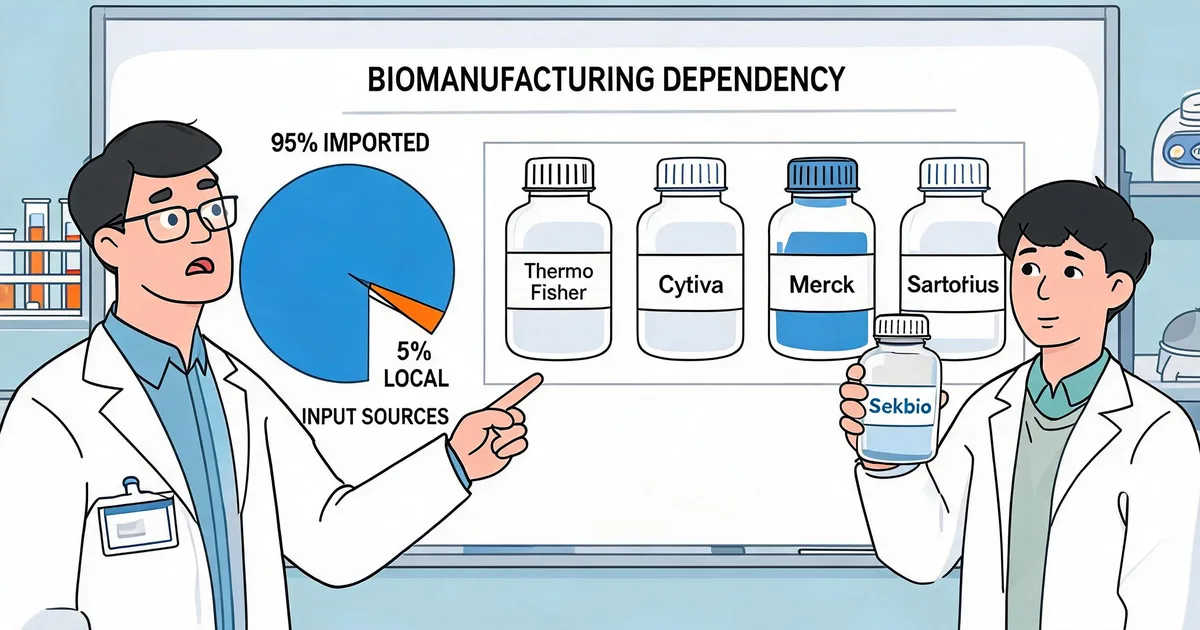
1. What Is Raw Material Import Dependency? Korea's 95% Number Explained
Raw material import dependency is the share of the reagents, consumables, and specialty materials a manufacturing sector needs that must be sourced from foreign suppliers because no qualified domestic alternative exists at the required scale or quality. Per Seoul Economic Daily's September 2026 report, Korea's biomanufacturing sector imported roughly 95% of its raw materials and components as of 2024, with the share climbing even higher for high-value core items such as culture media and virus filters. Raw materials and components represent an estimated 15–20% of total biopharmaceutical production cost — so a concentration this heavy sits underneath a fast-growing industry, not beside it.
- Domestic Korean suppliers — Bion Pack, Hanil Chemical Rubber Industrial, E-Cell, and Biox — have gained ground, but only in lower-value categories like packaging materials and cleaning agents.
- Higher-value, technically demanding categories (culture media, filters, resins) remain almost entirely import-dependent.
- Korea's Ministry of Food and Drug Safety plans a raw material manufacturing and quality certification system, effective late 2026, to directly certify domestic culture media, filters, and resins.
2. Where the Risk Concentrates: Culture Media, Filters, and the Big Four
The 55% market share held by Thermo Fisher, Cytiva, Merck, and Sartorius is concentrated in bioprocessing consumables — culture media, single-use filters, resins. Antibody and antigen raw materials for immunoassay manufacturing are a distinct category, but the underlying dynamic rhymes: a market report covering the IVD raw material market puts its value at $21.5 billion in 2026, growing to $31.1 billion by 2031 (7.7% CAGR), with Merck KGaA, Thermo Fisher, and Bio-Techne named among the largest suppliers alongside specialist antibody/antigen houses like Medix Biochemica, BBI Solutions, and China's Fapon Biotech. The same report projects Asia-Pacific to post the highest regional CAGR through 2031 as China expands domestic diagnostic manufacturing — the antibody/antigen equivalent of the localization push Korea is now attempting in bioprocessing consumables.
| Raw Material Category | Primary Suppliers | Import Concentration | Emerging Alternative |
|---|---|---|---|
| Culture media & filters (bioprocessing) | Thermo Fisher, Cytiva, Merck, Sartorius | Very high — 55% share held by four suppliers | Early-stage domestic Korean localization |
| Antibody & antigen raw materials (IVD) | Merck KGaA, Thermo Fisher, Bio-Techne, Medix Biochemica, BBI Solutions | High, concentrated among long-established Western suppliers | Asia-Pacific specialist manufacturers, incl. China (fastest-growing region) |
3. Why Buyers Can't Just Switch Suppliers Overnight
If the risk is this visible, why hasn't the market already diversified? Because contract development and manufacturing organizations (CDMOs) must use the materials their client's regulatory filing specifies, and biosimilar or new-drug developers strongly prefer already-validated raw materials over an untested alternative — switching mid-program can trigger comparability studies, stability re-testing, and filing amendments that cost far more than the material itself. Seoul Economic Daily's report frames this explicitly as a lock-in effect, not a lack of awareness.
Japan offers the counter-example: it built real competitiveness in this space not by starting from scratch, but by acquiring foreign companies that already carried the technology and the regulatory reference status — Asahi Kasei now supplies virus filters and Fujifilm Irvine Scientific supplies culture media, both with established track records rather than unproven domestic substitutes. That path is neither fast nor cheap, which is exactly why dual-sourcing — adding a validated second option rather than building a full replacement — is the realistic near-term move for most buyers.
IVD Application Note
For an immunoassay manufacturer, "switching suppliers" on an antibody or antigen raw material means re-running lot-to-lot CV, limit of detection, and cross-reactivity testing against the assay's existing specification. That's the same validation logic biosimilar developers apply to bioprocessing materials — it's why incumbency, not just performance, keeps a supplier in place.
4. The Real Cost of Single-Sourcing: What a Supply Disruption Looks Like
Single-sourcing works — until it doesn't. An export control change, a customs delay, a currency or tariff shift, a force majeure event, or a supplier simply discontinuing a catalog item can each halt a production line that has one specified material and no qualified alternative. The disruption doesn't stay contained to procurement: it delays regulatory submissions built on that material's data, forces inventory hoarding that ties up working capital, and pushes launch timelines that competitors with a second source don't have to move. Korea's major biopharmaceutical companies are on track to reach roughly 5 trillion won in combined revenue despite this reliance — which means the exposure is scaling right alongside the business, not shrinking as it grows.
"A supply chain that works 95% of the time until the one supplier you depend on has a problem isn't resilient — it's fragile with a good track record."
5. Dual-Sourcing as De-Risking, Not Replacement
Dual-sourcing keeps the primary, validated supplier exactly where it is and adds a second, independently qualified source for the same critical raw material — so a disruption at one supplier shifts volume to the other instead of stopping the line. It is not a call to abandon Thermo Fisher, Cytiva, Merck, or Sartorius, and for antibody and antigen raw materials it isn't a call to abandon an incumbent supplier either. It's insurance, structured so the premium is a qualification project, not a production halt.
- Qualify the second source in parallel with the incumbent, never as a same-day replacement.
- Run side-by-side lot comparability testing against the specification the incumbent already meets.
- Phase in volume gradually — start with a minority allocation, not a full cutover.
- Keep the primary supplier relationship intact; dual-sourcing is additive, not adversarial.
6. Sekbio's CHO + E. coli Dual-Platform Model as a Second Antibody Source
For IVD manufacturers whose exposure sits specifically in antibody and antigen raw materials rather than bioprocessing consumables, Sekbio offers a validated, ISO 13485- and CE-certified option for exactly this kind of parallel qualification. CHO and E. coli dual-platform expression means a manufacturer isn't locked into one production chemistry: CHO expression covers glycosylated, mammalian-format antibodies with turnaround as fast as 7 days and titers up to 2.4 g/L, backed by 800+ successful expression projects, while E. coli expression covers high-yield antigens and Fab fragments where post-translational modification isn't required.
That dual-platform base is already serving 200+ IVD brands across 30+ countries, manufactured under the same ISO 13485-certified traceability and lot-to-lot consistency that any second-source qualification needs to clear. The goal isn't to displace whichever antibody or antigen supplier is already in a customer's validated assay — it's to give that customer a second, documented option so a single supplier's disruption never becomes their production stoppage. Manufacturers evaluating this can review Sekbio's ISO 13485 and CE certification documentation as a starting point for a parallel qualification file.
7. Frequently Asked Questions — Import Dependency & Antibody Dual-Sourcing
What is raw material import dependency in biomanufacturing?
Raw material import dependency is the share of the reagents, consumables, and specialty materials a manufacturing sector needs that must be sourced from foreign suppliers because no qualified domestic alternative exists at the required scale or quality. Seoul Economic Daily's September 2026 report found that Korea imports roughly 95% of its biomanufacturing raw materials, with the dependency climbing even higher for high-value items like culture media and virus filters.
How long does it take to qualify a second antibody or antigen supplier for an existing IVD assay?
It depends on what's being qualified. Testing an existing catalog antibody pair against your current assay's specification — sensitivity, precision, cross-reactivity — can typically be scoped in weeks once samples are in hand. Developing a new antibody to match an existing pair's performance profile is a longer engagement; Sekbio's standard monoclonal antibody development runs 8–12 weeks end to end. Either path is faster than most teams assume, because you're validating against a known specification rather than starting from a blank page.
Can IVD manufacturers dual-source antibody raw materials without disrupting an already-validated assay?
Yes, if the second source is qualified through parallel lot comparability testing — limit of detection, lot-to-lot CV, and cross-reactivity — benchmarked against the specification your current supplier already meets, and volume is phased in gradually rather than switched all at once. That approach contains the validation work to a controlled pilot rather than triggering a full assay re-registration event.
What is the difference between single-sourcing and dual-sourcing risk mitigation?
Single-sourcing means one supplier's catalog item is written into your assay's specification and manufacturing batch record, so any disruption to that one supplier stops your production line. Dual-sourcing keeps that primary, validated supplier in place but adds a second, independently qualified source for the same raw material, so a disruption at one supplier shifts volume to the other instead of halting the line. It's risk mitigation, not a switch of vendors.
How do you validate a new antibody or antigen raw material supplier before switching production volume?
Validation typically runs the candidate material side-by-side with the currently validated one across sensitivity and specificity, lot-to-lot CV, a cross-reactivity panel against related analytes, and stability under your storage conditions, documented under an ISO 13485 quality system. Only after the candidate meets or exceeds the incumbent's specification on each of those parameters should production volume shift — and even then, a phased ramp is safer than a hard cutover.
Does Sekbio offer antibody and antigen raw materials as a second-source option for IVD manufacturers?
Yes. Sekbio manufactures recombinant antibodies and antigens on both CHO and E. coli expression platforms under ISO 13485 and CE certification, serving 200+ IVD brands across 30+ countries. That dual-platform base lets IVD manufacturers qualify Sekbio as an independent second source for antibody or antigen raw materials without touching their existing supplier relationship. Visit our antibody expression platforms page to scope a parallel qualification.
8. Summary
Korea's 95% biomanufacturing import dependency is a data point worth sitting with, beyond the headline:
- Korea imports ~95% of its biomanufacturing raw materials (Seoul Economic Daily, September 2026), with the share even higher for culture media and filters.
- Four Western suppliers hold 55% of that market — a concentration pattern with a close analog in antibody and antigen raw materials, where a growing $21.5B–$31.1B IVD raw material market is likewise led by a handful of established Western suppliers.
- Buyers can't switch overnight because CDMOs and biosimilar/new-drug developers are locked into raw materials already written into their validated specifications.
- The realistic fix is dual-sourcing — qualifying a second, independent supplier for critical raw materials — not replacing the incumbent.
- Sekbio's CHO + E. coli dual-platform, ISO 13485- and CE-certified manufacturing gives IVD developers a documented second source for antibody and antigen raw materials, without disturbing an existing supplier relationship.
If your antibody or antigen raw material supply currently runs through a single validated source, request a Sekbio antibody quote to start a parallel qualification — building in redundancy doesn't require disrupting the supplier relationship you already have.