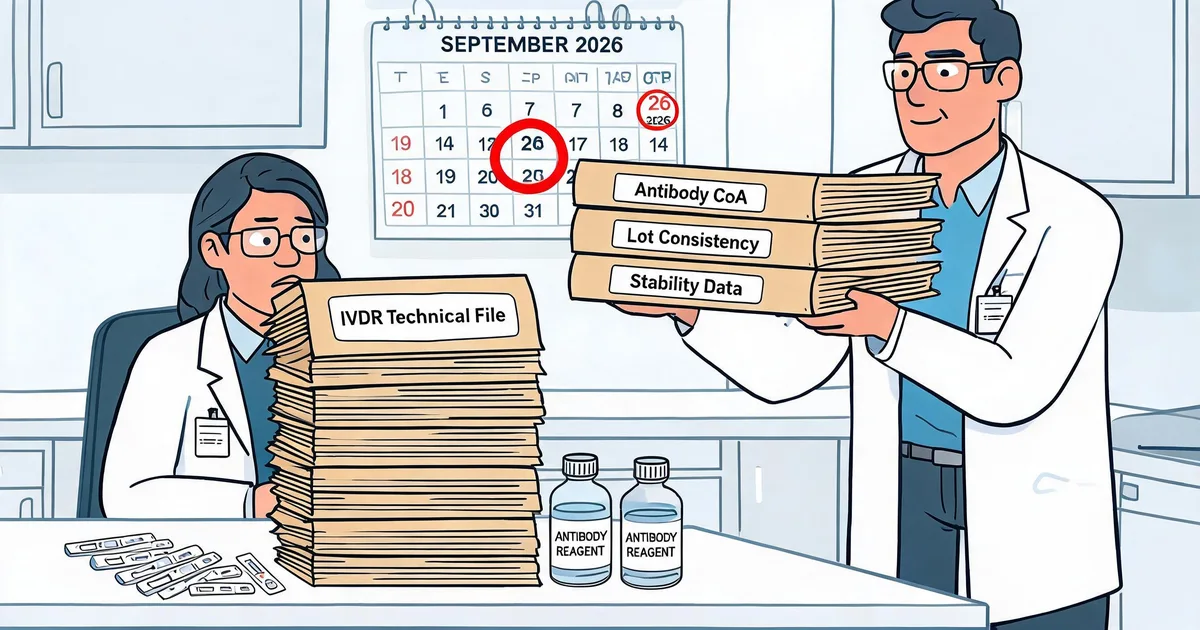
Three days ago, on 26 September 2026, the last contractual gate for legacy Class C in vitro diagnostics closed. Under Regulation (EU) 2024/1860, a manufacturer that wanted to keep selling an IVDD-era Class C device until the end of 2028 needed a signed written agreement with a notified body by that date. Companies that made it now face the audit itself. Companies that missed it face a harder conversation.
For small and mid-sized rapid test makers in Europe, the September date is less stressful than what comes next: a notified body reviewer reading a technical file that was written for self-declaration. Much of that file describes things the manufacturer does not control directly, and the antibodies on the test line are near the top of that list.
Self-Certification Is Over for Most IVDs
The In Vitro Diagnostic Medical Devices Regulation (EU) 2017/746, known as IVDR, replaced the old IVD Directive (98/79/EC) and changed who signs off on a diagnostic test. Under the Directive, a short list (Annex II lists A and B, plus self-tests) needed a notified body. Everything else was self-declared by the manufacturer. IVDR replaces that list with a risk-based system of four classes, A to D, and requires a notified body for every class except non-sterile Class A.
The shift is large. SGS, itself an IVDR notified body, estimates that roughly 80% of devices were self-certified under the Directive, while more than 90% need notified body assessment under IVDR.
The 2024 amendment gave legacy devices more time, but only on conditions. The staged dates look like this:
| IVDR class | Typical examples | Application lodged by | Written NB agreement by | Legacy sales end |
|---|---|---|---|---|
| Class D | HIV, HBV, HCV screening; blood grouping | 26 May 2025 | 26 Sep 2025 | 31 Dec 2027 |
| Class C | Tumor markers, prenatal screening, most self-tests, STI tests such as syphilis | 26 May 2026 | 26 Sep 2026 | 31 Dec 2028 |
| Class B and sterile Class A | Pregnancy and fertility self-tests, many clinical chemistry assays | 26 May 2027 | 26 Sep 2027 | 31 Dec 2029 |
All three tracks share two further conditions: an IVDR-compliant quality management system from 26 May 2025, and no significant change to the device's design or intended purpose during the transition. That second condition matters a great deal for raw materials, and we come back to it below.
A regulatory reform is also in the pipeline. On 16 December 2025 the European Commission published a proposal to simplify MDR and IVDR (COM(2025) 1023). It is still going through Parliament and Council. Nothing in it removes the obligation to show performance evidence for devices that are already in the queue, so planning around it would be a gamble.
Where Legacy Technical Files Fall Short
A Directive-era file for a self-declared rapid test was often a few binders: a product description, a risk analysis, some in-house performance data and a declaration of conformity. IVDR Annex II and Annex III ask for far more, and Annex XIII requires a performance evaluation built on three pillars:
- Scientific validity: evidence that the analyte is associated with the clinical condition the test claims to address.
- Analytical performance: sensitivity, specificity, trueness, precision, limit of detection, measuring range, interference, cross-reactivity and stability, each backed by data.
- Clinical performance: diagnostic sensitivity and specificity in the intended population, with the intended user.
Notified bodies reviewing legacy files tend to find the same gaps. Performance data came from one or two reagent lots. Stability claims rest on real-time data from a product that has since changed formulation. Interference studies cover a handful of substances. The literature review for scientific validity is out of date or missing.
Many of those gaps lead back to the same place. Look closely at "lot-to-lot precision" or "stability of the conjugate" and you are looking at the behavior of a monoclonal antibody that someone else manufactured.
The Antibody Is Part of Your Technical File
Antibodies sold to kit manufacturers as raw material are not IVD devices in their own right. The legal manufacturer carries full responsibility for the finished test. In practice, that responsibility travels straight back up the supply chain.
IVDR Annex II asks the technical file to describe the critical ingredients of the device, naming antibodies and antigens explicitly, and to identify the suppliers and subcontractors involved in manufacturing. ISO 13485 clause 7.4 then requires the manufacturer to evaluate and monitor those suppliers based on the risk they pose to the finished product. For a sandwich lateral flow test, the capture and detection antibodies set the detection limit, the hook effect threshold and most of the cross-reactivity profile. Few components are more critical.
So when an auditor asks how you know next year's kit lot will perform like the lots in your performance evaluation, the honest answer usually includes your antibody supplier's data. If that supplier can only send a one-page CoA with a concentration and a purity figure, the answer is weak.
Ascites-derived clones raise extra questions
Hybridoma antibodies produced in mouse ascites bring animal-origin material and wider lot variability into the file. Neither is disqualifying, but both need justification. Our comparison of recombinant antibody vs hybridoma sourcing under IVDR covers the trade-offs in detail.
A Supplier Documentation Checklist for IVDR
Customers preparing IVDR submissions often ask us what to request from an antibody supplier. Here is the list we suggest, mapped to where each item is used in the file.
| Supplier document | What it should contain | Where it supports your IVDR file |
|---|---|---|
| Lot-specific CoA | Concentration, purity (SDS-PAGE or SEC-HPLC), functional activity in a defined assay, endotoxin or bioburden where relevant | Incoming inspection records; Annex II critical ingredient description |
| Lot-to-lot consistency data | At least three production lots compared in the same functional assay, with acceptance criteria | Analytical performance: precision and reproducibility across reagent lots |
| Stability data | Real-time and accelerated stability for the supplied format and buffer | Shelf-life justification for the finished kit |
| Origin and expression statement | Hybridoma, ascites or recombinant (CHO, HEK293), animal-origin components used | Risk management; TSE/BSE assessment where applicable |
| Specificity and cross-reactivity data | Reactivity against related analytes and common interferents | Analytical specificity section of the performance evaluation |
| Change notification commitment | Written agreement to notify you before changing clone, process, site or formulation | ISO 13485 7.4 supplier control; protecting your "no significant change" status |
| Supplier QMS certificate | ISO 13485 certificate with a relevant scope | Supplier qualification evidence for the notified body audit |
Two items on this list get skipped most often: the change notification commitment and multi-lot consistency data. They are also the two that notified body auditors ask about when they sample your purchasing records.
Lot consistency deserves its own discussion. Our article on antibody batch-to-batch consistency in IVD manufacturing explains which release parameters actually predict kit behavior and how to qualify a new antibody lot.
What Sekbio provides by default
Sekbio operates under an ISO 13485 quality management system and holds CE marking. For our IVD raw materials, we supply lot-specific CoAs and can prepare lot consistency, stability and application data on request for customers building a regulatory file. Our recombinant antibodies are expressed in CHO cells from a sequenced clone, which removes ascites from the supply chain and keeps the protein sequence fixed from lot to lot. More detail on certificates and document control is on our ISO 13485 and CE quality documentation page.
What Registration Projects Taught Us
IVDR is not the only regulator asking these questions. China's NMPA requires registration certificates for Class II and III IVD reagents, and its technical reviewers probe the source and control of critical raw materials in much the same way a notified body does. Two recent projects show how supplier documentation feeds a submission.
AMH assay registration with Pudite
Pudite, an IVD manufacturer, used Sekbio antibodies in its anti-Müllerian hormone (AMH) assay and obtained a product registration certificate for it. Sekbio supplied the antibody raw material together with the supporting documentation the registration file needed, and provided technical support through the process. AMH is a fertility marker where results are compared against age-specific reference ranges, so consistent antibody behavior across lots feeds directly into the precision data a reviewer checks. Our AMH antibody pair selection guide covers the assay design side, and the AMH FIA test page lists current formats.
CHI3L1 ELISA kit registration with Shenzhen Deda Technology
Shenzhen Deda Technology obtained a product registration certificate for its chitinase-3-like protein 1 (CHI3L1, also called YKL-40) ELISA kit, built on Sekbio antibody raw material and supported by Sekbio's documentation and technical team. CHI3L1 is used as a marker in liver fibrosis and inflammatory disease assessment. The YKL-40 / CHI3L1 ELISA antibody pair page describes the pair used in this type of kit.
Neither of these was an IVDR submission. The lesson carries over anyway. Registration went smoothly where raw material questions could be answered with documents the supplier already had on file, rather than with data generated after the reviewer asked.
Changing Suppliers Mid-Transition Carries Its Own Risk
Some manufacturers react to a documentation gap by switching antibody suppliers. That may be the right long-term move. During the transition, though, timing matters.
Legacy devices keep their transitional status only if there is no significant change in design or intended purpose. The Medical Device Coordination Group's guidance on significant changes for legacy IVDs (MDCG 2022-6) looks at whether a change could affect performance or safety. Replacing the capture antibody on a lateral flow strip can shift sensitivity, specificity and interference behavior. In most cases that looks like a design change.
A safer sequence for a legacy product:
- Ask your current supplier for the missing documents first. Many have the data but have never been asked for it.
- If the gap cannot be closed, qualify the new antibody in parallel as part of the IVDR version of the device, not the legacy version.
- Talk to your notified body before any change reaches the market, and keep a written record of their view.
- Build change notification clauses into every critical supplier agreement now, so the supplier cannot make the decision for you.
For new products, the calculation is simpler. Choose a supplier whose documentation already meets IVDR expectations, and the question never comes up. Recombinant antibody pairs from a fixed sequence make this easier, because the supplier can reproduce the same molecule for the full life of your device. Our guide to lateral flow assay antibody pair selection covers the technical side of that choice.
Frequently Asked Questions
Is self-certification still possible for IVD devices under IVDR?
Only for non-sterile Class A devices, such as general laboratory reagents and specimen containers. Class B, C and D devices and sterile Class A devices all need a notified body. According to SGS, more than 90% of IVDs now fall into that group, compared with roughly 20% under the old IVD Directive.
What was the 26 September 2026 IVDR deadline?
It was the date by which manufacturers of legacy Class C devices had to sign a written agreement with a notified body. Meeting it, along with the May 2026 application deadline and the other Article 110 conditions, lets those devices stay on the market until 31 December 2028 while certification is completed.
Are antibody raw materials regulated as IVD devices under IVDR?
No. Antibodies sold to kit manufacturers as raw material are not devices in their own right. The kit manufacturer is responsible for them, must describe them as critical ingredients in the technical file, and must control the supplier under ISO 13485 clause 7.4.
What documents should I request from an antibody supplier for IVDR?
At minimum: a lot-specific CoA with functional activity, multi-lot consistency data, stability data, an origin and expression statement, cross-reactivity data, a written change notification commitment and the supplier's ISO 13485 certificate.
Does changing an antibody supplier count as a significant change for a legacy IVD?
It often does. MDCG 2022-6 treats changes that could affect device performance as potentially significant, and a new capture or detection antibody usually changes sensitivity or specificity. A significant change ends the device's transitional status, so discuss any switch with your notified body first.
Which rapid tests are Class C under IVDR?
Most self-tests, tests for sexually transmitted agents such as syphilis, cancer markers, prenatal screening tests and companion diagnostics fall into Class C. Pregnancy and fertility self-tests are Class B. Screening tests for HIV, HBV and HCV are Class D.
How does Sekbio support IVD manufacturers with regulatory documentation?
Sekbio works under ISO 13485 and CE marking, and supplies lot-specific CoAs with its IVD antibodies and antigens. On request we prepare lot consistency, stability and application data for customers' registration files, and our CHO recombinant expression keeps antibody sequence and quality fixed across lots. See our recombinant antibody development and CHO expression platforms for details.
What to Do This Quarter
If your Class C products made the September deadline, the next 12 to 24 months are about closing technical file gaps before the notified body finds them. For most rapid test makers, a large share of those gaps sits with critical raw materials, and the antibody on the test line is the first one to check.
Start with a simple exercise: take the checklist above, hold it against the file for each critical antibody, and send your suppliers a list of what is missing. If you need a supplier whose documentation is built for regulated IVD work, our team can share sample CoAs and consistency data for the Sekbio IVD antibody and antigen catalog.