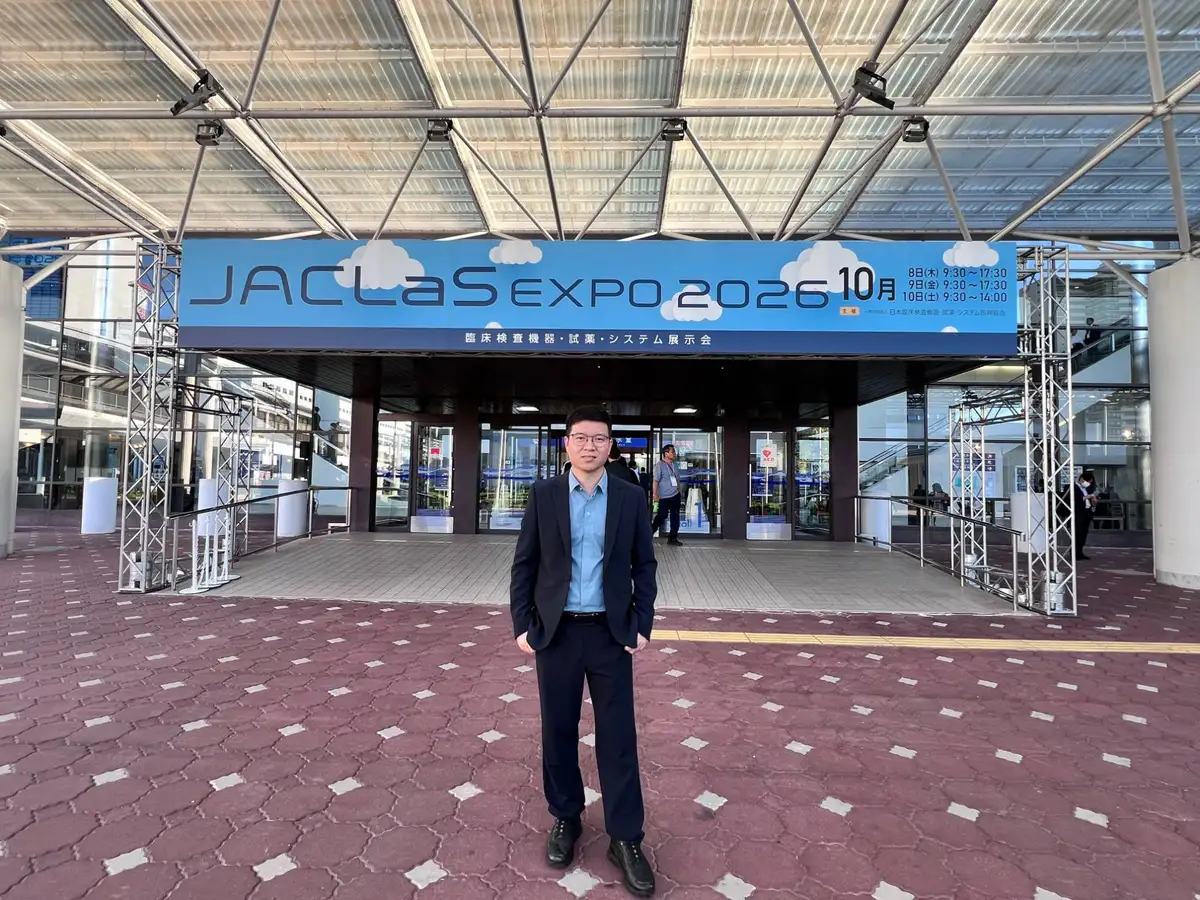
The banner over the entrance of the Kobe International Exhibition Hall listed three days, and the last one closed at 14:00. That was JACLaS EXPO 2026, October 8 to 10, and Sekbio was there to talk about recombinant antibodies.
This page is a short record of what we brought and what you can do next. We are not publishing visitor counts or deal numbers, because we would rather give you something you can act on: how an evaluation project starts, how long each step takes, and what to ask any antibody supplier.
The Show in Brief
JACLaS EXPO is an exhibition of clinical laboratory instruments, reagents and systems organized by JACLaS. The 2026 edition was held in Kobe and co-located with the 58th Annual Meeting of the Japan Association for Clinical Laboratory Science, which brings many laboratory professionals to the same venue.
- Dates: October 8-10, 2026
- Hours: October 8-9, 9:30-17:30; October 10, 9:30-14:00
- Venue: Kobe International Exhibition Hall, Kobe (Hyogo), Japan
- Co-located event: 58th Annual Meeting of the Japan Association for Clinical Laboratory Science
Our earlier article, Sekbio at JACLaS EXPO 2026: Recombinant Antibody Technology in Kobe, has the pre-show background.
What Kobe Felt Like After Years of Chinese IVD Shows
If you know the big Chinese IVD exhibitions, Kobe is a different experience. The aisles were quiet, the crowds were small, and photography was not allowed inside the hall. That is why this page shows the entrance and not our booth.
"A large Chinese IVD show is a hamburger. JACLaS EXPO is an egg tart."
That is how our team summed up the difference: smaller, calmer, and not something to measure by footfall.
The comparison says something about the industry as well. Before COVID, China's IVD sector grew at a pace that people came to treat as normal. When that surge faded, the market settled into a steadier rhythm, and it may end up looking more like Japan's than like its own recent past. Japan's market is mature, and its exhibition reflects that.
It is easy to be too optimistic when an industry is booming and too pessimistic when it is slow. That swing is the reason economic cycles are studied at all. A quiet hall in Kobe is a useful reminder that a calm market is not a failed one.
What a calmer market means for reagent suppliers
This is our view, not measured data. When growth is slow, buyers have less appetite for experiments and more reason to ask hard questions about lot consistency, documentation and supply continuity. Those are exactly the questions a sequence-defined recombinant antibody is built to answer, so we came away convinced that steady quality matters more in a mature market, not less.
What We Presented in Kobe
A recombinant antibody is a monoclonal antibody produced from a known DNA sequence in a host cell line such as CHO or HEK293, rather than from a hybridoma or animal ascites. Because the sequence is on file, the antibody can be made again whenever it is needed. That single property was the thread through every conversation we planned.
- Sequence-defined monoclonal antibodies expressed in CHO or HEK293 cells, with the construct archived
- Matched antibody pairs for ELISA, CLIA and lateral flow assays, listed in our IVD antibody product catalogue
- Stable CHO cell line development with yields up to 2.4 g/L (CHO stable cell line technology)
- Antibody engineering such as humanization, affinity maturation and format conversion
Behind these sit more than 800 completed CHO expression projects and an ISO 13485 quality system. For the regulatory side, see recombinant antibody vs hybridoma for IVDR compliance.
Why We Led with Recombinant Antibodies
Clinical laboratories judge a reagent by whether lot 2 behaves like lot 1. They rarely care how the antibody inside was made, until a lot changes and a control drifts.
That is why we led with consistency, cost and speed instead of technology for its own sake. When an incoming antibody lot behaves differently, the kit maker has to re-validate, which our article on antibody batch-to-batch consistency in IVD manufacturing puts at roughly 4-8 weeks of work per affected product. A sequence-defined antibody removes most sources of that drift, and binding-activity CV between lots is typically below 10%.
Why Cost Falls Without a Headline Percentage
The savings come from fewer re-validations, no lost clones, small-scale expression tests before a stable cell line is built, and one team instead of several vendors. How much that adds up to depends on your assay, supplier and volume, so we give a figure only after seeing those inputs.
How a Recombinant Antibody Is Made
Several visitors to any antibody booth want to see the workflow, so here it is in plain steps.
- Sequence. The heavy and light chain variable regions are defined, either from an existing clone or from a new campaign.
- Construct. The sequences are cloned into expression vectors. This construct is archived, and it is the master record of the antibody.
- Expression. CHO or HEK293 cells produce the antibody, first transiently for evaluation, later from a stable line if volume justifies it.
- Purification. Protein A or other chromatography removes host proteins and aggregates. Our article on antibody purification methods covers the options.
- Quality control. Purity, concentration, aggregate content and binding activity are tested before release.
The difference from a hybridoma route sits in step 2. Because the construct exists as defined DNA, a new lot starts from the same instructions every time. There is no passage-by-passage genetic drift to monitor, and no animal in the production loop. That is also why a recombinant antibody can be transferred to a second manufacturer, provided you own the sequence.
Catalogue Pair or Custom Project?
The most common first question after a show is whether you need a new antibody at all. Often you do not.
Start with a catalogue pair when
- Your marker is already in our catalogue, such as the CRP antibody pair or the cTnI antibody pair, and you mainly need to test performance in your matrix
- You are building a first prototype and want to learn the assay format before committing to development
- Timelines are tight, because an existing pair can be evaluated without waiting for expression
Move to a custom or recombinant project when
- You already hold a hybridoma clone or sequence and want a reproducible recombinant version
- An existing pair misses your sensitivity target, and engineering or a new campaign is the only route
- Supply continuity matters enough that you want the sequence and cell line under your own control
- You need a format change, for example IgG to Fab or scFv, to suit the assay
In practice, many partners do both: a catalogue pair keeps the product moving while a recombinant version is developed in parallel and then qualified as the long-term source. That avoids a gap in supply and spreads the validation work over time.
A Parallel Path Protects the Launch Date
If a product launch cannot slip, run the catalogue pair and the recombinant candidate side by side. Qualify the candidate against the same acceptance criteria, and switch only when the data supports it. Our guide to dual sourcing antibody raw materials describes how to set those criteria.
What Happens After a Booth Conversation
A trade-show meeting is a starting point. This is how it usually turns into an evaluation, with typical Sekbio timelines for each step.
| Step | What happens | Typical timeline |
|---|---|---|
| Project description | You send target, assay format, current antibody source and annual volume | Same day to a few days |
| Sequence and feasibility review | Developability check and route proposal, under NDA | 3-5 business days |
| Transient expression | CHO or HEK293 material for pairing and sensitivity tests | As fast as 7 days |
| Full antibody development | Sequence to a validated, application-ready antibody | 8-12 weeks |
| Stable cell line | High-yield CHO line for supply continuity | 2-3 months |
We suggest agreeing the acceptance criteria before any material is made, such as the sensitivity target, the sample matrix and the cross-reactivity panel, so that both sides read the same result the same way. Most evaluations stop after the transient step, because that is where you learn whether the candidate works in your assay. The stable cell line is a decision for later. Our comparison of CHO vs HEK293 for IVD antibody production explains how the host is chosen.
Questions to Put to Any Antibody Supplier
Whether you work with us or not, these questions separate a documented supply from a hopeful one:
- Who holds the sequence and the cell line? If the answer is not you or a documented escrow, dual sourcing later will be difficult.
- What is the lot-to-lot CV for binding activity? Ask for data from at least three lots, not a single certificate.
- Is any step animal-derived? Ascites adds documentation work for regulated products.
- What happens if the clone is lost? A re-expressible construct answers this; a hybridoma may not.
- Can the same team scale the product? Handoffs between vendors cost time and data.
Keep the Answers in Your Supplier File
Written answers to these questions double as supplier-qualification evidence. See how this fits an IVDR file in our article on antibody supplier documentation for IVDR 2026.
Next Stop: Seoul
The Kobe show was the first of two Asian laboratory medicine events on our calendar this month. The second is LMCE 2026, the Laboratory Medicine Congress & Exhibition, held with the 67th KSLM Annual Meeting at Grand Walkerhill Seoul from October 21 to 23. Details are in Sekbio at LMCE & KSLM 2026 in Seoul.
If you spoke with us in Kobe, or wanted to and could not, the quickest route is a short email to info@sekbio.com or a message through the Sekbio contact page. You can also call +86-135 9034 5917. Our monoclonal antibody development service page lists what a full project covers.
Frequently Asked Questions
What did Sekbio present at JACLaS EXPO 2026?
Sekbio presented its recombinant antibody technology: sequence-defined monoclonal antibodies produced in CHO and HEK293 cells, matched antibody pairs for ELISA, CLIA and lateral flow assays, stable cell line development and antibody engineering. The focus was how a recombinant approach lowers antibody cost and shortens IVD project timelines.
When and where was JACLaS EXPO 2026 held?
JACLaS EXPO 2026 ran from October 8 to 10, 2026 at the Kobe International Exhibition Hall in Kobe, Hyogo, Japan. The entrance banner listed 9:30 to 17:30 on October 8 and 9, and 9:30 to 14:00 on October 10. It was organized by JACLaS and co-located with the 58th Annual Meeting of the Japan Association for Clinical Laboratory Science.
I missed Sekbio in Kobe. How can I still discuss a project?
Email info@sekbio.com with the target name, assay format, current antibody source and expected annual volume. The same team that was in Kobe handles requests all year, and you can review services on the Sekbio platforms page before writing.
What happens after I send Sekbio a project description?
We review the target and assay format, then propose the shortest route to a candidate: an existing catalogue pair, an expression of a sequence you already hold, or a new antibody development project. A sequence and feasibility review typically takes 3-5 business days. Work is conducted under NDA.
How fast can Sekbio deliver a recombinant antibody for evaluation?
CHO transient expression can return material in as fast as 7 days. A full monoclonal antibody development project, from sequence to a validated antibody, typically takes 8-12 weeks, and building a stable CHO cell line takes about 2-3 months.
How does JACLaS EXPO compare with IVD exhibitions in China?
In our experience JACLaS EXPO is much smaller and quieter than the large Chinese IVD shows. The hall was calm, the crowds were modest, and photography was not allowed inside. We see it as a sign of a mature, steady market, where buyers focus on consistency, documentation and supply continuity rather than on novelty.
Who owns the antibody sequence and cell line after a project?
The client. All intellectual property from a Sekbio development project, including cell lines, antibody sequences, affinity data and characterization reports, belongs to the client on completion.
Will Sekbio attend other exhibitions this year?
Yes. Sekbio will attend LMCE 2026 and the 67th KSLM Annual Meeting at Grand Walkerhill Seoul, Korea, on October 21-23, 2026. To book a time, email info@sekbio.com before October 21.
From Kobe to Seoul
JACLaS EXPO 2026 gave us three days in Kobe to put recombinant antibody technology in front of laboratory and IVD professionals. If you want to continue a conversation, the next step is small: send us the target, the assay format, your current antibody source and the problem you want solved, and we will reply with a route and a timeline.
While you decide, browse the Sekbio antibody pairs for the markers you work on. Seoul is next.