Antibodies account for 34.5% of the global IVD raw material market, a bigger share than any other product type, according to a MarketsandMarkets press release published on August 14, 2026. That one figure explains why a forecast about "raw materials" is, for anyone building an immunoassay, mostly a forecast about the molecules on the test line.
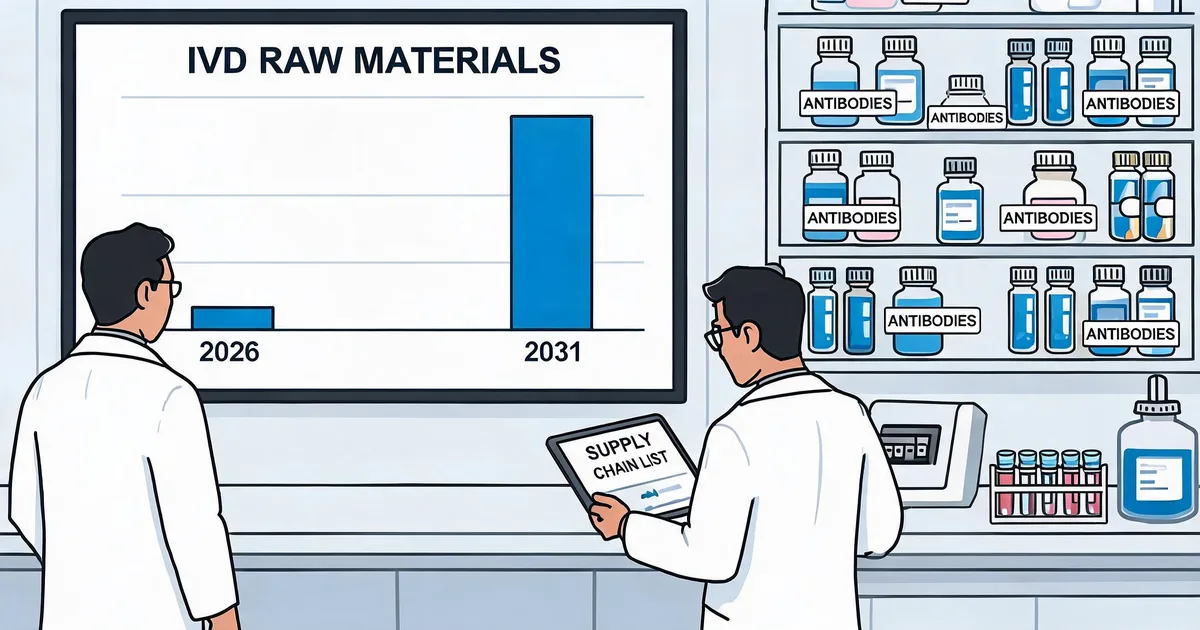
The same release projects the market growing from USD 21.5 billion in 2026 to USD 31.1 billion by 2031, a compound annual growth rate of 7.7%. Numbers like these are easy to quote and hard to check, so they are worth reading closely before anyone builds a sourcing plan on them.
IVD raw materials are the biological and chemical inputs, such as antibodies, antigens, enzymes, nucleic acids, membranes and buffers, that diagnostic manufacturers turn into finished tests. Everything below comes from the public press release and from one competing public forecast. We have not seen the paid report.
What the Forecast Actually Says
The press release is short on method but clear on headline numbers. Here is everything it quantifies, in one place:
| Metric | Figure | Year |
|---|---|---|
| Market size | USD 21.5 billion | 2026 |
| Projected market size | USD 31.1 billion | 2031 |
| Compound annual growth rate | 7.7% | 2026 to 2031 |
| Antibody share of product types | 34.5% | 2025 |
| In-house manufacturing share of supply | 66.1% | 2025 |
| Infectious disease share of applications | 25.5% | 2025 |
| Largest region | North America | 2025 |
| Fastest-growing region and technology | Asia Pacific; point-of-care testing | 2026 to 2031 |
The 7.7% rate implies the market adds roughly USD 9.6 billion over five years. The release gives no growth rates for individual segments, so "fastest-growing" for Asia Pacific and point-of-care testing is a ranking, not a number.
One caveat applies to every number above. The source is a vendor press release that promotes a paid report, and the 2025 shares are estimates, not audited sales. They are good enough to rank segments. They are not good enough to size a budget line for your own company.
Why Antibodies Lead the Product Mix
Every immunoassay needs something that recognizes the target. Enzymes, membranes, buffers and labels all matter, but the antibody decides what the test can detect and what it confuses with something else. In a sandwich format, the capture and detection antibodies set:
- the limit of detection and measuring range,
- the hook effect threshold,
- most of the cross-reactivity profile,
- how much lot-to-lot drift the finished kit will show.
The release does not say whether the 34.5% is a share of revenue or of volume. Reports of this type usually use revenue, and antibodies carry a high price per gram, which would make the share partly a pricing effect. Either way, the direction is not controversial: if you sell or build immunoassays, antibody sourcing is the largest line in the raw material budget.
For design-side detail, our guides to lateral flow assay antibody pair selection and CHO vs HEK293 antibody production for IVD cover how that choice plays out at the bench.
Two practical points follow from this mix. First, a buyer can read the antibody segment as a supply signal: more kit makers entering point-of-care formats means more requests for capture and detection pairs against the same popular targets, such as cardiac markers, inflammation markers and infectious disease antigens. Second, the antibody is rarely the only raw material that needs a second source. Membranes, conjugation reagents and blocking proteins often have the same single-supplier exposure, and they are usually reviewed less often.
Two-Thirds of Supply Is Made In-House
The 66.1% in-house figure is the one we would underline. It says most raw material value in this market never crosses a purchase order. Large diagnostic companies make their own antibodies, antigens and enzymes, and the market sizing counts that production.
Take the other side of that number. If the 2025 split held in 2026, the portion bought from outside suppliers would be roughly 34% of USD 21.5 billion, or about USD 7.3 billion. That is our arithmetic, not a figure from the report, and it mixes a 2025 share with a 2026 total, so treat it as an order of magnitude.
That outsourced slice is where independent antibody manufacturers compete. It is also where the buyers tend to be mid-sized IVD brands and rapid test makers who lack in-house cell culture and purification capacity. Those buyers carry the most risk when a supplier changes a clone or a process without notice, which is why documentation has become a purchasing criterion and not an afterthought. Our note on IVDR antibody supplier documentation lists what to ask for.
Point-of-Care and Asia Pacific Set the Pace
Two growth claims in the release matter to antibody buyers. Point-of-care testing is expected to have the highest CAGR among technologies, and Asia Pacific the highest among regions, with China, Japan and India named as the main growth markets. North America still held the largest share in 2025.
Infectious disease testing was the largest application in 2025 at 25.5%. Put those three facts together and you get a picture of where antibody demand is concentrating: lateral flow and fluorescence immunoassay formats, infectious disease and cardiac panels, and manufacturing bases in Asia.
Fapon Biotech, a Chinese company, is among the 15 players the release names, alongside Merck KGaA, Thermo Fisher Scientific, Bio-Techne, Medix Biochemica and BBI Solutions. Asia Pacific supply is no longer a minor part of the named supplier list.
If you are building for this segment, our rapid test antibody and antigen range is organized by target and format.
Same Market, Different Numbers
Market research firms do not agree on how large this market is. A ResearchAndMarkets release distributed by GlobeNewswire in December 2025 described a market of USD 27.7 billion in 2024 growing to USD 35.8 billion by 2030, a 4.3% CAGR.
| Publisher | Starting point | End point | CAGR |
|---|---|---|---|
| MarketsandMarkets (August 2026) | USD 21.5 billion (2026) | USD 31.1 billion (2031) | 7.7% |
| ResearchAndMarkets (December 2025) | USD 27.7 billion (2024) | USD 35.8 billion (2030) | 4.3% |
Run the second forecast forward two years at its own growth rate and you land near USD 30 billion for 2026, about 40% above the first publisher's 2026 figure. Again, that is our arithmetic. The gap points to different definitions: which materials count, whether in-house production is included, and how bundled kit components are treated.
Use the growth direction, not the dollar total, in planning
Both publishers agree the market grows through 2030 and 2031. They disagree on size and speed. For capacity or supplier planning, tie your assumptions to your own volume forecast and quote a range, not a single analyst number.
Where a Specialist Antibody Supplier Fits
The largest named players in market reports are broad catalog and platform companies. A different kind of supplier serves the outsourced slice for IVD manufacturers that need one thing done well: an antibody pair for a specific target, in a controlled format, with documents a regulator will accept.
Sekbio is built for that role. Founded in 2020 in Shenzhen, the company operates under ISO 13485 and holds CE marking (see our ISO 13485 and CE quality documentation), and supplies 200+ IVD brands in 30+ countries, as described on our About Sekbio page. Our work covers:
- monoclonal and recombinant antibody pairs for POCT, ELISA and CLIA formats,
- recombinant antibodies expressed in CHO cells from a fixed sequence, at titers up to 2.4 g/L,
- recombinant antigens and custom development for new targets,
- lot-specific CoAs, with consistency and stability data on request.
The relevant catalog pages are the IVD antibody and antigen product catalog and our antibody development platforms.
Sourcing Questions Worth Asking Now
A market growing at 7.7% a year does not make a supplier unreliable. It does mean more buyers competing for the same capacity, and more regulators asking where critical ingredients come from. Five questions we would put to any antibody source, ours included:
- Which antibodies do you make yourself, and which do you buy? The bought ones are where you have the least visibility.
- Is the antibody sequence fixed? A recombinant antibody can be reproduced indefinitely. A hybridoma line depends on cell stock management. The recombinant antibody vs hybridoma comparison under IVDR sets out the trade-offs.
- What does the CoA contain? Concentration and purity are the minimum. Functional activity in a defined assay and multi-lot comparison are what let you predict kit behavior. See antibody batch consistency in IVD manufacturing.
- Is there a written change notification commitment? A switched clone or site can alter sensitivity without warning.
- Is there a second source for the highest-volume pair? Qualifying one in advance costs less than doing it under pressure.
Frequently Asked Questions
How big is the IVD raw materials market?
MarketsandMarkets projects the IVD raw material market at USD 21.5 billion in 2026, rising to USD 31.1 billion by 2031 at a 7.7% CAGR. Other research firms use different scopes and base years, so published totals vary widely.
What counts as an IVD raw material?
Any biological or chemical input that goes into a diagnostic test: antibodies, antigens and recombinant proteins, enzymes and substrates, nucleic acids and oligonucleotides, beads and particles, membranes, labels and buffers. For immunoassays, the antibody pair is usually the component that sets sensitivity and specificity.
Which IVD raw material segment is the largest?
Antibodies. MarketsandMarkets reports a 34.5% share of the market for antibodies in 2025, ahead of every other product type it tracks.
Why do market reports give different sizes for IVD raw materials?
Scope and base year differ. A December 2025 ResearchAndMarkets release put the market at USD 27.7 billion in 2024 and USD 35.8 billion in 2030, a 4.3% CAGR. Whether a report counts only purchased materials or also materials made in-house changes the total considerably.
Which region is growing fastest in IVD raw materials?
Asia Pacific is projected to post the highest CAGR from 2026 to 2031, with China, Japan and India named as the main growth markets. North America held the largest regional share in 2025.
Do most IVD companies make their own raw materials?
According to the same MarketsandMarkets release, in-house manufacturing held a 66.1% share of supply in 2025. The remaining third is bought from outside suppliers, which is where independent antibody manufacturers compete.
How should an IVD manufacturer evaluate an outside antibody supplier?
Check five things: whether the antibody comes from a fixed sequence, whether lot-specific CoAs include functional activity, whether multi-lot consistency data exist, whether the supplier commits in writing to change notification, and whether it holds a current ISO 13485 certificate. Sekbio supplies recombinant antibodies on that basis; see our recombinant antibody development and CHO expression platforms.
What to Do With These Numbers
Take the growth direction and the segment ranking from this forecast, and leave the exact dollar totals to the analysts. Antibodies are the largest product type, most supply is made in-house, and the growth is tilted toward point-of-care formats and Asia Pacific.
The practical step is internal: list each antibody in your current products, mark which are bought, and check each one against the five questions above. If you want a second source qualified for a specific target, our team can share sample CoAs and consistency data from the Sekbio IVD antibody and antigen catalog.