A recombinant protein project can fail for a dozen reasons after cloning — bad induction conditions, a fussy host strain, a purification tag that won't cooperate. But some of the most expensive failures are decided before a single colony grows, at the moment the expression vector is chosen. Promoter strength, plasmid copy number, selection marker, signal peptide, and tag placement are all locked in on paper, and every one of them can quietly cap your yield, purity, or timeline.
This article walks through five vector selection mistakes that recur across bacterial, yeast, insect, and mammalian expression projects, why each one causes trouble downstream, and how to design around it before the construct ever reaches the bench.
1. What Is Vector Selection in Recombinant Protein Expression?
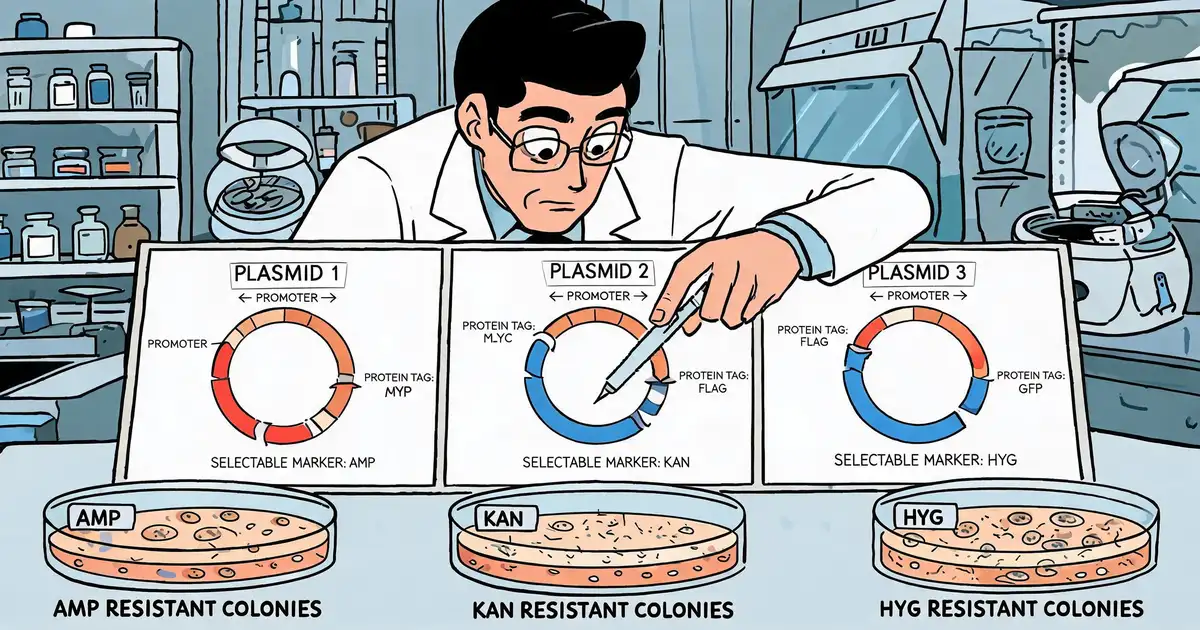
Vector selection is the process of choosing the plasmid or viral construct that will carry a target gene into a host cell for recombinant protein production, along with every regulatory element built into that construct: the promoter driving transcription, the origin of replication (ori) setting copy number, the selection marker used to identify successful transformants, and — where relevant — the secretion signal peptide and purification tag flanking the gene of interest. It is a design decision, not a shopping decision: the "right" vector depends entirely on the host system, the target protein's biology, and the scale the project needs to reach.
Every expression vector separates into two functional zones:
- The expression cassette — promoter, ribosome binding site or 5' UTR, optional signal peptide, the open reading frame (ORF) itself, purification/detection tag, and transcription terminator. This zone defines what gets made and how much.
- The backbone — origin of replication and selection marker. This zone defines how the plasmid survives in the host, independent of which gene is cloned into it.
Because these elements are independent of each other, a mistake in any single one — a promoter that's too strong, a marker that conflicts with the host, a tag on the wrong terminus — can undermine an otherwise well-chosen gene sequence. The five mistakes below cover the ones that recur most often across projects that reach out to Sekbio's recombinant protein expression platform after a construct has already failed once.
2. Mistake 1: Mismatching Promoter Strength to the Target Protein
The most common vector selection error is reaching for the strongest available promoter by default — T7 in bacterial systems, CMV in mammalian systems — on the assumption that more transcription always means more protein. For a large fraction of targets, that assumption breaks down badly.
2.1 Why an Overpowered Promoter Backfires
A strong constitutive or fully-induced promoter drives transcription and translation faster than the host's folding machinery can keep up. In E. coli, chaperones such as GroEL/GroES and DnaK/DnaJ have a finite processing rate; when nascent chains arrive faster than that rate, hydrophobic folding intermediates aggregate into insoluble inclusion bodies instead of folding correctly. In mammalian cells, an overdriven CMV promoter can trigger the unfolded protein response, reducing viable cell density and, paradoxically, total functional protein output.
2.2 Matching Promoter Strength to the Expression Goal
The fix is to treat promoter strength as a tunable parameter, not a fixed default:
- Tunable/inducible promoters (T7-lac operator with titratable IPTG, Tet-On/Tet-Off systems) let you dial transcription down for difficult, aggregation-prone targets without redesigning the vector.
- Moderate constitutive promoters (e.g., EF-1α in place of CMV) often outperform a maximal promoter for secreted or multi-domain proteins that need more folding time per molecule.
- Bicistronic or weaker ribosome binding sites can throttle translation independently of transcription, a second lever when the promoter itself must stay strong for other reasons.
Common Mistake
Teams often diagnose a low-yield, insoluble result as a "host cell" or "purification" problem and spend weeks optimizing lysis and refolding buffers, when the underlying cause is a promoter driving expression far past the host's folding capacity. Before extensive downstream troubleshooting, it's worth revisiting our guide to E. coli expression mistakes to rule out an induction or promoter-strength mismatch first.
3. Mistake 2: Ignoring Plasmid Copy Number and Backbone Stability
Copy number — how many plasmid molecules the origin of replication maintains per cell — is set by the vector backbone, not the insert, and it is easy to overlook because it doesn't show up until a project scales past small shake-flask cultures.
3.1 High Copy Number Isn't Always Better
A high-copy origin (such as a pUC-derived ori, often 500+ copies per cell) maximizes gene dosage, which helps for weakly expressed or difficult targets. But it also multiplies metabolic burden: the host spends more resources replicating plasmid DNA and expressing the marker gene, leaving less capacity for the target protein itself. For robust, well-folding targets, a medium-copy origin (p15A-derived, roughly 10–20 copies) or even a low-copy origin frequently gives a higher net yield of correctly folded, soluble protein.
3.2 Segregational Instability Under Fermentation Stress
High-copy plasmids carrying a metabolically costly insert are also more prone to segregational instability — daughter cells that lose the plasmid during division grow faster than plasmid-bearing cells and gradually take over the culture. In a small overnight culture this goes unnoticed; over a multi-day fermentation run, it can mean the majority of biomass at harvest carries no plasmid at all.
"The vector isn't a delivery vehicle you pick last — its promoter, copy number, marker, and tag choices are already deciding your yield and purity before the first colony grows."
Two practical checks catch this before it reaches production scale: tracking the percentage of antibiotic-resistant colonies across serial passages, and including stabilizing elements (par loci, or a lower-copy origin) for constructs with a known metabolic burden.
4. Mistake 3: Picking a Selection Marker That Fights the Host or the Process
A selection marker's only job, in principle, is to let successfully transformed cells grow while untransformed cells die. In practice, the marker choice has consequences that extend well past the initial transformation plate.
4.1 Marker–Host Conflicts
Some production host strains carry endogenous or previously introduced resistance genes. Cloning a new construct with a marker that duplicates an existing host resistance provides no real selective pressure — every cell survives, transformed or not, and true positives can't be distinguished from background. This is a frequent, easily missed problem when a lab reuses a strain across multiple projects without checking its resistance profile against the incoming vector.
4.2 Marker Choices That Complicate Scale-Up
Beta-lactam markers such as ampicillin resistance are convenient at bench scale but are frequently swapped out before larger production runs: residual beta-lactamase activity and antibiotic carryover into downstream steps complicate purification and quality documentation. Kanamycin, hygromycin, or auxotrophic complementation markers (for yeast and some mammalian systems) are more common choices once a construct is heading toward scale-up.
| Host System | Typical Promoter | Copy Number / Integration | Common Selection Marker | PTM & Glycosylation |
|---|---|---|---|---|
| E. coli (pET/T7 vectors) | T7 / lac (strong, inducible) | Multi-copy plasmid (15–40+, ori-dependent) | Ampicillin, kanamycin | None — no glycosylation; disulfide folding unreliable |
| P. pastoris (yeast) | AOX1 (methanol-inducible) | Single/multi-copy genomic integration | Zeocin, HIS4 auxotrophy | Basic N-/O-glycosylation, high-mannose type |
| Insect (baculovirus, Sf9/Hi5) | polh / p10 (very strong, late-phase) | Viral genome copy (transient, non-episomal) | Not required (viral infection-based) | Complex but non-human glycosylation patterns |
| Mammalian (CHO/HEK293) | CMV, EF-1α (constitutive) or Tet-inducible | Low-copy episomal or stable integration | Neomycin/G418, hygromycin, DHFR/GS amplification | Human-like N-/O-glycosylation, full disulfide machinery |
5. Mistake 4: Poor Signal Peptide and Tag Placement Design
Once the transcription and selection elements are settled, the signal peptide and purification tag are the last vector-design choices before cloning — and they are frequently made without checking the target protein's own structural biology.
5.1 Wrong Signal Peptide, Wrong Compartment
A signal peptide directs the nascent protein toward secretion or periplasmic export; without one (or with a mismatched one), a protein intended for secretion instead accumulates intracellularly, where it may misfold or become toxic to the host. Native signal peptides don't always transfer across host species — a mammalian signal sequence cloned unchanged into a bacterial vector is frequently not recognized by the bacterial Sec translocon, so heterologous signal peptides matched to the intended host (e.g., PelB or OmpA for E. coli periplasmic export) are the safer default.
5.2 Tag Position and the Missing Protease Site
Whether a His-tag or other affinity tag sits at the N- or C-terminus can determine whether it interferes with a functional domain: an N-terminal tag can block a native signal peptide or active site, while a C-terminal tag can be lost if a stop codon is inadvertently introduced during cloning. Just as important is including a specific protease cleavage site (TEV, thrombin, or a similar sequence) between the tag and the protein of interest — without one, the tag either has to stay on the final product or requires a nonspecific chemical cleavage step that risks damaging the target.
Pro Tip
When the target protein's terminus of interest isn't known in advance, cloning two parallel constructs — one N-terminal tag, one C-terminal tag — and screening both in a small-scale expression test is faster and cheaper than committing to one placement and discovering a folding problem after scale-up.
6. Mistake 5: Overlooking Host–Vector Compatibility
The final recurring mistake is choosing a vector backbone based on lab convenience or cost, rather than what the target protein actually requires from its host.
6.1 MCS and Codon Usage Conflicts
Restriction sites within the multiple cloning site (MCS) can conflict with the same restriction sites occurring naturally inside the insert, forcing an awkward cloning strategy or a switch to a seamless method (Gibson assembly, Golden Gate) mid-project. Separately, a vector's promoter and ribosome binding site may be well-tuned for the intended host's codon usage, but the insert itself — especially genes originally sourced from a different organism — often is not; without codon optimization matched to the chosen host, rare codons can stall translation regardless of how well the vector's own elements are designed.
6.2 When the Target Protein Dictates the Host
Some vector-selection mistakes are really host-selection mistakes wearing a vector's clothing. A target protein that requires human-type glycosylation or complex disulfide bonding for activity cannot be rescued by any bacterial vector design, no matter how well the promoter and tag are optimized — it needs a mammalian expression system from the start. Our CHO vs. HEK293 expression comparison covers how to choose between the two leading mammalian options once glycosylation requirements have ruled out a bacterial vector.
7. Frequently Asked Questions — Vector Selection Mistakes
What is vector selection in recombinant protein expression?
Vector selection is the process of choosing the plasmid or viral construct — including its promoter, origin of replication, selection marker, secretion signal, and tag arrangement — that will carry a target gene into a host cell for recombinant protein production. It is a design decision made before cloning begins, and it determines expression level, solubility, purification strategy, and host compatibility for the entire project.
How long does it take to redesign a vector after a failed expression run?
A targeted fix — swapping a promoter, relocating a tag, or changing a selection marker via restriction cloning or Gibson assembly — typically takes 1–2 weeks including sequence verification. A full redesign that also changes the host system (for example, moving from a bacterial to a mammalian expression vector) is a larger effort, often 3–6 weeks, because it usually requires codon re-optimization and a new signal peptide as well.
Can the same vector backbone be used for both E. coli and mammalian expression?
Not directly. E. coli and mammalian cells read different promoters, use different ribosome binding elements, and require different selection markers, so a true dual-host vector needs two complete expression cassettes (a bacterial promoter/marker pair and a mammalian promoter/marker pair) built into one backbone, or two separate vectors maintained in parallel. Simply moving an insert between a bacterial and mammalian vector without re-engineering these elements will not express.
What is the difference between a cloning vector and an expression vector?
A cloning vector is optimized for propagating and storing a DNA insert — it needs only an origin of replication, a multiple cloning site, and a selection marker. An expression vector adds the elements required to actually produce protein from that insert: a host-compatible promoter, ribosome binding site or 5' UTR, and often a secretion signal and purification tag. Many projects use a cloning vector for initial construct assembly, then subclone the verified insert into a dedicated expression vector.
How do you evaluate whether a plasmid backbone is stable enough for scale-up?
Plasmid stability at scale is evaluated by tracking marker retention (e.g., percentage of colonies remaining antibiotic-resistant) across serial passages or through a fermentation run, alongside plasmid copy number by qPCR and, where relevant, restriction digest or sequencing to confirm the insert has not recombined out. A backbone that shows significant marker loss or insert rearrangement by mid-fermentation is not stable enough for production without additional stabilizing elements (e.g., par loci) or a lower-copy origin.
Does Sekbio offer vector design services for recombinant protein and antibody expression?
Yes. Sekbio's antibody and recombinant protein platform includes expression vector design and optimization — promoter, copy number, selection marker, and tag configuration matched to the target protein and host system — as part of its broader recombinant antibody and antigen production services. Visit our recombinant protein expression platform page to discuss project-specific vector requirements.
8. Summary
Vector selection mistakes are expensive precisely because they surface late — after cloning, after the first expression test, sometimes only after scale-up. The five covered here account for most of the recurring failures:
- Promoter strength that outruns the host's folding capacity turns a viable target into inclusion bodies or a stressed culture.
- Copy number and backbone stability decisions made for bench-scale convenience often don't survive fermentation-scale passage.
- Selection markers need to be checked against both the host strain's existing resistance profile and downstream manufacturing constraints, not just picked from habit.
- Signal peptide and tag placement depend on the target protein's own structural biology — there is no universal default that works for every construct.
- Host–vector compatibility, including codon usage and post-translational modification needs, sometimes rules out an entire class of vector before promoter or tag choices even matter.
Getting these five decisions right before cloning starts is consistently faster and cheaper than diagnosing them after a failed expression run. Sekbio's recombinant protein and antibody expression platform builds vector design — promoter, backbone, marker, and tag configuration — into the earliest stage of every project, matched to the target protein's biology and the intended production host.