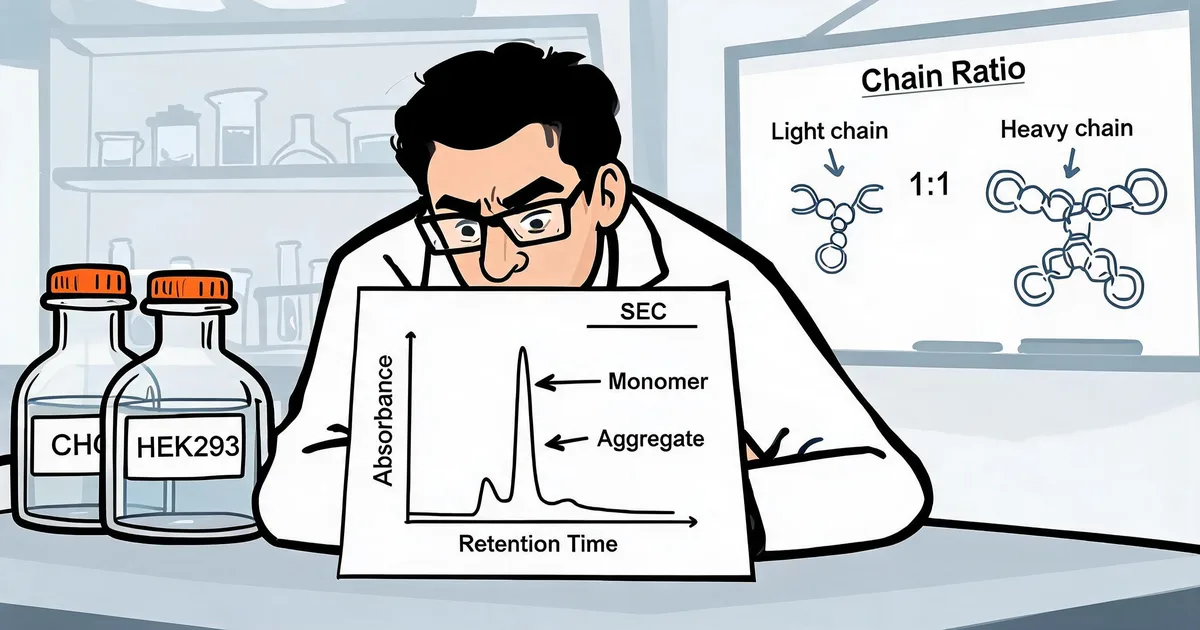
You run a routine transient transfection for a monoclonal antibody, purify over Protein A, inject on analytical SEC — and the monomer peak is flanked by a fat high molecular weight shoulder and a low molecular weight bump. Non-reducing CE-SDS then shows a clear half-antibody band. The sequence is right, the vector worked last quarter, and yet 25–35% of the material is unusable. This is one of the most frequently discussed headaches among antibody scientists working with CHO and HEK293 transient expression: light/heavy chain mispairing and rising aggregate levels, appearing together, batch after batch.
This guide treats the two problems as one linked failure mode and walks through a five-step fix, in the order you should actually try them: rebalance the chain plasmid ratio, correct codon usage and signal peptides, tune the transfection and culture, then screen purification and polishing buffers, and finally confirm the result with orthogonal analytics. Each step includes the readout that tells you whether it worked.
1. What Causes Light/Heavy Chain Mispairing and Aggregation in Transient Expression?
Light/heavy chain mispairing is any assembly outcome other than the canonical H2L2 antibody: two heavy chains paired with two light chains, correctly disulfide-linked. In transient CHO and HEK293 runs, the common mispaired species are free heavy chain, free light chain, half-antibodies (one heavy plus one light chain, ~75 kDa), light-chain dimers (~50 kDa), and heavy-chain-only species that seed aggregation.
The root cause is almost always a synthesis imbalance between the two chains. Correct antibody assembly in the endoplasmic reticulum depends on the light chain being available in slight excess: the light chain releases the heavy chain from the chaperone BiP and caps the hydrophobic CH1 domain. When heavy chain is made faster than light chain, unpaired heavy chain accumulates, exposes aggregation-prone surfaces, and is either retained and degraded or secreted as aggregate and half-antibody. This is why mispairing and elevated high molecular weight (HMW) species show up together.
Contributing factors, roughly in order of how often they are the real problem:
- Plasmid ratio — a 1:1 light:heavy co-transfection is the single most common mistake.
- Codon usage and signal peptide — a poorly optimized or rare-codon-rich chain, or a weak secretion signal, throttles one chain's output.
- Expression rate outpacing folding capacity — high DNA load, high temperature, and peak cell density all push flux past what the ER can fold.
- Intrinsic sequence liabilities — exposed hydrophobic patches, unpaired cysteines, or low-stability VH/VL interfaces that aggregate regardless of process.
Pro Tip
Before changing anything, run non-reducing CE-SDS or SDS-PAGE alongside SEC. SEC alone cannot distinguish a half-antibody from a clipped monomer, and it under-reports free light chain. Knowing whether your problem is mispairing, aggregation, or both decides which of the steps below matters most.
2. Step 1: Rebalance the Light-to-Heavy Chain Plasmid Ratio
This is the highest-yield change and the one to try first. When light and heavy chains are on separate plasmids, co-transfect with the light chain in excess. A practical titration matrix for a standard IgG:
- Light:Heavy = 1:1 (baseline), 1.5:1, 2:1, 3:1
- Hold total DNA constant; adjust the two plasmid masses against each other.
- Harvest at the same time point and read monomer % by analytical SEC and half-antibody / free-chain % by non-reducing CE-SDS for each ratio.
For most IgG1 and IgG4 constructs, monomer content is maximized somewhere between 2:1 and 3:1 light:heavy, with free heavy chain and half-antibody dropping sharply above 1.5:1. Titers may dip slightly at high light-chain excess, but usable, monomeric antibody per liter typically goes up. If both chains sit in a single dual-promoter or IRES vector, you cannot tune the ratio this way — move to a two-plasmid system for the troubleshooting run, or re-clone with the light chain under the stronger promoter.
"A 1:1 light-to-heavy plasmid ratio is a default, not a decision. For antibodies with a mispairing or aggregation problem, the light chain almost always needs to be in two- to threefold excess."
For bispecific antibodies, ratio tuning is necessary but not sufficient: you also need a pairing-forcing design (knobs-into-holes plus one or more of the CrossMab, charge-pair, or common-light-chain strategies). Ratio screening on a bispecific means titrating each of the two heavy chains and the light chain(s) independently, with correctly paired species quantified by hydrophobic interaction chromatography or native mass spectrometry.
3. Step 2: Optimize Codon Usage and Signal Peptides for Balanced Chain Output
If the plasmid-ratio screen improves things but does not resolve them, the next suspect is unequal translational and secretory efficiency between the two chains. Even at a corrected DNA ratio, one chain can be under-produced because its coding sequence or its signal peptide is working against it.
Codon optimization
- Codon-optimize both chains for the expression host (CHO or HEK293), not just the heavy chain.
- Remove rare codons, long mononucleotide runs, cryptic splice donor/acceptor sites, and premature polyadenylation signals.
- Target GC content roughly 50–60% and avoid strong mRNA secondary structure around the start codon.
- Keep the two chains at comparable codon adaptation indices — a heavily optimized heavy chain paired with an unoptimized light chain recreates the imbalance you are trying to remove.
Signal peptide selection
The secretion signal sets how efficiently each nascent chain enters the ER. Test two or three signal peptides per chain (for example the native murine Ig leader, a human IgG heavy-chain leader, and a synthetic optimized leader), and pick the combination that gives the highest secreted, correctly assembled fraction. A mismatched signal peptide is a common reason a light chain under-performs despite a generous plasmid ratio.
Common Mistake
Optimizing only the heavy chain "because that's the limiting one." In practice the light chain is what must be in functional excess; if its sequence or leader is throttling output, adding more light-chain plasmid cannot compensate, and free heavy chain keeps aggregating.
4. Step 3: Tune Transfection and Culture Conditions to Limit Misfolding
Chain assembly competes with aggregation kinetically. If total expression flux exceeds the ER's folding and quality-control capacity, correctly optimized chains still aggregate before they can pair. Reduce the flux and give folding time to keep up:
| Parameter | Typical over-driven setting | Adjustment to reduce aggregate |
|---|---|---|
| Total plasmid DNA | High (max titer) | Reduce 30–50%; re-check monomer %, not just titer |
| Post-transfection temperature | 37 °C throughout | Shift to 32–34 °C at 24 h to slow synthesis and favor folding |
| Viable cell density at transfection | Near peak | Transfect mid-exponential; avoid nutrient-limited, stressed cells |
| Feed / supplements | Standard | Add mild chaperone inducers or anti-apoptotic / antioxidant supplements |
| Harvest time | Late (max accumulation) | Harvest earlier if late-culture aggregate rises with viability drop |
A temperature shift to 32–34 °C after the first day is the most reliable single lever here: it lowers transcription and translation rate, extends the folding window, and often cuts HMW species by a third or more with only a modest titer cost. Co-transfecting a small amount of a folding helper (for example XBP1s or an ER chaperone) can help chronic cases but adds a variable — try process conditions first.
5. Step 4: Screen Purification and Polishing Buffers to Remove Mispaired and Aggregated Species
Even a well-optimized transient run leaves some aggregate and mispaired product. Purification should remove these species, and a poorly chosen buffer can create more — low-pH Protein A elution is a classic aggregation trigger.
Protein A capture
- Screen elution pH from 3.3 to 3.8; use the highest pH that still elutes cleanly.
- Neutralize immediately to pH 5.5–6.5 with a defined volume of 1–2 M Tris; avoid overshoot to neutral pH where some mAbs self-associate.
- Add arginine (0.1–0.5 M), sucrose, or a trace non-ionic detergent to the neutralization or hold buffer to suppress reversible aggregation.
Polishing step (add one)
- Preparative SEC — simplest for small-scale material; directly separates monomer from HMW and LMW species.
- Cation exchange (CEX) — resolves aggregate and often half-antibody by charge; scalable.
- Mixed-mode chromatography — effective when aggregate co-elutes with monomer on CEX.
Run a small buffer matrix (pH × salt × additive) and read monomer recovery and purity by analytical SEC for each condition. The same discipline Sekbio applies to its recombinant antibody products — defined polishing plus release-level SEC — is what keeps monomer content reproducible from batch to batch.
6. Step 5: Confirm Chain Pairing and Monomer Content with Orthogonal QC
No single assay proves the problem is fixed. Confirm the corrected material with a small orthogonal panel:
- Analytical SEC (SEC-HPLC) — monomer %, HMW %, LMW %. Target for research-grade mAb material is typically ≥ 95% monomer, often ≥ 98% after polishing.
- Non-reducing CE-SDS or SDS-PAGE — detects half-antibody (~75 kDa), free light chain (~25 kDa), and light-chain dimer (~50 kDa) that SEC misses.
- Reducing CE-SDS — confirms the light:heavy mass ratio and flags clipped or glycation-shifted chains.
- Intact and reduced mass spectrometry — verifies the assembled molecule carries the expected light and heavy chain masses with correct disulfide connectivity; essential for bispecifics.
- For bispecifics: hydrophobic interaction chromatography or native MS to quantify correctly paired vs. mispaired species.
Lab Note
Record monomer % and half-antibody % at every step of the troubleshooting so you can attribute the improvement. A run that goes from 70% to 96% monomer after ratio + temperature changes tells you the polishing screen only needs to close a 4% gap, not carry the whole fix.
7. Frequently Asked Questions — Chain Mispairing & Aggregation
What is light/heavy chain mispairing in recombinant antibody expression?
Chain mispairing is any antibody assembly outcome other than the intended two light chains paired with two heavy chains. In transient CHO or HEK293 expression it shows up as free heavy chain, free light chain, half-antibodies (one heavy plus one light chain), light-chain dimers, and heavy-chain-only aggregates. It is driven mainly by an imbalance between light-chain and heavy-chain synthesis: free heavy chain that cannot find a light-chain partner is prone to misfolding and aggregation, so mispairing and elevated aggregate levels usually appear together on an SEC trace.
How long does it take to troubleshoot aggregation in a CHO or HEK293 transient run?
A focused round of troubleshooting is typically two to four weeks: about one week to run a small plasmid-ratio and codon or signal-peptide matrix, one week for a repeat transient expression at the best conditions, and a few days for a purification buffer and polishing screen with analytical SEC and CE-SDS readouts. Cases where the heavy chain itself is intrinsically aggregation-prone can take longer and may need sequence-level engineering rather than process changes alone.
Can I fix high aggregate levels by purification alone, without changing the expression setup?
Sometimes, but it is inefficient. A polishing step such as preparative SEC, cation exchange, or mixed-mode chromatography can pull monomer away from aggregate and half-antibody, and buffer optimisation with arginine or sucrose can suppress reversible self-association. However, if the transient run produces 20 to 40 percent aggregate because chain output is unbalanced, purification means discarding most of the material and often still leaves 2 to 5 percent high molecular weight species. Correcting the plasmid ratio and folding conditions first raises the starting monomer fraction so downstream polishing has far less to remove.
What is the difference between chain mispairing and antibody aggregation on an SEC trace?
Aggregation appears as high molecular weight peaks eluting earlier than the ~150 kDa monomer: dimers, oligomers, and a void-volume shoulder. Chain mispairing produces species at or below the monomer position: half-antibodies near 75 kDa, free light chain near 25 kDa, and light-chain dimers near 50 kDa, best resolved by non-reducing CE-SDS rather than SEC alone. The two problems are linked because unpaired heavy chain is a common nucleation point for aggregate, so a run with a large half-antibody peak on CE-SDS almost always also shows elevated high molecular weight species on SEC.
How do you measure light/heavy chain mispairing?
Use orthogonal methods rather than a single assay. Non-reducing CE-SDS or SDS-PAGE reveals half-antibodies and free chains by apparent molecular weight; reducing CE-SDS confirms the light-to-heavy chain mass ratio. Analytical SEC quantifies monomer versus high and low molecular weight species. Intact and reduced mass spectrometry confirms that the assembled molecule carries the expected light and heavy chain masses with correct disulfide connectivity. For bispecific formats, add hydrophobic interaction chromatography or native mass spectrometry to quantify the correctly paired species against mispaired byproducts.
Does Sekbio offer CHO and HEK293 transient expression with SEC quality control?
Yes. Sekbio runs recombinant antibody expression in both CHO and HEK293 transient systems, from 40 mL screening to multi-litre scale, with plasmid-ratio optimisation, codon optimisation, and a purification and polishing workflow tuned to each molecule. Every batch is released with analytical SEC for monomer content and non-reducing CE-SDS or SDS-PAGE for chain pairing, and mass spectrometry confirmation is available. See Sekbio's CHO and HEK293 antibody expression platform to discuss a mispairing or aggregation problem on a specific construct.
8. Summary
Light/heavy chain mispairing and aggregation in transient expression are one linked problem, and they respond to a fixed order of interventions:
- Diagnose first: run non-reducing CE-SDS with SEC to separate mispairing (half-antibody, free chains) from aggregation (HMW species).
- Plasmid ratio: put the light chain in 2:1–3:1 excess — the single highest-yield change.
- Codon and signal peptide: optimize both chains to comparable efficiency; test two or three leaders per chain.
- Process: lower DNA load, shift to 32–34 °C after 24 h, transfect healthy mid-exponential cells.
- Purification: raise Protein A elution pH, neutralize to pH 5.5–6.5, add arginine, and include a polishing step (SEC, CEX, or mixed-mode).
- Confirm: analytical SEC (≥ 95–98% monomer), CE-SDS, and intact/reduced MS before release.
If a construct resists this workflow — or you would rather not spend a month of instrument time on it — Sekbio runs both CHO and HEK293 antibody expression with chain-ratio and codon optimization built in and SEC plus CE-SDS on every batch. See the CHO and HEK293 antibody expression platform to bring a specific mispairing or aggregation case to the team.