Every year, IVD developers lose months of assay development time to a decision made in week one: which antibody to screen. The wrong choice rarely announces itself immediately — an antibody pair can look perfectly reasonable in an early feasibility ELISA, only to fall apart weeks later against real patient serum, or worse, after a kit has already shipped and lot-to-lot drift starts generating out-of-spec results.
This guide walks through the most common — and most costly — mistakes IVD developers make when screening and selecting antibodies, starting with the single biggest one: treating a research antibody as if it were built for diagnostic use. Each pitfall includes what actually goes wrong, why it happens, and how to screen it out before it reaches your production line.
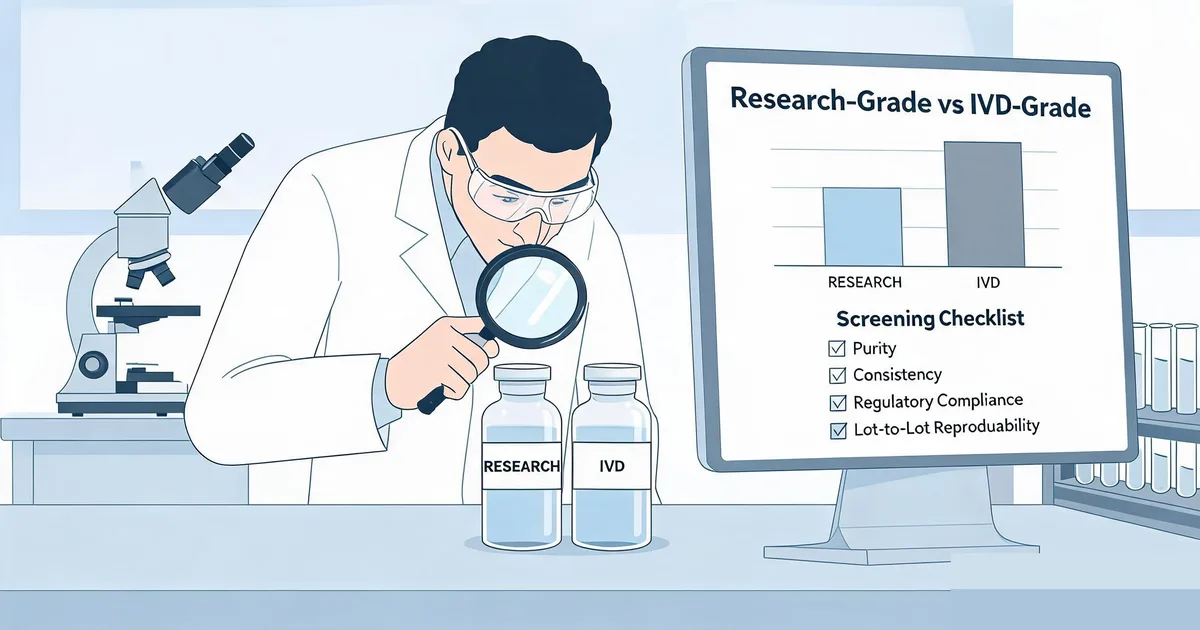
1. What Is IVD Antibody Screening?
IVD antibody screening is the systematic evaluation of candidate antibodies — usually monoclonal — against the specific performance requirements of an in vitro diagnostic assay: sensitivity, specificity, matrix compatibility, epitope pairing, manufacturability, and long-term lot-to-lot consistency. It is distinct from general antibody characterization because the acceptance bar is not "does it bind the target," but "does it bind the target reliably enough, in real patient samples, batch after batch, to support a regulated clinical decision."
A typical screening program moves through several stages: initial binding and affinity assessment (ELISA, SPR, or BLI), epitope mapping to identify non-competing capture-detection pairs, specificity testing against related analytes and isoforms, and finally matrix validation against individual clinical serum or plasma samples. Antibodies that were never designed with this pathway in mind — most catalog research antibodies — routinely fail at the matrix validation stage, which is exactly where teams discover the mistakes covered below.
"A research antibody validated for Western blot tells you almost nothing about how it will perform capturing native antigen out of diluted patient serum."
2. Pitfall 1: Mistaking a Research Antibody for an IVD-Grade Antibody
This is the pitfall behind more failed IVD projects than any other: selecting a catalog antibody because its datasheet lists the right target and species reactivity, without asking what application that antibody was actually developed and validated for.
Most commercial research antibodies are raised and screened for applications such as Western blot, immunohistochemistry, immunofluorescence, or immunoprecipitation. These formats detect denatured or fixed antigen, often in a cell lysate or tissue section — a completely different molecular context from a sandwich immunoassay, which must capture native, folded antigen at low concentration directly out of serum or plasma. An antibody that gives a clean Western blot band can bind an epitope that is buried or structurally altered in the native protein, and simply fail to capture anything in solution.
- Application mismatch: "Validated for WB, IHC" on a datasheet says nothing about sandwich ELISA or lateral flow performance.
- No matrix data: Research antibodies are rarely tested against serum or plasma, so matrix interference is unknown until you test it yourself.
- Undocumented lot history: Catalog clones are often produced in small, ad hoc batches with no formal lot-to-lot consistency data.
- No supply continuity: Research suppliers can discontinue a clone without notice, breaking a diagnostic kit's supply chain mid-development or, worse, mid-production.
Common Mistake
Teams often shortlist antibodies purely from literature or catalog datasheets showing strong performance in an unrelated application, then discover during matrix testing that the antibody was never developed with an IVD use case in mind — costing weeks of screening time that a proper IVD-grade pair would have avoided.
The fix is not to avoid commercial antibody sources altogether, but to screen for fit-for-purpose validation from the outset. Ask suppliers directly whether a candidate clone has been tested in a sandwich immunoassay format against native antigen, and treat any antibody without that evidence as an unvalidated starting point — not a finished reagent. Sekbio's IVD antibody pair screening and development services validate every candidate specifically in immunoassay format before it is offered as an IVD-grade reagent.
3. Pitfall 2: Skipping Real Clinical Matrix Testing
An antibody pair that performs beautifully in PBS or recombinant antigen spiked into buffer can behave very differently once real patient serum enters the picture. Serum and plasma contain heterophilic antibodies, rheumatoid factor, hemoglobin, bilirubin, lipids, and structurally related proteins — any of which can bind non-specifically, block an epitope, or generate false signal.
Screening only against purified antigen in buffer is a fast way to get an encouraging early result and a slow way to discover a real problem. Matrix effects typically surface only when the assay is tested against individual clinical samples spanning the expected concentration range, including samples known to carry common interferents.
- Hemolyzed, icteric, and lipemic samples: Test each interferent class separately at defined concentrations to confirm the assay tolerates realistic sample quality.
- Heterophilic antibody interference: Screen against samples known to contain human anti-animal antibodies (HAAA), a frequent cause of false-positive sandwich immunoassay results.
- Individual patient samples, not pools: Pooled serum averages out interference; individual samples reveal it.
Building matrix testing into the screening stage — not the validation stage that follows months later — lets a team eliminate a poorly performing antibody candidate before significant development resources are committed to it.
4. Pitfall 3: Ignoring Epitope Overlap and Cross-Reactivity
A sandwich immunoassay requires a capture and a detection antibody that bind non-overlapping epitopes on the same antigen simultaneously. Screening antibodies individually for affinity, without confirming pairing compatibility, is a common shortcut that produces a pair that looks strong on paper but cannot form a sandwich in practice.
Cross-reactivity is the second half of this pitfall. An antibody selected only against the intended target, without a specificity panel against structurally related analytes, isoforms, or homologous proteins from other species, can generate false-positive signal that only appears once the assay meets a broader sample population.
- Checkerboard pairing matrix: Test every candidate capture-detection combination against a fixed antigen concentration to confirm true sandwich formation, not just individual binding.
- Epitope binning: Use competitive binding assays to confirm candidate antibodies occupy distinct, non-competing epitope bins before committing to a pair.
- Cross-reactivity panel: Test against related family members, isoforms, and common interfering proteins at 100x the target concentration.
Teams building sandwich assays should treat pairing and specificity screening as inseparable steps — see our antibody pair selection best practices for a full checkerboard titration workflow.
5. Pitfall 4: Underestimating Lot-to-Lot Consistency and Supply Continuity
An antibody that screens perfectly in one lot but drifts in the next is arguably worse than an antibody that fails screening outright — the failure only becomes visible after a kit is already in production or, worse, already in the field. Research-grade antibody sources are rarely built around the batch-to-batch reproducibility that a diagnostic manufacturing process demands.
| Criterion | Typical Research-Grade Antibody | IVD-Grade Antibody |
|---|---|---|
| Validated Application | WB / IHC / IF / IP | Sandwich ELISA / CLIA / Lateral Flow |
| Antigen Form Tested | Denatured or fixed lysate | Native antigen in serum/plasma matrix |
| Matrix Testing | Buffer only, if any | Individual clinical sample panel incl. interferents |
| Batch Documentation | Single lot, limited COA | Full COA; intra-batch CV <10%, inter-batch CV <15% |
| Manufacturing QMS | Not specified | ISO 13485-controlled |
| Supply Continuity | Catalog clone, no supply agreement | Long-term or custom manufacturing agreement |
Confirming lot-to-lot consistency during screening — not after a supplier relationship is locked in — means running at least two independent production batches through the same matrix panel and comparing recovery and precision directly, a practice documented in more detail in our article on batch-to-batch consistency in IVD manufacturing.
6. Pitfall 5: Overlooking Regulatory Traceability and Documentation
Even a technically excellent antibody pair can become a regulatory liability if it lacks the documentation a submission requires. FDA, IVDR, and NMPA reviewers expect traceable evidence of raw material sourcing, cell line history, and manufacturing controls — not just performance data.
- Cell bank documentation: Master and working cell bank records, including hybridoma or recombinant cell line characterization.
- Raw material traceability: Full documentation of immunogen source, purification method, and any animal-derived components.
- Certificate of Analysis per lot: Quantitative release criteria, not a generic specification sheet.
- Manufacturing under a quality system: Reagents produced under ISO 13485-certified manufacturing carry documentation that a research antibody catalog listing simply does not provide.
IVD Application Note
Regulators will ask for the origin and history of every critical reagent in a submitted assay. An antibody without a documented cell bank or raw material file can force a late-stage re-sourcing effort that a five-minute documentation check during screening would have prevented.
7. A Practical IVD Antibody Screening Checklist
Use the following checklist when evaluating any antibody candidate for an IVD assay, whether sourced commercially or developed in-house:
- Confirm the antibody was validated in an immunoassay format (ELISA, CLIA, or lateral flow) — not only WB, IHC, IF, or IP.
- Request binding data against native, non-denatured antigen, not only recombinant protein or cell lysate.
- Run a checkerboard pairing matrix to confirm true sandwich formation with your chosen capture-detection combination.
- Test specificity against a cross-reactivity panel of related analytes and isoforms at 100x target concentration.
- Validate performance against individual clinical serum or plasma samples, including hemolyzed, icteric, and lipemic samples.
- Screen for heterophilic antibody interference using known HAAA-positive samples.
- Confirm lot-to-lot consistency across at least two independent production batches.
- Request cell bank documentation, raw material traceability, and a quantitative Certificate of Analysis.
- Confirm the supplier can commit to long-term supply continuity or provide a custom manufacturing agreement.
Pro Tip
Run this checklist before committing development time to a candidate antibody, not after early feasibility results look promising — matrix and lot-consistency failures are the most expensive to discover late.
Sekbio's validated IVD-grade antibody pairs are pre-screened against this exact set of criteria, so developers can skip the early elimination rounds and start directly from matrix-validated candidates.
8. Frequently Asked Questions — IVD Antibody Screening
What is IVD antibody screening?
IVD antibody screening is the process of evaluating and selecting antibody candidates for use in in vitro diagnostic assays based on criteria such as specificity, sensitivity, matrix compatibility, and manufacturability — rather than research performance alone. It typically involves binding assays (ELISA, SPR), sample matrix panels, cross-reactivity panels, and lot consistency studies before a pair is locked for assay development.
How long does IVD antibody screening typically take?
A thorough IVD antibody screening program typically takes 8 to 16 weeks, depending on how many candidate clones are being compared and whether new hybridomas need to be generated. Screening against a real clinical matrix panel and confirming lot-to-lot consistency across at least two production batches usually accounts for the majority of this timeline.
Can a research-grade antibody ever be used in an IVD assay?
In rare cases, a research-grade antibody performs adequately in an IVD assay after full re-validation in the intended matrix, but this is the exception rather than a starting assumption. Even when the epitope and species reactivity look correct on a datasheet, IVD use requires re-testing for specificity in serum or plasma, lot-to-lot reproducibility, and documented traceability that most research antibody suppliers do not provide.
What is the difference between research-grade and IVD-grade antibodies?
Research-grade antibodies are typically validated for applications like Western blot, immunohistochemistry, or flow cytometry using purified protein or cell lysates, with limited batch documentation. IVD-grade antibodies are validated specifically for immunoassay formats (ELISA, CLIA, lateral flow) against real clinical sample matrices, manufactured under quality systems such as ISO 13485, and supplied with batch-to-batch consistency data and long-term supply agreements.
How do you validate an antibody pair for a clinical sample matrix?
Validating an antibody pair for a clinical matrix involves testing the candidate pair against a panel of individual patient serum or plasma samples spanning the expected concentration range, including samples with common interferents such as hemoglobin, bilirubin, and lipids. Recovery, precision, and cross-reactivity against structurally related analytes are measured directly in the matrix, not just in buffer, before the pair is considered IVD-ready.
Does Sekbio offer IVD-grade antibody screening and pair validation services?
Yes. Sekbio develops and screens monoclonal antibody pairs specifically for IVD applications, with matrix-based validation, ISO 13485-controlled manufacturing, and documented batch-to-batch consistency data. Visit our Antibody Development Services page to discuss custom screening or off-the-shelf IVD-grade antibody pairs for your assay.
9. Summary
Most IVD antibody screening failures trace back to a small set of avoidable mistakes:
- Research-grade mismatch: An antibody validated for WB, IHC, or IF was never tested for immunoassay use — verify immunoassay-specific validation before screening further.
- Missing matrix testing: Buffer-only screening hides interference that only appears in real serum or plasma.
- Unverified pairing: Epitope overlap and cross-reactivity must be confirmed with a checkerboard matrix and specificity panel, not assumed.
- Unproven lot consistency: A single strong lot is not evidence of manufacturable, reproducible performance.
- Incomplete documentation: Regulatory traceability requirements should be checked at screening, not discovered at submission.
At Sekbio, we develop and manufacture monoclonal antibodies and antigens specifically screened and validated for IVD applications — never repurposed research reagents. Every antibody pair is matrix-tested, lot-consistency verified, and manufactured under ISO 13485 with full documentation. If you're screening antibodies for a new assay and want to skip the pitfalls above, let's talk.