For most of the last decade, confirming Alzheimer's disease meant a lumbar puncture or an amyloid-PET scan — expensive, invasive, and confined to specialist centers. That is changing fast. In 2025 the first blood test for Alzheimer's pathology received regulatory clearance, and through 2026 multiple Chinese diagnostic companies have moved p-tau217 and NfL chemiluminescence assays into China's regulatory registration testing with the aim of bringing peripheral-blood early screening to routine practice. Blood-based neurodegeneration testing has quietly become one of the most bankable growth stories in the IVD sector.
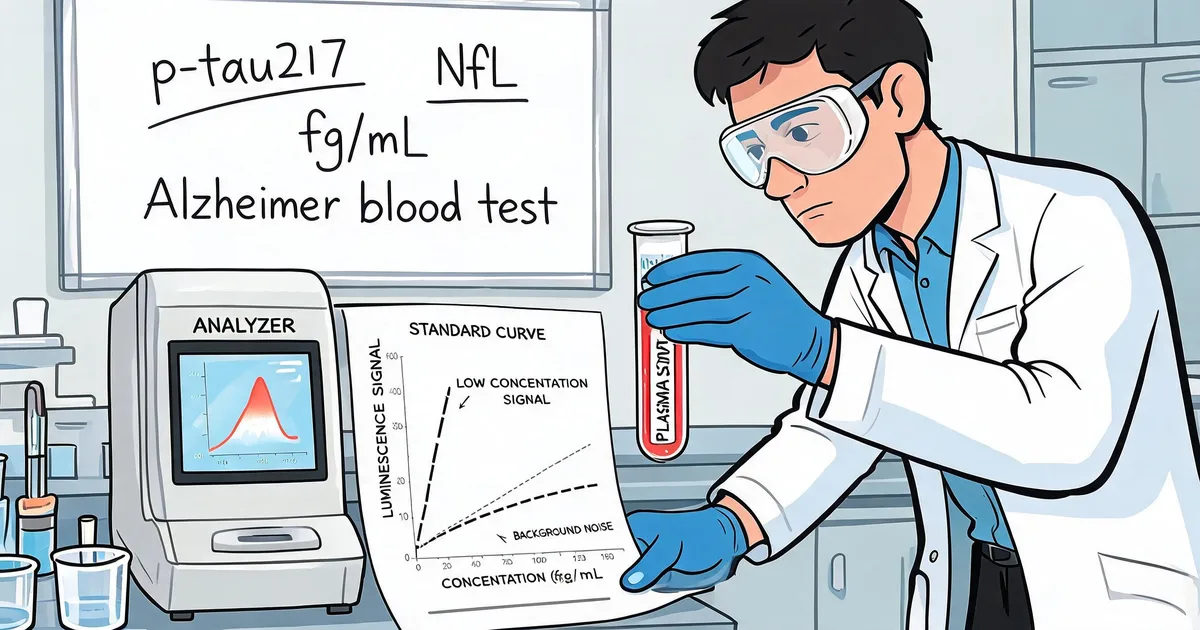
This article defines p-tau217 and NfL, explains why the registration wave is happening now, and drills into the reason these assays are hard to build: they require measuring a target present at femtogram-to-picogram levels in a plasma matrix full of interfering proteins. That analytical problem — separating a tiny specific signal from background noise — is where reagent quality decides whether an assay clears its registration panel.
1. What Are p-tau217 and NfL? Blood Biomarkers of Alzheimer's and Neurodegeneration
p-tau217 is the tau protein phosphorylated at the threonine-217 residue. When Alzheimer's disease pathology begins — amyloid-beta plaques and neurofibrillary tau tangles forming years before symptoms — phosphorylated tau fragments leak into cerebrospinal fluid and, at far lower concentrations, into blood. Of all the phospho-tau species, p-tau217 shows the largest separation between people with and without amyloid pathology, which is why it has become the reference blood analyte for Alzheimer's-specific disease.
NfL (neurofilament light chain) is a structural protein of the axonal cytoskeleton. It is released into the interstitial fluid and blood whenever axons are injured, regardless of cause. That makes NfL a highly sensitive but disease-nonspecific marker: it is elevated in Alzheimer's, but also in multiple sclerosis, ALS, frontotemporal dementia, traumatic brain injury, and normal aging. Used together, the two markers answer different questions:
- p-tau217 — "Is this cognitive decline caused by Alzheimer's pathology?"
- NfL — "How much neuronal damage is occurring, and is it progressing?"
Both circulate far below the reach of a conventional colorimetric ELISA, so commercial assays are built on chemiluminescence and single-molecule detection platforms. Sekbio's Tau protein antibody for Alzheimer's CLIA and NfL antibody pair for neurofilament light chain IVD are developed specifically for this sensitivity class.
2. Why 2026 Is the Breakout Year for Blood-Based Alzheimer's Screening
Several forces converged to make peripheral-blood Alzheimer's testing the most predictable growth pocket in IVD right now:
- Regulatory precedent. In May 2025 the U.S. FDA cleared the first in vitro diagnostic blood test for Alzheimer's pathology, based on a plasma p-tau217 / β-amyloid 1-42 ratio. Clearance of a defined analyte and cutoff gives every follow-on developer a validated target product profile.
- Disease-modifying therapy. Anti-amyloid antibody drugs are now approved in several markets. They require confirmed amyloid status before treatment, creating a large, recurring demand for a low-cost triage test that reduces PET and CSF referrals.
- Domestic registration momentum. Multiple Chinese diagnostic manufacturers have advanced p-tau217, NfL, and related panels (GFAP, Aβ42/40) into registration testing at NMPA-recognized institutes during 2026, targeting chemiluminescence analyzers already installed across hospital laboratories.
- Reimbursable clinical pathway. Unlike many novel biomarkers, blood-based Alzheimer's testing slots into an existing memory-clinic and neurology workflow, shortening the path from clearance to routine use.
Why registration testing is the bottleneck
Registration testing evaluates an assay's analytical performance — limit of detection, precision, linearity, interference, and cross-reactivity — against a fixed protocol at an accredited institute. For an ultra-sensitive marker like p-tau217, the interference and precision sections are where borderline reagents fail, because matrix effects that are invisible at nanogram levels dominate the signal at picogram levels.
3. From Lumbar Puncture and PET to a Blood Draw: The Clinical Case
The clinical argument for a blood test is straightforward once the analytical performance is in place. A single venous draw is orders of magnitude cheaper than amyloid-PET, carries none of the procedural risk of a lumbar puncture, and can be run on chemiluminescence analyzers that most hospital labs already operate.
In validation cohorts, plasma p-tau217 has classified amyloid status with diagnostic accuracy approaching that of CSF, and crucially it holds that performance in primary-care populations, not only in specialist memory clinics. The intended clinical use follows a tiered model:
- Rule-out / rule-in triage. A blood p-tau217 result places a symptomatic patient into a low, intermediate, or high likelihood of Alzheimer's pathology.
- Confirmatory testing only where needed. Intermediate results proceed to PET or CSF; clear results avoid it, cutting confirmatory testing volume substantially.
- NfL as a companion. An NfL result flags the overall intensity of neurodegeneration and helps identify non-Alzheimer's causes when p-tau217 is low but symptoms are marked.
The gap between "promising biomarker" and "registered product" is almost entirely an assay-engineering gap: the biology is settled, the reagent performance is not.
4. The Analytical Challenge: Measuring Femtomolar Analytes in Plasma
Plasma p-tau217 circulates in roughly the 0.1–5 pg/mL range, and the difference between a normal and an abnormal result can be a factor of two to three. NfL sits somewhat higher but still demands sub-picogram resolution at the low end. A sandwich immunoassay operating this close to zero faces two linked problems: generating enough specific signal, and suppressing everything that is not specific signal.
Where the background noise comes from
- Nonspecific adsorption of the labeled detection antibody to the solid phase, which sets the assay floor.
- Heterophilic and anti-animal antibodies in patient plasma that bridge capture and detection reagents, producing false positive signal.
- Rheumatoid factor and high-abundance matrix proteins that create sample-dependent bias.
- Over-conjugated labels — too many acridinium ester or enzyme molecules per antibody raises background faster than signal.
| Assay parameter | Typical requirement (p-tau217 / NfL) | Reagent factor that drives it |
|---|---|---|
| Limit of detection | fg/mL to low pg/mL | Detection antibody affinity and low nonspecific binding |
| Functional sensitivity (CV ≤ 20%) | Near the medical decision point (~0.3–0.5 pg/mL p-tau217) | Pair stability and lot-to-lot consistency |
| Interference recovery | 90–110% with heterophilic-positive samples | Blocking reagent system and antibody isotype |
| Phospho-site specificity | No signal from non-phosphorylated or pT181/pT231 tau | Capture or detection antibody raised against the pT217 epitope |
| Dynamic range | No saturation in high-NfL neurological patients | Antibody kinetics and calibrator design |
5. Antibody Pair Selection for Ultra-Sensitive p-tau217 and NfL Assays
At femtomolar working concentrations, the antibody pair is not one component among many — it sets the ceiling on every performance metric in the table above. Two selection problems dominate.
Epitope strategy for p-tau217
A p-tau217 assay needs one antibody that recognizes the phosphorylated threonine-217 epitope with strict specificity — no binding to non-phosphorylated tau or to the neighboring pT181 and pT231 sites — paired with a second antibody against a distant, constant region of the tau fragment. If both antibodies target closely spaced epitopes, they compete and the pair loses sensitivity. Recombinant monoclonal antibodies are strongly preferred here because the phospho-specific clone must be reproducible lot after lot; a hybridoma that drifts destroys assay calibration.
Blocking heterophilic and matrix interference
Because false signal from bridging antibodies scales with assay sensitivity, an ultra-sensitive assay needs an interference-control strategy designed in from the start: recombinant antibodies with defined isotype and low intrinsic stickiness, non-immune IgG of the label host species in the buffer, and a dedicated polymeric blocker. Sekbio's heterophilic blocking reagent for immunoassay interference is formulated for exactly this class of low-abundance sandwich assay.
"In a femtomolar assay, you do not win sensitivity by amplifying signal — you win it by removing everything that is not signal."
The practical implication for a developer heading into registration testing: lock the antibody pair and blocking system early, characterize nonspecific binding on the target chemiluminescence platform, and validate interference recovery with a real heterophilic-positive sample panel before the formal protocol begins.
6. How Sekbio Supports Neurodegeneration Assay Development
Sekbio develops recombinant monoclonal antibodies and matched capture-detection pairs for neurodegeneration and neuroinflammation markers, produced under an ISO 13485 quality system for OEM diagnostic supply. For blood-based Alzheimer's and neurodegeneration programs, the relevant capabilities are:
- Phospho-specific and total tau antibodies — clones screened for phospho-site specificity and epitope non-overlap, suitable for CLIA and single-molecule platforms. See the Tau protein antibody for neurodegeneration IVD.
- NfL antibody pairs — matched pairs for neurofilament light chain quantification with defined dynamic range. See the NfL neurofilament light chain antibody pair.
- Interference control reagents — the heterophilic blocking reagent for suppressing bridging-antibody false signal in low-abundance sandwich assays.
- Recombinant antibody engineering — affinity maturation, isotype conversion, and format work on the Sekbio antibody engineering platform when an off-the-shelf clone does not meet the sensitivity or specificity target.
Developers can request pair data, phospho-site characterization, and platform compatibility details, or discuss a custom program, through the Sekbio recombinant antibody catalog and technical team.
7. Frequently Asked Questions — Blood Biomarkers for Alzheimer's
What are p-tau217 and NfL?
p-tau217 is tau protein phosphorylated at threonine 217, a fragment released into blood when Alzheimer's disease pathology begins forming amyloid plaques and tau tangles. Plasma p-tau217 rises early and tracks closely with amyloid-PET and CSF status, which makes it the leading blood biomarker for Alzheimer's-specific pathology. NfL (neurofilament light chain) is a structural axon protein released whenever neurons are damaged; it is elevated across many neurological conditions, so it is a sensitive but disease-nonspecific marker of neurodegeneration and is often measured alongside p-tau217.
Why is p-tau217 considered the best blood biomarker for Alzheimer's disease?
Among the phosphorylated tau species measurable in blood, p-tau217 shows the largest fold-change between amyloid-positive and amyloid-negative individuals and the strongest correlation with both amyloid-PET and CSF reference methods. It becomes abnormal early in the disease course, before symptoms, and its performance holds up in primary-care populations rather than only in specialist memory clinics. Head-to-head studies have repeatedly ranked plasma p-tau217 ahead of p-tau181, p-tau231, GFAP, and the amyloid-beta 42/40 ratio for identifying Alzheimer's pathology.
How sensitive does a p-tau217 or NfL immunoassay need to be?
Plasma p-tau217 circulates in the low picogram-per-milliliter to sub-picogram-per-milliliter range, and the diagnostically important difference between normal and abnormal can be a factor of two or three. A viable assay generally needs a limit of detection in the femtogram-per-milliliter to low picogram-per-milliliter window, a functional sensitivity with CV at or below 20 percent near the medical decision point, and a dynamic range that does not saturate in high-NfL neurological patients. This is why acridinium-ester and enzymatic chemiluminescence platforms, not colorimetric ELISA, are the practical basis for these tests.
What is the difference between p-tau217 and NfL as biomarkers?
p-tau217 is disease-specific: it reports Alzheimer's amyloid and tau pathology and is used to rule in or rule out Alzheimer's as the cause of cognitive symptoms. NfL is disease-agnostic: it rises with axonal injury from any cause, including multiple sclerosis, ALS, traumatic brain injury, stroke, and normal aging, so it is used to gauge the presence and intensity of neurodegeneration and to monitor change over time rather than to make an etiological diagnosis. Many assay panels run both so a clinician can separate "is there neuronal damage" from "is it Alzheimer's".
How do you reduce background noise in an ultra-sensitive chemiluminescence assay?
Background in a femtomolar sandwich assay comes mainly from nonspecific binding of the labeled detection antibody to the solid phase and from matrix components such as heterophilic antibodies, rheumatoid factor, and anti-animal antibodies bridging capture and detection reagents. Practical controls include using recombinant monoclonal antibodies with low intrinsic stickiness and defined isotype, optimizing blocker and surfactant systems, adding polymeric heterophilic blocking reagents and non-immune IgG of the label host species, minimizing label-to-antibody ratio to avoid over-conjugation, and selecting a capture-detection pair whose epitopes do not co-recognize a common truncated fragment.
Does Sekbio supply antibody pairs for p-tau217 and NfL assay development?
Yes. Sekbio develops recombinant monoclonal antibodies and matched capture-detection pairs for neurodegeneration markers including total tau, phosphorylated tau, and neurofilament light chain, together with heterophilic blocking reagents for matrix interference control. Pairs are screened for affinity, epitope non-overlap, and low nonspecific binding on chemiluminescence platforms. Assay developers can discuss phospho-site specificity, buffer compatibility, and OEM supply on the Sekbio antibody engineering platform.
8. Summary
Blood-based neurodegeneration testing has moved from research to registration:
- p-tau217 is the Alzheimer's-specific blood marker — it tracks amyloid and tau pathology and now has regulatory precedent as a cleared IVD analyte.
- NfL is the disease-agnostic companion — it quantifies overall axonal damage and helps flag non-Alzheimer's causes of cognitive decline.
- 2026 is a registration-testing wave — multiple Chinese diagnostic firms are pushing p-tau217 and NfL chemiluminescence assays through Chinese regulatory evaluation, driven by anti-amyloid therapy demand and an existing clinical pathway.
- The hard part is analytical, not clinical — measuring a femtogram-to-picogram analyte in plasma means winning the fight between specific signal and background noise.
- Reagent quality decides registration outcomes — antibody pair affinity, phospho-site specificity, low nonspecific binding, and a designed-in heterophilic blocking strategy are what pass the interference and precision sections of the protocol.
If your program is building a p-tau217 or NfL blood assay, the earliest high-leverage decision is the antibody pair and blocking system. Sekbio supports that step with recombinant tau and NfL antibody pairs and antibody engineering for sensitivity-critical neurodegeneration assays.