Only 2%–5% of the cortisol in a blood sample is free, and the free fraction is the part that is biologically active. The rest is bound to plasma proteins. An antibody for a cortisol immunoassay has to work on a modest signal in serum, and on far less in saliva or hair.
Cortisol is the most abundant glucocorticoid secreted by the adrenal cortex. It helps regulate energy metabolism, electrolyte balance, blood pressure, immune responses and the stress response. Measuring it in body fluids is how laboratories diagnose Cushing's syndrome (too much cortisol) and Addison's disease (too little), and how they follow treatment.
Sekbio supplies two mouse monoclonal anti-cortisol antibodies, McAb-56 and McAb-45, plus a Cor-BSA conjugate to pair with them. The numbers below come from the Sekbio cortisol product sheet: detection limits, steroid cross-reactivity and a comparison with a commercial analyzer.
Why cortisol needs a competitive assay
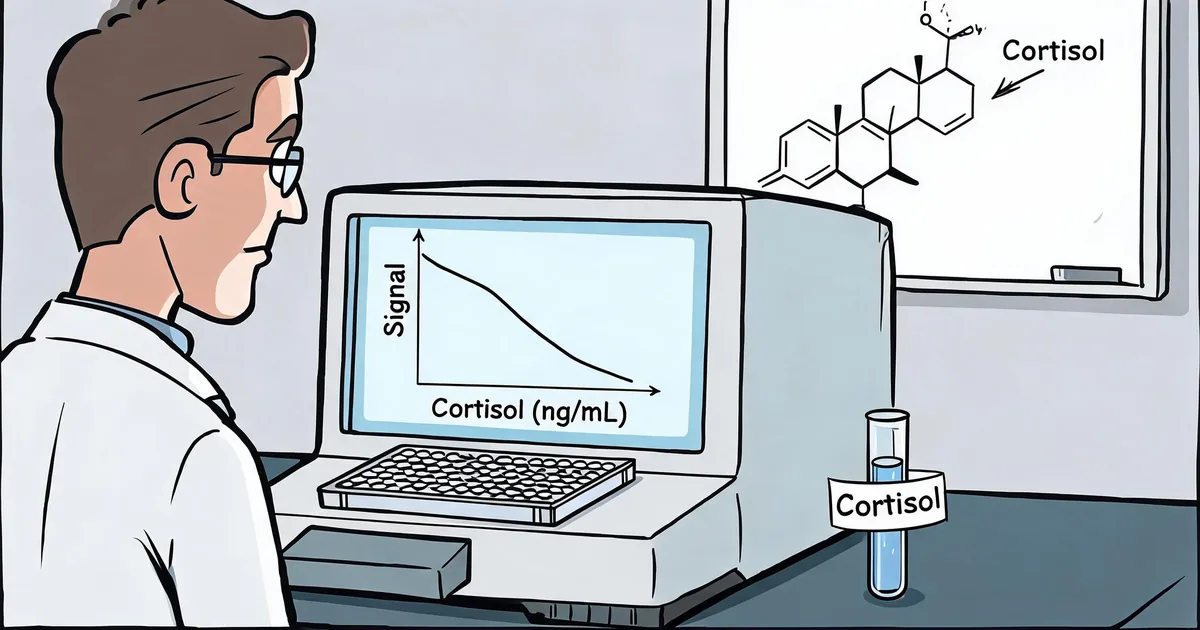
Cortisol is a steroid of about 362 Da. Two IgG antibodies cannot sit on a molecule that small at the same time, so the sandwich format used for proteins is off the table. Cortisol assays are competitive: cortisol from the sample competes with a fixed amount of labeled or immobilized cortisol for a limited number of antibody binding sites.
The signal runs backwards. More cortisol in the sample means less signal. Figure 2 below shows exactly that shape.
Three things follow for anyone building a kit:
- One antibody does all the work. There is no second antibody to add specificity, so cross-reactivity is set by a single clone.
- Sensitivity tracks affinity. A clone that binds cortisol tightly can be used at a lower concentration, which pushes the detection limit down.
- The conjugate matters. A protein conjugate such as Cor-BSA is the usual way to present a small hapten on a solid phase. Sekbio lists Cor-BSA as the paired conjugate for its cortisol antibodies.
What a cortisol result is used for
The product sheet names the clinical questions a cortisol result answers:
- Cushing's syndrome (CS): diagnosing excess cortisol, and following the response to treatment with the dexamethasone suppression test.
- Addison's disease: diagnosing adrenal steroid insufficiency, and monitoring hormone replacement.
- Rare adrenal enzyme deficiencies and the period after prolonged stress, where cortisol is low.
The other direction is messier. Serum cortisol also rises with stress responses, psychiatric disorders, obesity, diabetes, alcoholism and pregnancy, and those physiological elevations can interfere with a Cushing's diagnosis. An assay cannot fix that. It can avoid adding errors of its own.
The sample type changes with the question. The Endocrine Society's Cushing's syndrome guideline (Nieman et al., J Clin Endocrinol Metab 2008) endorses urine free cortisol, late-night salivary cortisol and dexamethasone suppression testing as first-line tests. The primary adrenal insufficiency guideline (Bornstein et al., 2016) names the short corticotropin test as the reference test and morning ACTH and cortisol as an initial screen.
| Clinical question | Sample types | What it asks of the antibody |
|---|---|---|
| Cushing's syndrome screening | Late-night saliva, 24-hour urine, serum after dexamethasone | Detect low free-cortisol levels in saliva and urine |
| Adrenal insufficiency | Morning serum or plasma, before and after corticotropin | Quantify across a wide range |
| Long-term stress exposure | Hair | Detect the lowest concentrations of the three |
Saliva, free cortisol and hair: where the detection limit counts
Total serum cortisol is the easy case. Free cortisol, which the sheet puts at 2%–5% of the total, is harder. Hair holds less again.
According to the sheet, immunoassays built on McAb-56 detect cortisol below 30 pg/mL. Besides blood and urine, they can also be used for the much lower levels of free cortisol and hair cortisol.
Hair is the extreme case because it records accumulated exposure, not one moment. A 2017 meta-analysis of 66 studies (Stalder et al.) found hair cortisol 22% higher in people under stress, and 43% higher when the stress was still ongoing at the time of sampling. Concentrations in hair extracts are far below serum levels, so sensitivity is not optional.
A DELFIA Detection Limit Does Not Transfer to Other Platforms
The "below 30 pg/mL" figure was measured in Cor-DELFIA, a time-resolved fluorescence format. A chemiluminescence, ELISA or lateral flow build will give a different limit with the same antibody. Re-measure it on your platform and in your sample matrix before you set a claim.
McAb-56 and McAb-45 side by side
Both clones are mouse monoclonal antibodies, and the sheet reports both in a Cor-DELFIA format.
| Parameter (Cor-DELFIA) | Anti-Cor McAb-56 | Anti-Cor McAb-45 |
|---|---|---|
| Limit of detection | < 30 pg/mL | < 100 pg/mL |
| Cross-reactivity: corticosterone | < 1% | < 0.3% |
| Cross-reactivity: cortisone | < 2.5% | < 6% |
| Cross-reactivity: prednisolone | < 79% | < 10% |
| Other similar steroids at their highest physiological concentrations | No effect on cortisol measurement | No effect on cortisol measurement |
McAb-56 has the lower detection limit. McAb-45 is tighter on prednisolone, with a ceiling of 10% against 79%.
The gap on the other two steroids is smaller and runs both ways. McAb-45 is tighter for corticosterone (below 0.3% against below 1%), while McAb-56 is tighter for cortisone (below 2.5% against below 6%).
Read "<" as an Upper Bound
Every figure in this table is a ceiling reported on the sheet, not a measured midpoint. A clone listed as "< 79%" for prednisolone may cross-react less than that, but you should plan for the ceiling until you test it yourself.
Prednisolone is the one that bites in practice. It is a synthetic glucocorticoid that patients take for inflammatory disease, and a 2014 study of a widely used cortisol immunoassay (Krasowski et al.) found that prednisolone and 6-methylprednisolone cross-react strongly enough to matter in patients taking them. A result that reads high because of the drug can look like cortisol excess.
Our reading of the sheet: start with McAb-56 for saliva, free cortisol and hair work, where the detection limit decides the outcome, and with McAb-45 for serum assays aimed at patients on prednisolone. That is a reading of the numbers, not a tested recommendation. Run both clones against your own interference panel.
What the two plots on the sheet show
Calibration curve: signal falls as cortisol rises
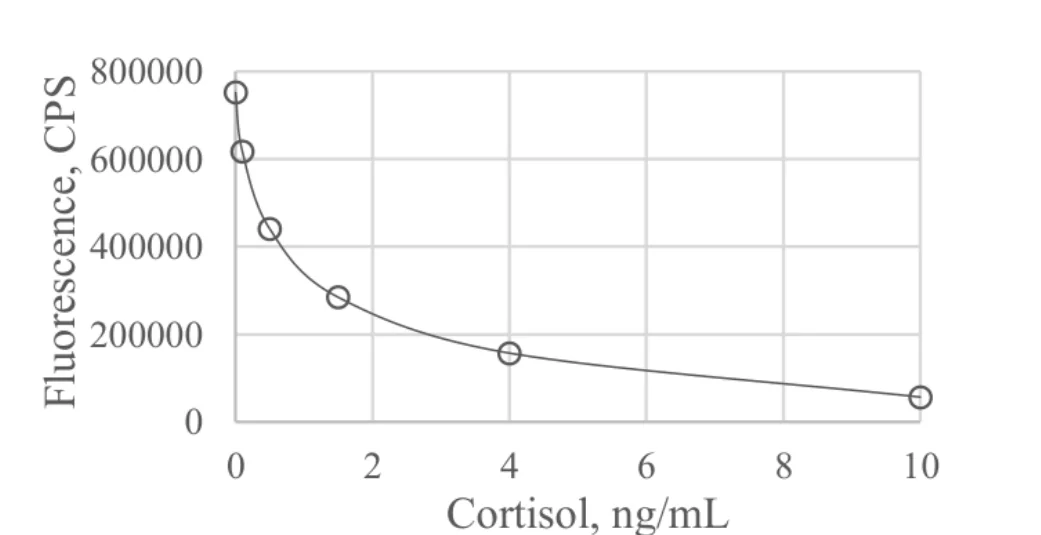
Figure 2 is the typical Cor-DELFIA calibration curve for McAb-56, run from 0 to 10 ng/mL with six calibrator points.
Values read from the plot are approximate:
- Signal starts near 750,000 CPS with no cortisol.
- It falls to about 285,000 CPS by 1.5 ng/mL, roughly two thirds of the whole drop.
- At 10 ng/mL it is about 55,000 CPS, and the curve is nearly flat.
The curve is steep at the low end and flat at the top. Low cortisol levels are well resolved. Above about 4 ng/mL, a small signal error becomes a large concentration error.
Agreement with Elecsys Cortisol II
Figure 3 compares Cor-DELFIA built on McAb-56 with the Roche Elecsys Cortisol II assay on 24 samples.
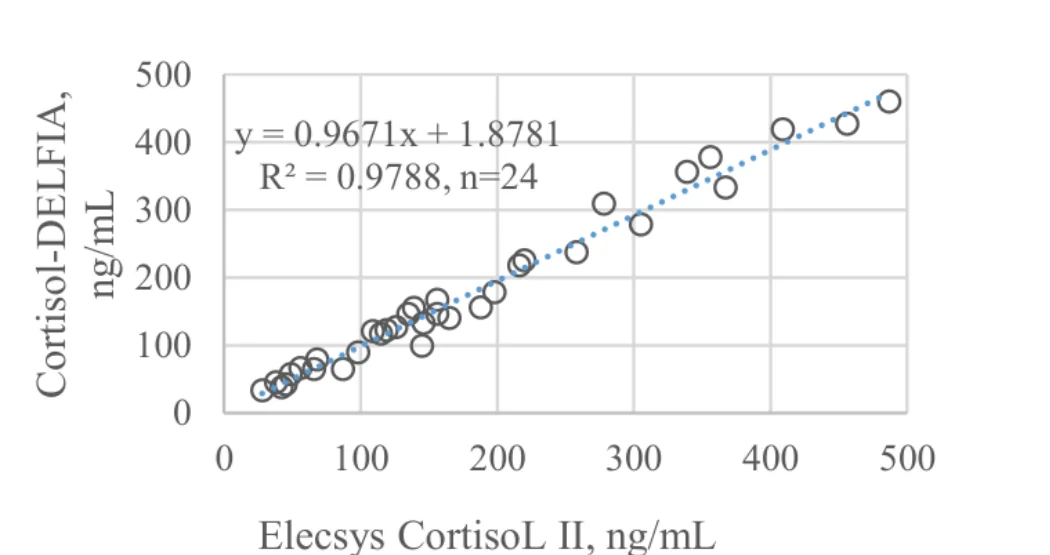
- Regression: y = 0.9671x + 1.8781, with Cor-DELFIA on the y-axis and Elecsys on the x-axis, both in ng/mL.
- Fit: R² = 0.9788, n = 24.
- Range: roughly 30 to 490 ng/mL on the Elecsys axis, read from the plot.
A slope of 0.9671 puts Cor-DELFIA about 3% below Elecsys in proportion. The intercept of 1.8781 ng/mL is small against a range that reaches 490 ng/mL. For one immunoassay set against another, that is close agreement.
Agreement is not accuracy. Both methods are immunoassays and both can be pushed by cross-reacting steroids, so a good fit shows that they rank samples alike. When accuracy is the question, isotope-dilution LC-MS/MS is the usual reference.
What the product sheet does not tell you
It is a two-page sheet, so it leaves things out. Ask for these before you plan around it:
- Matrix validation. The sheet says free and hair cortisol can be measured, but it shows no saliva, urine or hair data, and no recovery or precision in any of those matrices.
- Precision and lot consistency. No CV, no spike recovery and no lot-to-lot figures.
- The samples behind Figure 3. A set of 24 is small, and the sample type, the regression method and the dilution scheme are not stated. Samples reaching about 490 ng/mL sit well above the 0 to 10 ng/mL calibration range, so ask how they were brought into it.
- McAb-45 plots. The sheet gives McAb-45 a detection limit and cross-reactivity values but no calibration curve and no method comparison.
- Other platforms. Everything here was measured on DELFIA.
What Sekbio can supply
Three items are listed for cortisol immunoassay development:
- Anti-Cor McAb-56, mouse monoclonal, with the lower detection limit in Cor-DELFIA (below 30 pg/mL).
- Anti-Cor McAb-45, mouse monoclonal, with the tighter prednisolone cross-reactivity (below 10%).
- Cor-BSA, the protein conjugate paired with the cortisol antibodies.
Cortisol listings sit on the Sekbio cortisol antibody page. The same competitive logic is worked through for progesterone antibody pair design for competitive CLIA and LFA, and our VB12-BSA conjugate coating optimization post is a worked example of tuning a hapten-BSA conjugate for a competitive assay. For neighboring steroids, see the progesterone antibody and testosterone antibody pages, or browse the full IVD antibody and antigen catalog.
Frequently Asked Questions
What is cortisol and why is it measured?
Cortisol is the most abundant glucocorticoid made by the adrenal cortex. It is measured to diagnose Cushing's syndrome (too much cortisol) and Addison's disease (too little), and to monitor treatment, for example with the dexamethasone suppression test or hormone replacement. Stress, psychiatric disorders, obesity, diabetes, alcoholism and pregnancy can also raise it.
Why is cortisol measured with a competitive immunoassay instead of a sandwich?
Cortisol is a steroid of about 362 Da, too small for two antibodies to bind it at the same time. In a competitive assay, cortisol in the sample competes with a fixed amount of labeled or immobilized cortisol for a limited number of antibody sites, so the signal falls as cortisol rises. That also makes the single antibody responsible for the assay's specificity.
What detection limit do Sekbio's anti-cortisol antibodies reach?
In a Cor-DELFIA format, the limit of detection is below 30 pg/mL for McAb-56 and below 100 pg/mL for McAb-45. These figures come from the Sekbio cortisol product sheet and were measured on a time-resolved fluorescence platform. Limits change with platform and sample matrix, so re-measure on your own system.
Which steroids cross-react with McAb-56 and McAb-45?
For McAb-56, cross-reactivity is below 1% for corticosterone, below 2.5% for cortisone and below 79% for prednisolone. For McAb-45 it is below 0.3%, below 6% and below 10%. Other structurally similar steroid hormones at their highest physiological concentrations did not affect cortisol measurement with either clone.
Does prednisolone interfere with cortisol immunoassays?
It can. Prednisolone is structurally close to cortisol, and a 2014 study of a widely used cortisol immunoassay found that prednisolone and 6-methylprednisolone cross-react strongly enough to matter in treated patients. The Sekbio sheet gives prednisolone cross-reactivity below 79% for McAb-56 and below 10% for McAb-45, so McAb-45 is the safer first choice where prednisolone use is common.
Can these antibodies be used for saliva, urine or hair cortisol?
The sheet says McAb-56 immunoassays can measure cortisol in blood and urine, and can also be used for the much lower levels of free cortisol and hair cortisol. It does not include recovery or precision data for each matrix, so verify those in your own protocol before you rely on a result.
How well does Cor-DELFIA with McAb-56 agree with Elecsys Cortisol II?
On 24 samples, the regression was y = 0.9671x + 1.8781 with R² = 0.9788, with Cor-DELFIA on the y-axis and Elecsys Cortisol II on the x-axis. That is close agreement between two immunoassays. The sheet does not state the sample type, so treat it as a method-comparison snapshot rather than a full validation.
Can Sekbio supply cortisol antibodies and conjugate for kit development?
Yes. Anti-Cor McAb-56, Anti-Cor McAb-45 and Cor-BSA are listed for cortisol immunoassay development. Tell us your platform, sample type and target range and we can suggest a clone and plan a feasibility run. See our immunoassay development platforms or request a quote.
Which Clone to Request First
McAb-56 is the clone to try when the detection limit decides the project: saliva, free cortisol, hair. McAb-45 is the clone to try when your sample population includes patients taking prednisolone. Both come with the same gaps, because the sheet carries no matrix, precision or recovery data.
The practical next step is a side-by-side run on your own interference panel. Send us your platform, sample type and target range, and we can help plan it. Start from the Sekbio products page or contact the team.