Antibody Raw Material · OEM Ready

Pepsinogen I/II Antibody Panel

IDA201/IDA202 Capture & Detection Antibody Pair for the ABC Method Gastric Cancer Risk Screening CLIA

CLIA LOD <1 ng/mL 0–200 ng/mL Linear ABC Method Benchmarked vs Abbott OEM Supply
<1
ng/mL Detection Limit
0–200
ng/mL Validated Linear Range
≤3.11%
Inter-Replicate CV Across Range
0.913
R² vs. Abbott Reference Method

What is Pepsinogen I/II? — A Definition for IVD Developers

Pepsinogen I (PGI) and Pepsinogen II (PGII) are inactive zymogen precursors of the digestive protease pepsin, secreted into gastric juice and, in small quantities, into the bloodstream. The two isoforms come from different cellular sources within the stomach: PGI is secreted exclusively by chief cells and mucous neck cells located in the fundic (acid-secreting) mucosa of the gastric fundus and body, while PGII is secreted more broadly — by fundic mucosa as well as the pyloric antrum and proximal duodenum. This difference in tissue origin is the biochemical basis for using the two isoforms together as a non-invasive marker of gastric mucosal health.

As chronic atrophic gastritis develops — most commonly driven by long-standing Helicobacter pylori infection — the specialized fundic mucosa that produces PGI is progressively lost, while PGII-producing tissue is comparatively preserved. The result is a disproportionate fall in serum PGI relative to PGII, producing a falling PGI/PGII ratio that tracks the severity of gastric mucosal atrophy. Because atrophic gastritis is an established precursor lesion for intestinal-type gastric adenocarcinoma, serum PGI level combined with the PGI/PGII ratio is used worldwide, and particularly in Japan and Korea, as the serological "pepsinogen method" for non-invasive gastric cancer risk stratification (Miki K, Gastric Cancer 2006).

For IVD developers, Sekbio's flagship, fully validated product is the Pepsinogen I capture/detection antibody pair — IDA201 (capture) and IDA202 (detection) — purified from BALB/c mouse ascites by affinity chromatography to 95% purity by SDS-PAGE. The pair was validated with a 0–200 ng/mL linear range and <1 ng/mL detection limit, benchmarked against an Abbott reference platform. A Pepsinogen II antibody for the complete PGI/PGII ratio assay is also available on request, alongside our existing H. pylori antibody product for the serology half of the ABC method algorithm.

Gastric Mucosal Atrophy Marker ABC Method Screening ISO 13485 Manufacturer Ascites-Derived, Affinity Purified

Antibody Specifications (IDA201)

Product NameAnti-Human Pepsinogen I mAb (Capture)
Catalog No.IDA201
Host / IsotypeMouse IgG1
SourceBALB/c Mouse Ascites (Affinity Purified)
Purity95% (SDS-PAGE)
FormatLiquid (typ. 5.4 mg/mL)
Buffer15mM Phosphate + 0.15M NaCl, pH 7.2
Storage2–8°C (≤2 months) / −20°C (long term)
PlatformsCLIA

Pepsinogen I Antibody Pair — All SKUs

Matched capture and detection antibodies for a validated Pepsinogen I CLIA sandwich immunoassay.

Catalog No.Product NameRolePurityConcentrationStorage
IDA201Anti-Human Pepsinogen I mAbCapture95% SDS-PAGE~5.4 mg/mL2–8°C / −20°C
IDA202Anti-Human Pepsinogen I mAbDetection95% SDS-PAGE~6.4 mg/mL2–8°C / −20°C

Recommended pair: IDA201 (capture) + IDA202 (detection). Both supplied in 15mM phosphate buffer + 0.15M NaCl + 0.09% sodium azide, pH 7.2. A Pepsinogen II antibody for the complete PGI/PGII ratio panel is available on request — contact info@sekbio.com for current PGII datasheets and MOQ.

Analytical Validation Data

Six-point precision study and dilution linearity data for the IDA201/IDA202 Pepsinogen I sandwich assay (RLU-based CLIA readout).

1 Precision Across the Calibration Range

Six calibrators spanning 0.42–218.51 ng/mL were tested in triplicate. Inter-replicate CV remained at or below 3.11% at every non-blank concentration, and signal-to-noise (S/N) exceeded 40 even at the lowest non-zero standard.

Concentration (ng/mL)Mean RLUCV%S/N
218.5101,991,0270.68%7127.78
109.691,170,5192.19%4190.40
23.26331,9023.11%1188.19
4.2680,5963.06%288.53
0.4211,7251.51%41.97
0.00 (blank)2798.92%1.00

Test protocol: 5 µL sample + 50 µL Ra + 50 µL Rd, incubate 5 min, wash 200 µL, then add 100 µL Substrate A + 100 µL Substrate B (chemiluminescent two-step sandwich format).

2 Dilution Linearity

A high-concentration sample (~220 ng/mL) was serially diluted and re-assayed; recovered concentration was compared against the expected value at each dilution ratio. Recovery remained ≥89% down to approximately 88 ng/mL, with expected reduced recovery at the lowest dilution steps approaching the assay's low end.

Dilution RatioExpected (ng/mL)Measured Avg (ng/mL)Recovery
1.00219.68219.68100.0%
0.90197.71189.0695.6%
0.80175.74173.5098.7%
0.70153.78143.3993.2%
0.60131.81123.6193.8%
0.50109.84105.3395.9%
0.4087.8778.7889.7%
0.3065.9051.4078.0%
0.2043.9434.3378.1%
0.1021.9715.1268.8%

Recovery is calculated as measured average ÷ expected concentration. Full dilution and precision datasets available in the technical datasheet on request.

3 Method Comparison vs. Abbott

Patient samples were tested in parallel on the IDA201/IDA202 CLIA sandwich assay and on an Abbott reference platform. Regression analysis across the paired results gives y=1.1019x−1.4939 with R²=0.9129, confirming good agreement with the reference method across the tested range (approximately 9–170 ng/mL).
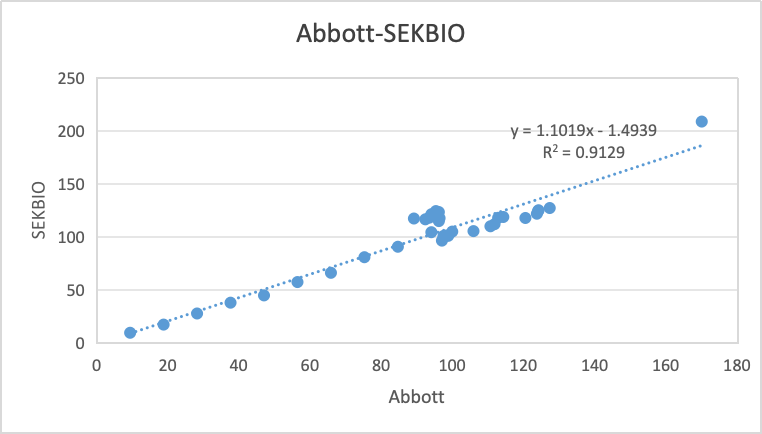
Method comparison scatter plot of Sekbio Pepsinogen I assay versus Abbott, showing linear regression y = 1.1019x - 1.4939 and R-squared 0.9129

Sekbio Pepsinogen I (ng/mL) vs. Abbott (ng/mL). y=1.1019x−1.4939, R²=0.9129.

Performance Advantages for Gastric Cancer Screening Panel Development

A validated, benchmarked antibody pair for building the ABC method's pepsinogen half.

Benchmarked Against Abbott

IDA201/IDA202 were validated head-to-head against an Abbott reference platform, giving developers a documented performance baseline for regulatory submissions and competitive positioning.

<1 ng/mL Detection Limit

A validated detection limit below 1 ng/mL and 0–200 ng/mL linear range comfortably cover the clinically important PGI ≤70 ng/mL atrophy cut-off used in the ABC method risk classification.

Documented Precision & Linearity

Six-point precision data (CV ≤3.11%) and multi-point dilution linearity give IVD developers real analytical validation data to reference during kit design and regulatory documentation, not just headline specifications.

Built for ABC Method Combination Panels

Designed to pair with a Pepsinogen II antibody and Sekbio's H. pylori antibody product, enabling a complete raw material set for the ABC method gastric cancer risk classification (Groups A–D).

High Purity, Ascites-Derived

Both IDA201 and IDA202 are affinity-purified from BALB/c mouse ascites to 95% purity by SDS-PAGE, supporting the low-end analytical precision needed near the clinical cut-off.

OEM-Ready Global Supply

ISO 13485-compliant manufacturing in Shenzhen, China, with full Certificate of Analysis documentation and MOQ 1 mg per clone for R&D, scaling to production-volume CLIA kit manufacturing.

Pepsinogen Applications in IVD Development

Pepsinogen I antibody pair validated for gastric mucosal atrophy assessment and non-invasive gastric cancer risk screening.

ABC Method Gastric Cancer Risk Screening

Combining PGI (and PGI/PGII ratio) with H. pylori serology classifies patients into four risk groups (A–D), with Group D (H. pylori-negative, PG-positive, reflecting extensive atrophy that has suppressed detectable H. pylori titers) carrying the highest reported gastric cancer risk. See our H. pylori Antibody product for the companion serology reagent.

Chronic Atrophic Gastritis Assessment

A falling PGI/PGII ratio tracks the progression of chronic atrophic gastritis as fundic mucosa is replaced by intestinal or antral-type epithelium, giving clinicians a non-invasive, blood-based alternative to routine endoscopic biopsy for monitoring mucosal status over time.

Population Gastric Cancer Screening Programs

The pepsinogen method's non-invasive, blood-based format — and IDA201/IDA202's validated 0–200 ng/mL linear range — make it suitable for large-scale population screening in high-incidence regions, a model established in Japanese and Korean national gastric cancer screening programs.

OEM CLIA Kit Manufacturing & Regulatory Support

Sekbio's ISO 13485-certified manufacturing, full CoA documentation, and validated precision/linearity data support OEM CLIA kit manufacturers preparing CE IVD and other regulatory submissions. Visit our Products page for the full oncology raw material portfolio, or contact us to discuss OEM supply.

Frequently Asked Questions — Pepsinogen I/II Antibody Panel

Technical and commercial questions from IVD R&D engineers and procurement teams.

What is Pepsinogen I and why is it used as a gastric cancer risk marker?

Pepsinogen I (PGI) is an inactive precursor of the digestive enzyme pepsin, secreted exclusively by chief and mucous neck cells in the acid-producing fundic mucosa of the stomach. As chronic atrophic gastritis (most often driven by Helicobacter pylori infection) progresses and this fundic mucosa is lost, serum PGI falls, and the PGI/PGII ratio falls disproportionately because Pepsinogen II is secreted more broadly and is comparatively preserved. Because atrophic gastritis is a recognized precursor lesion for intestinal-type gastric cancer, low serum PGI combined with a low PGI/PGII ratio is used worldwide as a non-invasive marker of gastric cancer risk (Miki K, Gastric Cancer 2006).

What catalog numbers are in Sekbio's Pepsinogen I antibody pair?

Sekbio supplies a matched Pepsinogen I sandwich pair: IDA201 (capture antibody) and IDA202 (detection antibody), both anti-human Pepsinogen I monoclonal antibodies (mouse IgG1) purified from BALB/c mouse ascites by affinity chromatography, purity 95% by SDS-PAGE. A Pepsinogen II antibody for the complete PGI/PGII ratio assay is also available; contact info@sekbio.com for current PGII specifications and datasheets.

What is the validated analytical performance of Sekbio's Pepsinogen I antibody pair?

The IDA201/IDA202 pair was validated with a linear range of 0–200 ng/mL, a detection limit below 1 ng/mL, and was benchmarked against an Abbott reference platform: paired patient samples (approximately 9–170 ng/mL) gave the regression y=1.1019x−1.4939 with R²=0.9129. A six-point precision study across the range (0.42 to 218.51 ng/mL) showed inter-replicate CV between 0.68% and 3.11% at all non-blank concentrations, with signal-to-noise ratio exceeding 40 even at the lowest non-zero standard (0.42 ng/mL), confirming reliable quantification near the low end of the clinically relevant range.

What is the clinical cut-off for the Pepsinogen ABC method gastric cancer screening?

The most widely cited criterion, established by Miki K (Gastric Cancer 2006), defines a "PG-positive" (atrophy-positive) result as serum PGI ≤70 ng/mL combined with a PGI/PGII ratio ≤3.0. In the ABC method used in Japanese gastric cancer screening, this PG result is combined with Helicobacter pylori serology to stratify patients into four risk groups (A: Hp-negative/PG-negative, B: Hp-positive/PG-negative, C: Hp-positive/PG-positive, D: Hp-negative/PG-positive), with Group D carrying the highest reported gastric cancer risk due to extensive mucosal atrophy that can also suppress detectable H. pylori antibody titers. Sekbio's validated 0–200 ng/mL linear range and <1 ng/mL detection limit comfortably cover this clinical decision point.

What are the MOQ and storage conditions for Pepsinogen I antibodies?

MOQ is 1 mg per clone for R&D evaluation, with OEM production quantities available on request. IDA201 and IDA202 are supplied in 15mM phosphate buffer with 0.15M NaCl and 0.09% sodium azide, pH 7.2, and should be stored at 2–8°C for up to 2 months or below −20°C for long-term storage, avoiding repeated freeze/thaw cycles. Certificate of Analysis with purity (SDS-PAGE) and concentration data accompanies every lot.

Can Sekbio supply Pepsinogen antibodies for OEM CLIA kit development and regulatory submissions?

Yes. Sekbio is an ISO 13485-certified manufacturer supplying the matched Pepsinogen I capture/detection antibody pair with full batch documentation, Certificate of Analysis, and validated precision/linearity data to support CE IVD and other regulatory submissions. Sekbio also supplies a companion H. pylori antibody product for combined ABC method assay development. Contact info@sekbio.com to request datasheets or OEM pricing. Visit our Platforms page for antibody development and custom antigen expression services.

Ready to Develop Your Pepsinogen Assay?

Request the full technical datasheet, precision/linearity data, or discuss OEM supply for your gastric cancer screening IVD development programme.

Guangming District, Shenzhen, China