Testosterone looks, on paper, like a straightforward analyte: one well-characterized steroid, a clear clinical use case, decades of assay history. In practice, it is one of the more deceptively difficult targets in the IVD antibody catalog. At just 288 Da, it is far too small to trigger an immune response on its own, structurally almost identical to several other circulating androgens the assay has to ignore, and — uniquely among the steroids we work with — split across three different binding states in serum that complicate what "measuring testosterone" even means.
This article walks through how Sekbio's antibody engineering team approaches a recombinant anti-testosterone antibody program — from hapten-carrier conjugate design through hybridoma screening and scale-up in CHO (Chinese Hamster Ovary) cells — as a complement to our established sheep-derived testosterone antibody catalog, and uses the resulting antibody's characterization data to illustrate what specificity looks like for one of the trickiest small-molecule diagnostic targets.
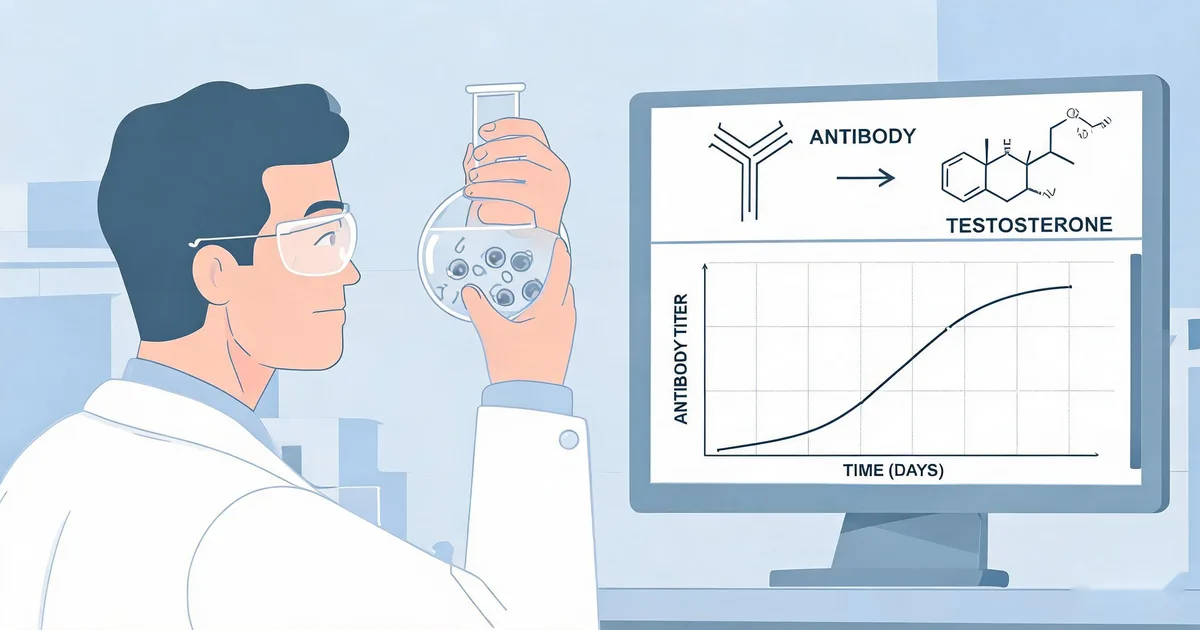
1. What Is Testosterone and Why Its Measurement Matters
Testosterone (C₁₉H₂₈O₂, 288 Da) is the primary androgenic steroid hormone, produced predominantly by the Leydig cells of the testes in men (roughly 5–7 mg/day) and in smaller quantities by the ovaries and adrenal glands in women. In circulation, testosterone exists in three binding states: about 2% free, 58% bound to SHBG (sex hormone-binding globulin), and 40% bound to albumin — a distribution that matters directly for how the hormone is measured, not just how it acts.
Clinically, quantitative testosterone testing supports several distinct decisions:
- Hypogonadism diagnosis — total testosterone below the reference interval (males 300–1,000 ng/dL; females 15–70 ng/dL), confirmed on a morning sample, is a core diagnostic criterion.
- Infertility evaluation and PCOS screening — elevated testosterone in women is a key diagnostic feature of polycystic ovary syndrome, while low testosterone in men is investigated as a cause of infertility.
- Congenital adrenal hyperplasia (CAH) management — testosterone and its precursors are tracked to titrate glucocorticoid replacement therapy.
- Gender-affirming hormone therapy monitoring and sports doping control — both require reliable, reproducible testosterone quantification against defined clinical or regulatory thresholds.
Every one of these applications depends on an antibody that can bind testosterone selectively and consistently — and, as the next section covers, testosterone makes that unusually hard.
2. Why Testosterone Is a Difficult Target for Antibody-Based Diagnostics
Protein biomarkers present multiple large, structurally distinct surfaces, giving both the immune system and an antibody screening campaign many independent epitopes to work with. Testosterone offers none of that. As a small-molecule hapten, it creates compounding challenges — and one problem that has nothing to do with the antibody at all.
Insufficient size to be independently immunogenic
A molecule under roughly 1,000 Da is generally too small to provoke an immune response on its own. Testosterone must first be chemically conjugated to a large carrier protein — commonly BSA for screening assays and KLH for immunization — before an animal's immune system will raise antibodies against it at all.
No room for a two-antibody sandwich
Testosterone's entire steroid nucleus is not large enough to accommodate two antibodies binding simultaneously without steric clash. Every testosterone immunoassay in clinical use — CLIA, ELISA, or LFA — therefore uses a competitive format, in which labeled and unlabeled testosterone compete for a limited pool of antibody binding sites.
Near-identical structural neighbors
Dihydrotestosterone (DHT) differs from testosterone by the saturation of a single double bond in the A-ring; androstenedione differs by a ketone in place of a hydroxyl at C-17; DHEA-S carries a sulfate group but shares the same steroid backbone. Any of these can drive a false elevation if the antibody's binding pocket cannot discriminate a single-bond difference — which is precisely why patients with CAH or adrenal tumors, who often have elevated adrenal androgen precursors, are a specific validation concern for testosterone assay specificity.
A matrix problem the antibody alone cannot fix
Because roughly 98% of testosterone is protein-bound, "free testosterone" — the biologically active fraction — is a moving target that depends on SHBG concentration, which itself varies with age, obesity, thyroid status, and liver function. Direct analog immunoassays for free testosterone attempt to measure this fraction without physically separating it first, and their accuracy degrades whenever a patient's SHBG deviates from the assay's assumed reference distribution. This is a limitation of the assay chemistry, not the antibody's affinity or specificity — no amount of antibody engineering compensates for a physically confounded measurement principle.
Common Mistake
Treating "free testosterone assay" as simply "a more sensitive version" of a total testosterone assay is a frequent misunderstanding. Professional endocrinology guidelines caution against direct analog free testosterone immunoassays for clinical decision-making, recommending equilibrium dialysis or calculation from total testosterone and SHBG instead — a distinction assay developers need to communicate clearly to clinical customers.
3. Designing the Immunogen: Hapten Conjugation Strategy
The immunogen design step sets the ceiling on everything downstream. For a testosterone program, Sekbio's antibody engineering team selects a conjugation position — typically at the C-3 or C-7 position of the steroid ring — that leaves the A-ring and the 17β-hydroxyl region fully exposed, since that combination of features most reliably distinguishes testosterone from DHT, androstenedione, and DHEA-S.
- Linker chemistry — carboxymethyl-oxime (CMO) or hemisuccinate linkers, chosen for conjugation stability and minimal interference with the exposed epitope face.
- Carrier protein selection — KLH for immunization, BSA for screening ELISA plates, so that clones binding only the carrier-linker junction are filtered out early rather than discovered downstream.
- Hapten density — typically 15–25 hapten molecules per carrier protein, balanced to maximize immunogenicity without an immune response dominated by low-specificity, linker-adjacent epitopes.
The linker position is a deliberate trade-off: it has to sit far enough from the A-ring and 17β-OH to leave the discriminating features exposed, while still producing a stable, high-yield conjugation reaction.
4. From Immunization to Candidate Screening
Following immunization and hybridoma fusion, the screening cascade for testosterone is built around one priority: eliminating cross-reactive clones before they ever reach an affinity ranking step.
- Primary binding screen — competitive ELISA against the BSA-testosterone conjugate identifies clones with any measurable binding.
- Cross-reactivity counter-screen — surviving clones are challenged in parallel against DHT-BSA, androstenedione-BSA, DHEA-S-BSA, and estradiol-BSA conjugates; clones with above-threshold cross-reactivity are eliminated at this stage.
- Affinity ranking — remaining candidates are ranked by IC50 in a competitive format, since sensitivity in the low ng/dL range for female and pediatric reference intervals depends directly on binding affinity.
- Sequence rescue — the variable heavy- and light-chain genes of the top-performing clone are sequenced directly from the hybridoma, rather than carried forward as a hybridoma-secreted product.
"DHT is the cross-reactant that actually matters most for a testosterone antibody — it differs from testosterone by a single double bond, and it's present in every male serum sample at clinically meaningful concentrations, not just in edge-case patients."
5. From Sheep-Source to Recombinant: Expression in CHO Cells
Sekbio's established testosterone antibodies — S01-T-1S and Testo-W251S — are sheep-derived monoclonal antibodies, validated for competitive CLIA and LFA and available today from our Testosterone Antibody catalog. For customers who need GMP-scale batch consistency without depending on a continuous animal source, our team also develops a recombinant version of a validated clone: once a lead candidate's sequence is confirmed, the variable region genes are cloned into a mammalian expression vector and transfected into CHO cells rather than relying on the original serum source.
CHO cells are the industry-standard host for recombinant antibody production for three reasons that matter for an IVD antibody program:
- Human-like post-translational modification — CHO cells glycosylate antibodies in a pattern close enough to native immunoglobulin folding to preserve binding conformation through conjugation and storage.
- Batch-to-batch consistency — a sequence-verified, stable CHO cell line produces antibody with a fixed amino acid sequence every run, independent of variability in a donor animal's immune response over time.
- Scalable, GMP-compatible manufacturing — the same cell line and process used for a small validation batch scales directly into bulk production without re-deriving the antibody.
Sekbio's CHO expression platform — used across more than 800 completed expression projects — can deliver a scaled-up recombinant antibody from a confirmed sequence in as little as 7 days, with titers up to 2.4 g/L depending on the construct. Broader trade-offs between CHO and other expression hosts, and a parallel case study on estradiol, are covered in our CHO vs. HEK293 antibody production guide and our estradiol antibody CHO expression case study.
IVD Application Note
Moving from a sheep-derived antibody to a recombinant CHO-expressed version does not change the antibody's binding specificity — that is fixed by the sequence identified during hybridoma screening. What changes is manufacturability: a defined CHO cell line removes dependence on a continuous animal source and the lot-to-lot variability that can come with it.
6. Characterization Results: Affinity, Specificity & Assay Performance
The cross-reactivity panel below reflects the specificity target for a recombinant anti-testosterone clone from this program, benchmarked against the androgens and adrenal steroids most likely to interfere with a clinical testosterone assay:
| Cross-Reactant | Structural Relationship to Testosterone | Cross-Reactivity |
|---|---|---|
| Dihydrotestosterone (DHT) | Differs by saturation of one A-ring double bond | < 1% |
| Androstenedione | Ketone in place of 17β-hydroxyl | < 1% |
| DHEA-S | Same steroid backbone, sulfated adrenal precursor | < 0.5% |
| Estradiol | Aromatized A-ring, different ring system | < 0.5% |
These targets are validated against the same reference intervals published for Sekbio's testosterone portfolio — 300–1,000 ng/dL in males and 15–70 ng/dL in females — since a specificity panel is only meaningful if the assay can also resolve concentrations across that full clinical range, from female and pediatric levels at the low end to adult male levels at the high end.
| Program Parameter | Result |
|---|---|
| Assay Format | Competitive immunoassay (CLIA / LFA compatible) |
| Reportable Range Target | 15 – 1,000+ ng/dL |
| Primary Cross-Reactant Controlled | Dihydrotestosterone (DHT), < 1% |
| Expression Host | Recombinant CHO cell line |
| CHO Scale-Up Turnaround | As little as 7 days from confirmed sequence |
7. Lessons for Small-Molecule IVD Antibody Programs
Several practical takeaways from this program generalize to other androgen and steroid hormone targets, including cortisol, DHEA-S, and 17-hydroxyprogesterone panels:
- Identify the single most dangerous cross-reactant early — for testosterone, that is DHT, not a distant structural relative, and screening has to be designed around it specifically.
- Separate antibody problems from assay-format problems — the free testosterone matrix issue is a physical measurement limitation, not something a better antibody can fix; assay developers need to size that up before promising a direct free-T immunoassay.
- Choose the conjugation site deliberately, based on which structural features must remain exposed to distinguish the target from its closest chemical relatives.
- Offer both animal-source and recombinant options where it makes sense — a sheep-derived antibody and a recombinant CHO-expressed version of the same binding specificity serve different manufacturing needs, not competing claims.
Developers working on testosterone or other androgen assays can review Sekbio's established Testosterone Antibody portfolio, or discuss a custom recombinant antibody program on our antibody development platforms page.
8. Frequently Asked Questions — Testosterone Antibody Development
What is testosterone and why is it measured in IVD testing?
Testosterone is the primary androgenic steroid hormone, produced predominantly by the Leydig cells of the testes in men and in smaller quantities by the ovaries and adrenal glands in women. It is clinically essential for diagnosing hypogonadism, evaluating infertility, screening for PCOS, managing congenital adrenal hyperplasia, monitoring gender-affirming therapy, and sports doping control. Testosterone immunoassays rely on anti-testosterone monoclonal antibodies to quantify the hormone in serum or plasma.
Why is developing an antibody against testosterone harder than against a protein biomarker?
Testosterone is a hapten of only 288 Da, far below the size needed to independently trigger an immune response or present two distinct, non-overlapping epitopes. It must first be conjugated to a carrier protein to become immunogenic, and the resulting antibody must discriminate testosterone from near-identical androgens like dihydrotestosterone and androstenedione that differ by a single double bond or functional group. Protein biomarkers, by contrast, present multiple large, distinct epitopes that make both immunization and specific antibody selection considerably more straightforward.
Why is free testosterone especially difficult to measure accurately by immunoassay?
Roughly 98% of circulating testosterone is bound to SHBG (about 58%) or albumin (about 40%), leaving only about 2% free. Direct analog immunoassays designed to measure free testosterone can be disrupted by variations in SHBG concentration, which is why professional endocrinology guidelines caution against direct analog free testosterone immunoassays for clinical decision-making and recommend equilibrium dialysis or calculated free testosterone from total testosterone and SHBG instead. This is a matrix limitation that antibody specificity alone cannot solve.
How long does it take Sekbio to develop a recombinant antibody like this?
Sekbio's end-to-end recombinant antibody development — from immunization through hybridoma screening, sequence rescue, and stable CHO cell line construction — typically runs 8–12 weeks. CHO expression scale-up from a validated construct can be delivered in as little as 7 days once the sequence is confirmed, drawing on Sekbio's track record of 800+ completed CHO expression projects.
What is the difference between sheep-source and recombinant CHO-expressed testosterone antibodies?
Sekbio's established testosterone antibodies (S01-T-1S and Testo-W251S) are sheep-derived monoclonal antibodies, purified directly from immunized sheep serum. A recombinant CHO-expressed antibody instead uses the original immunization only to identify and sequence a lead clone; the variable region genes are cloned into a defined CHO expression vector and expressed from a stable, sequence-verified cell line. This removes dependence on a continuous animal source and gives tighter lot-to-lot consistency for GMP-scale manufacturing.
How do you validate specificity against cross-reacting androgens like DHT and DHEA-S?
Specificity is validated with a cross-reactivity panel: the candidate antibody is challenged with dihydrotestosterone (DHT), androstenedione, DHEA-S, and estradiol at clinically relevant concentrations, and percent cross-reactivity is calculated relative to testosterone itself. IVD-grade anti-testosterone antibodies are expected to show low cross-reactivity with these structurally related steroids, consistent with CLSI EP7 interference-testing practice, to avoid false elevations in patients with conditions like congenital adrenal hyperplasia or adrenal tumors.
Does Sekbio offer both animal-source and recombinant antibody options for testosterone?
Yes. Sekbio's established sheep-derived testosterone antibodies remain available for standard competitive CLIA and LFA development, and our antibody engineering team also develops custom recombinant CHO-expressed testosterone antibodies for customers who need GMP-scale batch consistency. Visit our antibody development platforms page to discuss which option fits your assay program.
9. Summary
- Testosterone is a hapten, not a protein antigen: its 288 Da size requires carrier-protein conjugation before an immune response is even possible.
- DHT is the cross-reactant that matters most: a single double-bond difference from testosterone, present in every male sample, makes it the highest-priority specificity target.
- Free testosterone is a matrix problem, not an antibody problem: direct analog immunoassays are limited by SHBG variability, which no antibody can engineer around.
- Recombinant CHO expression complements, not replaces, animal-source antibodies: it offers an alternative manufacturing path for customers who need defined-sequence, GMP-scale consistency.
- Specificity has to be designed in from the immunogen stage: conjugation site selection and early cross-reactivity screening determine whether the final antibody performs across the clinical reference range.
At Sekbio, our antibody engineering team develops both established sheep-derived and custom recombinant antibodies for testosterone and other small-molecule IVD targets under ISO 13485, backed by in-house CHO and HEK293 expression platforms. If you're sourcing or developing an androgen immunoassay and need a validated, specificity-tested antibody, explore our Testosterone Antibody portfolio or get in touch with our technical team.