On May 6, 2026, a research report on the lateral flow assay (LFA) market went out under a headline that put AI and digital technology integration ahead of every other growth theme through 2030. A lateral flow assay is a paper-based immunoassay in which a liquid sample migrates along a membrane and produces a visible line when the target is present. Pregnancy tests and rapid antigen tests are the familiar examples.
A headline like that invites a lazy reading: AI is about to rewrite how test strips are made. The evidence says something narrower. AI already does useful work at the reading end of the strip. At the reagent end, where antibodies, antigens and small-molecule conjugates are chosen and manufactured, it is promising but far less proven, and it still depends on wet-lab data that someone has to generate.
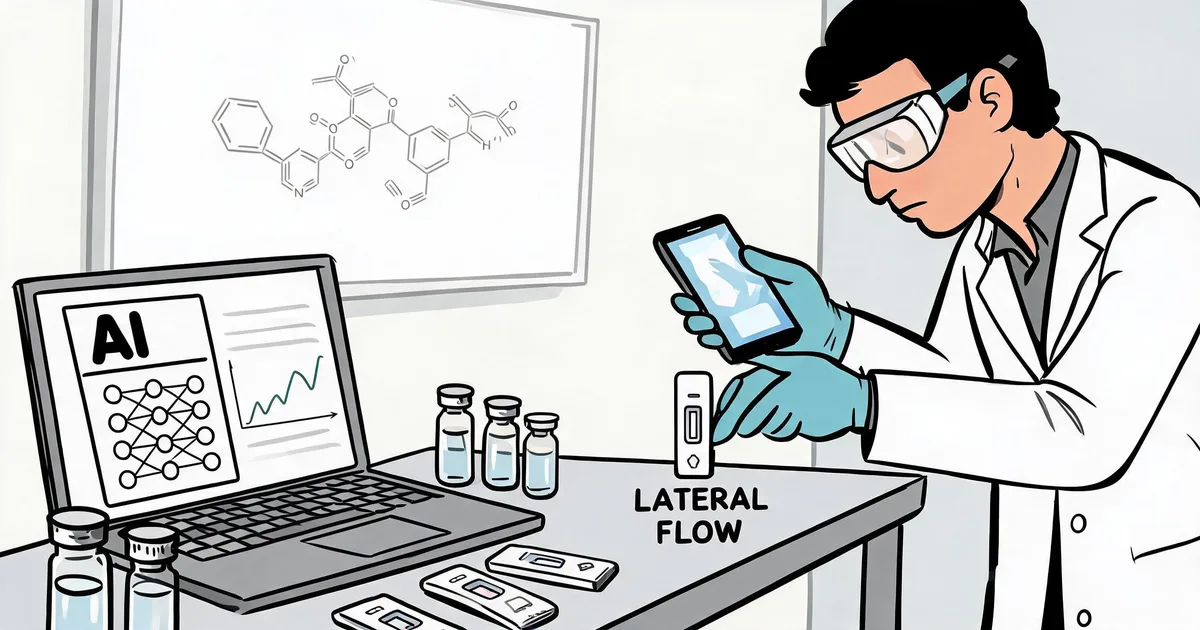
What the Market Reports Say About AI in Lateral Flow
The release, distributed through GlobeNewswire, frames AI and digital technology integration as the driver of LFA market expansion to 2030. As summarized publicly, it takes the market from about US$10.01 billion in 2024 to US$15.42 billion by 2030, a CAGR of 7.46% for 2025 to 2030.
Other analysts disagree on the size, so be careful with any single number:
| Source | Public forecast | AI / digital angle |
|---|---|---|
| ResearchAndMarkets release (May 2026) | US$10.01B (2024) to US$15.42B (2030), 7.46% CAGR | AI and digital technology integration named as the expansion driver |
| Meticulous Research | About US$13.7B (2026) to about US$27.4B (2036), 7.9% CAGR | Digital and mobile readers expected to be the fastest-growing reader type, 2026–2036 |
| Arizton | 3.20% CAGR to US$11.66B by 2030 | Smartphones and AI cited as improving the efficiency of portable testing |
Base years, market definitions and methods differ, which probably explains the spread. We have not read the paid full reports, so every figure above is as stated in the public summaries.
What the three share is where they put the AI: in the reader, the app and the data around the strip. The summaries we saw do not claim that AI changes how the antibody, antigen or conjugate on the strip is made.
Where AI Already Works: Reading the Strip
A conventional LFA output is qualitative or semi-quantitative, and it depends on a person judging a line. A 2026 critical review in Lab on a Chip (Parmaksizoglu et al., DOI 10.1039/D5LC01124H) lists the limits plainly: analytical sensitivity, non-quantitative output and subjective visual interpretation. Its argument is that smartphone-assisted readers combined with convolutional neural networks (CNNs) give objective, quantitative signal extraction and better detection of weak test lines.
The primary literature points the same way. A 2025 Biosensors study, Machine Learning-Based Quantification of Lateral Flow Assay Using Smartphone-Captured Images, found that random forest and CNN models classified results better than the other standard machine-learning models it tested.
What a reader pipeline has to do
An IntechOpen chapter on ML-enabled point-of-care readers treats the reader as a full measurement system rather than a camera plus a classifier:
- Controlled image acquisition (lighting, distance, cassette position)
- Region-of-interest segmentation (finding the test and control lines)
- Calibrated prediction (a concentration rather than only positive or negative)
- Uncertainty handling (flagging images the model should not trust)
The same chapter names the catch. Phone models and software updates change image characteristics, and that can destabilize a model that looked fine at validation.
A Model Reads Signal; It Cannot Create It
A better reader detects fainter test lines. It does not fix a line that is faint because the gold label was poorly conjugated, or one that varies between lots. Lot-to-lot variation in the strip simply becomes noise in the model's input.
On the Reagent Side, the Evidence Is Thinner
We searched for peer-reviewed work applying machine learning to hapten synthesis or conjugate design and did not find a study on synthesis route selection. What exists is computational design and structure-based reasoning, which points the same direction:
- Hapten rigidity. A 2024 Journal of Hazardous Materials study defined three molecular descriptors for rigidity, designed four rifamycin haptens with them, and found that more rigid haptens gave stronger antibody responses. The method was computational chemistry, not machine learning.
- Linker composition. A 2019 histamine study found that a phenyl-containing linker, which breaks the usual linear aliphatic guideline, gave better antibodies. Rules of thumb fail often enough that a data-driven approach is attractive.
- De novo binders. In January 2025 a Nature paper reported designed proteins that neutralize cobra toxins, which we covered in AI-designed cobra toxin binders. It shows the binder side can be designed, though the data came from large, specialized experiments.
- Existing antibodies. Sequence-level changes can improve stability or affinity; see antibody sequence optimization for IVD performance.
Our reading: AI helps most where the search space is large and the readout is cheap. Hapten and linker choice has a large space. The readout is slow, because it runs from immunization to titer to affinity to strip performance and takes weeks.
The bottleneck is labeled data, not model architecture.
How we use it for haptens
We described our own version at Diagmand 2026 in Suzhou (August 21–22). In that session, Jack Sun, Sekbio's founder, explained that an AI-assisted synthesis platform narrows the candidate pool of derivatization sites and linker chemistries before any wet-lab synthesis starts. The aim is a shorter loop between structural design and assay-level sensitivity data. In the vitamin B12 derivative project, optimizing the synthesis route this way improved reaction sensitivity.
We have not published a quantified comparison, so we do not put a number on the gain here. The model removes candidates; the bench still has to confirm the ones that remain. The full recap is in Sekbio at Diagmand 2026: CDMO and hapten synthesis, and the related reagents are on the vitamin B12 product page.
That matters most for small-molecule targets, which run in a competitive format. There the hapten design shapes both the antibody that is raised and the conjugate that competes on the strip. Examples on our side include competitive LFA antibodies for drugs of abuse and mycotoxin antibodies.
A Small-Molecule Data Point: Conjugate Quality in a Competitive Assay
Here is one result from our own bench, with its limits stated first. In September 2026 we compared a Sekbio-made FA-BSA conjugate (a small-molecule analyte, FA, coupled to BSA) with a commercial equivalent in a magnetic-bead chemiluminescence competitive assay on the I2900 platform. This is not an LFA, and the evaluation itself did not involve a model. We include it because it shows how much the conjugate alone can move signal separation in a competitive format.
We varied the dilution of the conjugate and of the biotinylated FA-binding protein to get eight conditions, then tested each at six concentrations (0, 0.5, 1, 5, 10 and 20 ng/mL) in duplicate wells. The metric was S/N, the zero-dose signal divided by the signal at that concentration. Higher means better separation.
| FA concentration | Commercial S/N | Best Sekbio condition S/N | Ratio |
|---|---|---|---|
| 0.5 ng/mL | 9.1 | 19.3 | 2.1× |
| 1 ng/mL | 20.6 | 107.0 | 5.2× |
| 5 ng/mL | 41.9 | 131.4 | 3.1× |
| 10 ng/mL | 59.5 | 153.9 | 2.6× |
| 20 ng/mL | 92.8 | 178.3 | 1.9× |
Read it with these caveats:
- It is a single experiment with duplicate wells. Triplicates across two lots are the planned repeat.
- The best condition differs by concentration. One condition that suited the 1–20 ng/mL range gave an S/N of only 2.91 at 0.5 ng/mL, against 9.08 for the commercial product, so the low end needs tuning.
- Of 48 concentration points, 40 had a duplicate CV below 10%, with a median CV of 4.0%.
Now the link to AI. Eight conditions at six concentrations is 48 data points. A useful model needs orders of magnitude more, in a consistent format, across repeated lots. The realistic ask is structured records: coupling ratio, purification method, labeling density, and the assay result that followed. A supplier that logs those can feed a model later. One that does not, cannot.
Four Things a Model Cannot Fix
- Lot-to-lot reagent variation. See antibody batch consistency in IVD manufacturing.
- Interference. Hemolysis, hook effect and heterophilic antibodies change the physical signal; lateral flow assay interference pitfalls covers how to test for them.
- Conjugation errors. An unstable gold label is a chemistry problem, as in colloidal gold conjugation mistakes in rapid tests.
- Training data that does not match the field. The Lab on a Chip review lists dataset quality, standardization and regulatory alignment as open challenges.
A regulator will ask what the model was trained on and how it behaves on a phone it has never seen.
Questions to Ask a Reagent Supplier if a Model Reads Your Strip
If your product pairs a strip with a digital reader, the reagent specification becomes part of the algorithm's input. Ask:
- Can you show test-line signal for the same antibody pair across at least three lots?
- For hapten-protein conjugates, how is the coupling ratio measured, and what is the acceptance range?
- Are the coupling chemistry and purification fixed, and will you notify us before changing either?
- Will the antibody clone come from the same documented source for the life of the product?
- Can you provide raw data (RLU, OD, images) rather than pass/fail summaries?
Recombinant production helps with the first and fourth questions because the sequence is fixed. Our recombinant antibody and antigen platforms are described on the platforms page.
Frequently Asked Questions
How is AI used in lateral flow assays today?
Mostly at the reading stage. Smartphone cameras or dedicated readers capture the strip, and a model such as a CNN or random forest locates the test line, quantifies its intensity and reports a result with a confidence value. Reviews published in 2026 describe this as the most mature application, ahead of AI-assisted reagent design.
Does AI make a lateral flow test more sensitive?
Partly. A model can detect weaker test lines than the human eye, which lowers the practical cutoff of the reading step. It cannot add signal the strip never produced. The analytical sensitivity still comes from the antibody pair, the label and the membrane.
What do the 2026–2030 LFA market forecasts say about AI?
A May 2026 report names AI and digital technology integration as a growth driver, with a 7.46% CAGR for 2025–2030. Meticulous Research expects digital and mobile readers to grow fastest among reader types. Forecast sizes differ between analysts, so cite the source with the number.
Can machine learning help design haptens for small-molecule LFA tests?
It may, but the published evidence is limited. Most of it is computational studies on hapten rigidity and linker effects. At Sekbio, an AI-assisted platform narrows derivatization-site and linker candidates before synthesis, and the bench confirms the survivors. The main obstacle is the small number of consistent, labeled datasets linking hapten structure to antibody performance.
Do digital LFA readers need special reagents?
Not special, but more consistent ones. A reader quantifies line intensity, so lot-to-lot variation in antibodies, conjugates and labels shows up directly as measurement variation. Tighter lot specifications matter more than they do for a visually read strip.
What data do you need to train a model on strip images?
Images of the same assay across multiple reagent lots, phones, lighting conditions and sample matrices, each paired with a reference result from a lab method. Without that spread, a model validated on one phone can fail on another.
Can Sekbio supply antibodies and conjugates for competitive LFA development?
Yes. Sekbio supplies recombinant antibodies, antigens and small-molecule hapten conjugates for IVD developers, and can discuss lot data and coupling specifications for your format. See our expression and conjugation platforms or contact the team with your target.
Bottom Line: Treat AI as a Reader Upgrade First
The market reports are right that AI and digital integration are reshaping lateral flow, and the evidence for that sits in smartphone readers and quantification models. For reagent R&D the case is still open. We use AI to cut the list of hapten candidates before synthesis and see value in it, but labeled, consistent data is what limits how far it goes.
If you are planning a digital LFA, start by asking your suppliers for lot-level data on antibodies, antigens and conjugates. That record is what a model, and a regulator, will eventually want to see.