Every year, IVD companies with a promising new biomarker target or a freshly granted patent face the same wall: strong science, but no in-house path to a manufacturable product. The antibodies, antigens, and small molecule derivatives behind a diagnostic concept all have to be engineered, optimized, and produced at scale before they become a sellable raw material. That gap between research-stage innovation and manufacturable IVD raw material was the focus of a keynote delivered by Jack Sun, Founder and CEO of Sekbio, at Diagmand 2026 in Suzhou.
This article recaps Sun's session at Diagmand 2026 and focuses on the two themes attendees responded to most: Sekbio's CDMO product development model — spanning recombinant antibody engineering, raw material optimization, and manufacturing scale-up — and the company's AI-enabled chemical synthesis platform for solving a persistent pain point in immunoassay development: small molecule hapten sensitivity and stability.
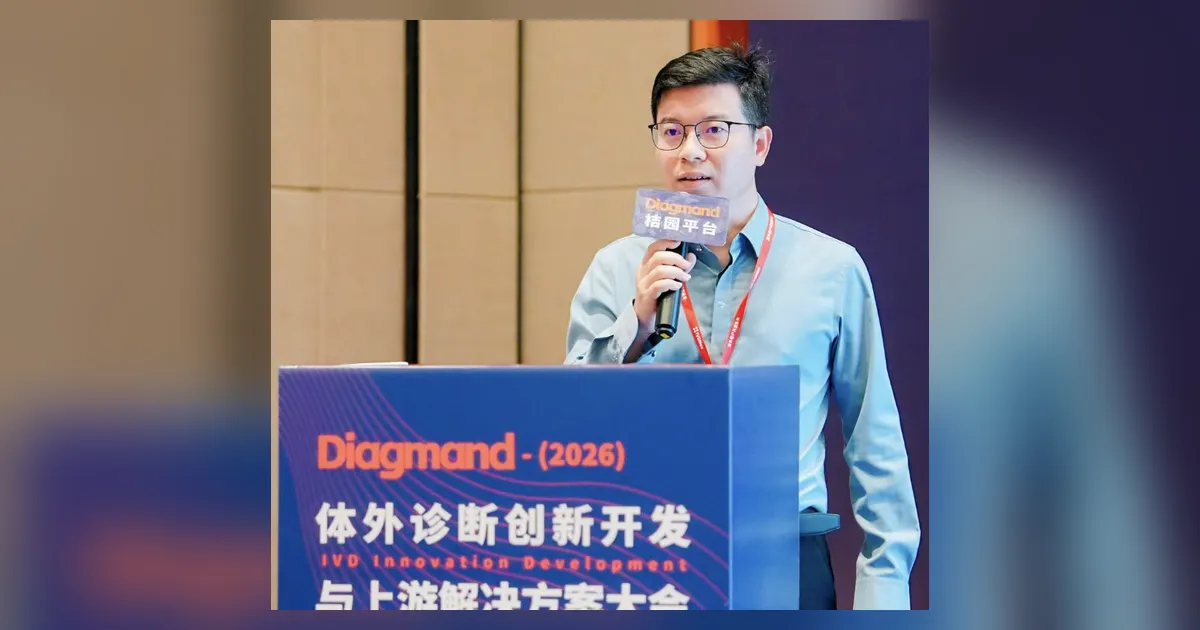
1. What Is Diagmand 2026 and What Did Sekbio Present?
Diagmand 2026 is the 4th IVD Innovation Application and Technology Solutions Conference and 4th IVD Upstream Industry Chain Exhibition — an annual gathering of IVD manufacturers, upstream raw material suppliers, and technology providers focused on diagnostic product innovation and commercialization. The 2026 edition ran August 21-22 at the Shishan International Convention Center in Suzhou, China.
| Field | Details |
|---|---|
| Event | Diagmand 2026 — 4th IVD Innovation Application & Technology Solutions Conference and 4th IVD Upstream Industry Chain Exhibition |
| Dates | August 21-22, 2026 |
| Venue | Shishan International Convention Center, Suzhou, China |
| Speaker | Jack Sun, Founder & CEO, Sekbio |
| Session focus | IVD product development, CDMO manufacturing, and small molecule (hapten) synthesis |
Sun's session walked through how Sekbio's CDMO/CRO one-stop model and AI-assisted chemical synthesis platform turn a validated target into a manufacturable IVD raw material — illustrated with live case examples from vitamin B12 and progesterone derivative projects.
2. Sekbio's CDMO One-Stop Model: From New Target to Manufactured Product
Sekbio's CDMO one-stop model is built for startups and research institutions that hold a new biomarker target or a granted patent but lack the industrialization capability to turn it into a manufacturable IVD raw material on their own. Rather than handing a project between multiple vendors, Sekbio carries it through a single connected pipeline:
- Product optimization — translating a research-stage antibody pair, antigen, or hapten conjugate into an IVD-grade reagent with documented sensitivity, specificity, and batch consistency.
- Recombinant antibody & raw material engineering — building the underlying monoclonal antibody, recombinant antigen, or small molecule derivative that the finished product depends on.
- Production line setup & manufacturing scale-up — establishing compliant, scalable manufacturing so the optimized reagent can be produced at commercial volume with consistent batch-to-batch quality.
- After-sales technical support — ongoing quality and technical support once the raw material or reagent is in a customer's hands.
By owning product optimization, antibody and raw material engineering, and manufacturing under one roof, Sekbio's model is designed to shorten the distance between "we have a new target" and "we have a manufacturable raw material" — the gap Sun's Diagmand 2026 session was built around.
Pro Tip
When evaluating a CDMO partner for a new target, check whether antibody/antigen engineering and raw material synthesis happen in-house or are subcontracted — fragmented handoffs between reagent development and manufacturing are where timelines and quality control usually slip.
3. Recombinant Antibody & Raw Material Development at Sekbio
Every finished IVD reagent Sekbio ships — whether a protein antigen, a monoclonal antibody pair, or a hapten-carrier conjugate — is built on the same underlying recombinant expression and antibody development platform. This is the capability layer that makes the product optimization stage of the CDMO model fast rather than a multi-month bottleneck.
| Capability | Platform Detail |
|---|---|
| CHO expression | Up to 7-day delivery, titers up to 2.4 g/L, 800+ completed projects |
| HEK293 expression | 1,000+ proteins expressed, scalable from 40 mL to 20 L |
| Monoclonal antibody development | 8-12 week end-to-end delivery — sequencing, expression, screening, and stable cell line establishment |
| Raw material formats | Recombinant antibodies and antigens, colloidal gold conjugates, and small molecule hapten derivatives |
This dual-platform foundation — mammalian expression for large-molecule antigens and antibodies, plus the chemical synthesis platform described below for small molecule haptens — is what lets Sekbio take on both protein-based and hapten-based IVD targets under the same CDMO engagement. For full technical specifications, see the Antibody & Antigen Development Platform page.
4. AI-Enabled Chemical Synthesis: Solving Hapten Sensitivity and Stability Challenges
The second half of Sun's presentation moved from process to chemistry. A hapten — also called a small molecule derivative in immunoassay development — is a small compound such as a steroid hormone, vitamin, or drug metabolite that is too small on its own to trigger an immune response. To be used for antibody generation or as a coating/competition reagent, a hapten must first be chemically derivatized at a specific site and conjugated to a carrier protein, most commonly BSA. The conjugation ratio, linker chemistry, and derivatization site all directly affect the resulting antibody's binding affinity (Source: Effect of hapten-carrier conjugation ratios and molecular orientations on antibody affinity, PubMed).
Sun described low sensitivity and poor stability in hapten-based reagents as one of the most common, and most underestimated, technical bottlenecks in immunoassay development — particularly for structurally difficult small molecules where the "easy" derivatization site is rarely the best-performing one.
"Hapten sensitivity and stability aren't a niche chemistry problem — they're a recurring bottleneck across the industry, and the projects that get stuck longest are usually the structurally difficult small molecules."
To address this, Sekbio has built an AI-assisted chemical synthesis platform that narrows the candidate pool of derivatization sites and linker chemistries before wet-lab synthesis begins — shortening the iteration cycle between structural design and assay-level sensitivity data. This is the platform behind the two case examples Sun presented at Diagmand 2026.
5. Case Highlights: VB12 and Progesterone Derivative Optimization
Sun illustrated the AI-assisted synthesis platform with live project data, most notably a vitamin B12 (VB12) derivative case and a progesterone derivative case — both structurally challenging small molecules with a history of sensitivity limitations in immunoassay formats.
| Project | Molecule Type | Challenge Addressed | Sekbio Resource |
|---|---|---|---|
| VB12 Derivative | Vitamin hapten | Reaction sensitivity in the derivatization/conjugation route | VB12 Intrinsic Factor & BSA Tracer Conjugate · VB12 Derivative Selection Guide |
| Progesterone Derivative | Steroid hormone hapten | Hapten structural design and conjugation process control | Progesterone Antibody · Progesterone Antibody Pair Design |
| Additional small molecule projects | Steroid hormones, vitamins, drug metabolites | Broader hapten structural design, conjugation, and QC capability | Antibody & Antigen Development Platform |
For the VB12 project, AI-assisted optimization of the synthesis route materially improved reaction sensitivity, giving IVD customers a stronger foundation for upgrading their assay's analytical performance. The progesterone case, along with several other small molecule derivative projects Sun referenced, further demonstrated Sekbio's depth in hapten structural design, conjugation chemistry, and quality control — capabilities that sit underneath every hapten-based product Sekbio ships.
6. Frequently Asked Questions — Diagmand 2026 and Sekbio's CDMO Solutions
What is Diagmand 2026?
Diagmand 2026 is the 4th IVD Innovation Application and Technology Solutions Conference and 4th IVD Upstream Industry Chain Exhibition, held August 21-22, 2026 at the Shishan International Convention Center in Suzhou, China. The event brings together IVD manufacturers, upstream raw material suppliers, and technology providers to discuss product innovation, raw material development, and supply chain solutions.
How long does Sekbio's CDMO one-stop process take, from a new target to a manufacturable product?
Timelines vary by target complexity and required production scale, since raw material engineering and manufacturing scale-up are the primary variables. As a reference point, Sekbio's underlying antibody and antigen development services operate on 7-day CHO expression turnaround and 8-12 week end-to-end monoclonal antibody development, which sets the baseline pace for the product optimization stage of a CDMO engagement. Contact Sekbio's team for a project-specific timeline estimate.
Can an early-stage IVD startup with only a new target or patent use Sekbio's CDMO service?
Yes. Sekbio's CDMO one-stop model is specifically designed for innovators who hold a new biomarker target or patent but lack in-house industrialization capability. Sekbio supports the full path from product optimization and recombinant antibody or raw material engineering through production line setup and after-sales support, so a startup does not need to build antibody development or manufacturing infrastructure independently.
What is the difference between a hapten and a protein antigen in immunoassay development?
A protein antigen, such as a biomarker like CRP or AFP, is large enough to be directly immunogenic and to present multiple non-overlapping epitopes for capture and detection antibody pairs. A hapten is a small molecule, such as a steroid hormone, vitamin, or drug metabolite, that is too small to trigger an immune response on its own. Haptens must first be chemically derivatized and conjugated to a carrier protein, such as BSA, before they can be used to raise antibodies or configured as coating and competition reagents in an immunoassay.
How does Sekbio validate a hapten synthesis route for sensitivity and stability?
Sekbio's chemical synthesis platform screens candidate derivatization sites and linker chemistries, then evaluates each resulting hapten-carrier conjugate for coupling ratio, structural stability, and the resulting assay signal-to-noise performance. AI-assisted route optimization is used to narrow the candidate pool before wet-lab synthesis, shortening the iteration cycle between structural design and assay-level sensitivity data.
Does Sekbio offer AI-assisted small molecule derivative synthesis for targets beyond VB12 and progesterone?
Yes. The VB12 and progesterone projects discussed at Diagmand 2026 are representative examples of Sekbio's broader small molecule hapten synthesis capability, which extends to other steroid hormones, vitamins, and drug-of-abuse targets used in immunoassay development. Visit Sekbio's antibody and antigen development platform page to discuss a specific target.
7. Summary
Diagmand 2026 gave Sekbio a platform to lay out how it helps IVD innovators close the gap between a validated target and a manufacturable product:
- Turning a new target into a manufacturable product is a systems problem, not just a science problem: reagent translation, antibody/raw material engineering, and manufacturing scale-up all have to come together — which is exactly where most new-target projects stall without a CDMO partner.
- Sekbio's CDMO one-stop model covers product optimization, recombinant antibody and raw material engineering, production line setup, and after-sales support under a single accountable partner.
- Hapten sensitivity and stability remain an underestimated bottleneck in immunoassay development, especially for structurally difficult small molecules.
- AI-assisted chemical synthesis is now measurably shortening the path from hapten structural design to assay-level sensitivity data, demonstrated in Sekbio's VB12 and progesterone derivative projects.
At Sekbio, these capabilities sit on top of the same recombinant antibody and antigen development platform used across our IVD raw material and rapid test business. If your team is holding a new target or a granted patent and needs a partner to carry it through optimization, engineering, and manufacturing, our CDMO/CRO team is a good place to start that conversation.