Vitamin B12 (cobalamin) is one of the most technically demanding small-molecule analytes to build a reliable immunoassay around. Unlike protein biomarkers, native B12 in serum is tightly bound by transport proteins, exists as four distinct chemical forms, and is too small to trigger an immune response on its own — which means the antibody and the assay format only work as well as the vitamin B12 derivative chosen to stand in for it. Teams that treat derivative selection as an afterthought routinely discover, late in validation, that their assay under-reports methylcobalamin, over-reports cyanocobalamin, or drifts under normal lab lighting.
This guide walks through why native B12's chemistry forces assay developers toward a derivative-based design, the mistakes that most commonly surface during vitamin B12 assay development, the criteria that separate a workable derivative from a problematic one, and how to validate that the derivative you've chosen actually behaves like the vitamin B12 circulating in patient serum.
1. What Is a Vitamin B12 Derivative, and Why Does Assay Design Need One?
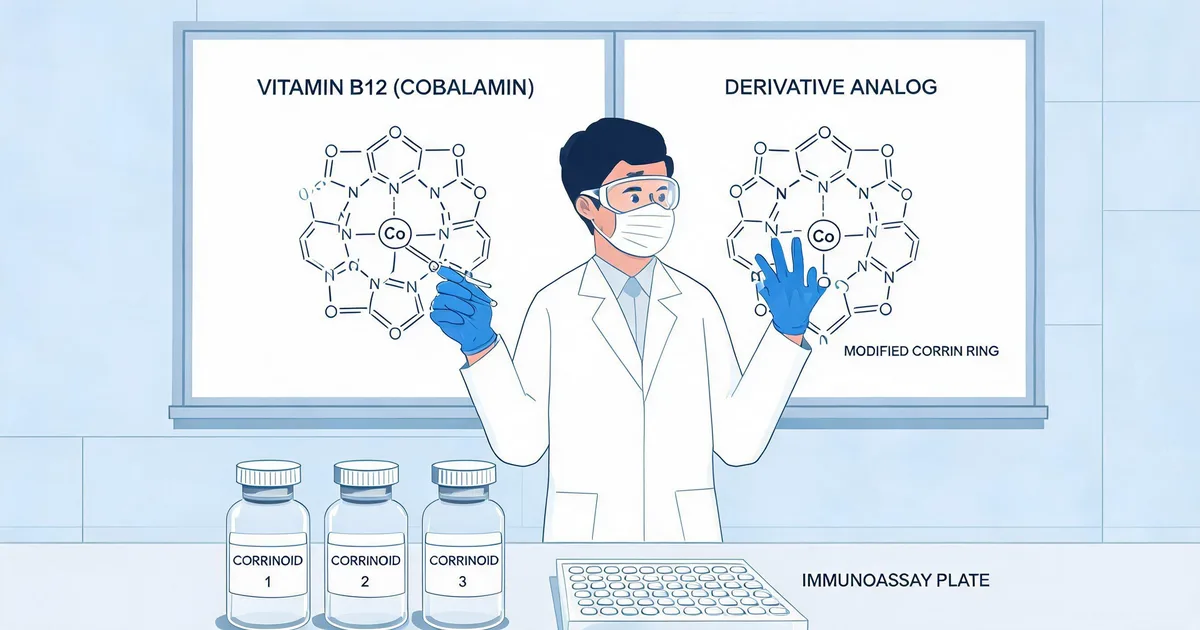
A vitamin B12 derivative is a chemically modified form of cobalamin — typically starting from cyanocobalamin — engineered with a reactive handle so it can be covalently attached to a carrier protein or a detection label without disturbing the region of the molecule that an antibody recognizes. It is the working substitute for native B12 at two separate points in immunoassay development:
- Immunization: Native cobalamin has a molecular weight of only about 1,355 Da — far below the threshold generally needed to provoke an immune response on its own. A derivative is conjugated to a large carrier protein (commonly BSA or KLH) to create a hapten-carrier immunogen capable of generating anti-B12 antibodies.
- Tracer / competitor design: In the competitive immunoassay format used for virtually all vitamin B12 IVD tests, a labeled B12 derivative competes with the patient's endogenous B12 for a fixed, limiting amount of antibody. Signal is inversely proportional to the patient sample's B12 concentration.
Both applications depend on the same underlying requirement: the derivative must be modified at a site the antibody does not use for recognition, and it must remain chemically representative of the B12 forms actually present in human serum. Get either of those wrong, and the resulting antibody — however well it was screened — will not report patient B12 concentrations accurately.
2. Why Native Vitamin B12's Structure Complicates Immunoassay Design
Cobalamin's structure creates two separate problems that most other IVD analytes don't have.
2.1 Four Circulating Forms, One Assay
Vitamin B12 does not circulate as a single chemical species. Four vitamers occur physiologically or enter the body through supplementation: cyanocobalamin, hydroxocobalamin, methylcobalamin, and adenosylcobalamin. They differ only in the group attached to the corrin ring's central cobalt atom, but that difference is often enough to change how well an antibody raised against one vitamer recognizes the others. An assay that responds strongly to cyanocobalamin (the form most common in supplements and injectable formulations) but weakly to methylcobalamin or adenosylcobalamin (the dominant endogenous forms) will systematically misreport results depending on a patient's supplementation history — a problem that stays invisible until cross-vitamer recovery testing is performed.
2.2 Serum Binding Proteins Shield the Epitope
In circulation, roughly 80% of B12 is bound to haptocorrin and the remainder to transcobalamin — both of which bind cobalamin with extremely high affinity, among the tightest known protein-ligand interactions in human biology. If the sample pretreatment step doesn't fully release and denature these binding proteins before the antibody is introduced, residual bound B12 stays shielded from antibody recognition. This produces falsely low signal — a serious problem clinically, since a falsely low B12 result can trigger unnecessary deficiency workups or mask an accurate diagnosis.
Critical Principle
A vitamin B12 derivative is only "correct" if it preserves the same corrin-ring face across all four vitamers and survives sample pretreatment without additional degradation. Optimizing antibody affinity before locking down derivative chemistry is optimizing the wrong variable first.
3. Common Mistakes in Vitamin B12 Assay Development
Most vitamin B12 assay problems that surface during validation trace back to decisions made early, during derivative and conjugate design. The following are the mistakes we see most often.
Mistake 1: Conjugating at a Site That Blocks the Antibody Epitope
The corrin ring offers several carboxyl side chains (commonly referred to by their b, d, and e positions) as conjugation handles. Choosing a handle close to the region most antibodies recognize can sterically block binding entirely, or reduce affinity enough to compromise sensitivity — a mistake that isn't obvious until antibody screening yields unexpectedly weak candidates across the board.
Mistake 2: Ignoring Differential Cross-Reactivity Across Vitamers
Screening antibody candidates against only one cobalamin form (usually cyanocobalamin, because it's the most commercially available and photostable) misses differences in how the antibody binds methylcobalamin and adenosylcobalamin. This is one of the most common root causes of unexplained result discordance between an in-development assay and an established reference method.
Mistake 3: Underpowered Protein-Release Step
Because haptocorrin and transcobalamin bind B12 so tightly, sample pretreatment must fully denature these proteins before antibody exposure. Reusing a generic protein-release protocol from another assay, without re-optimizing pH, denaturant concentration, and incubation time specifically for B12's binding proteins, routinely leaves residual bound analyte and depresses assay signal.
Mistake 4: Over- or Under-Conjugating the Immunogen
Too few hapten molecules per carrier protein produce weak immunogenicity and poor antibody titers; too many can distort the carrier protein's structure and generate antibodies against conjugation artifacts rather than the B12 epitope itself. Hapten-to-carrier ratio needs to be measured and controlled, not assumed.
Mistake 5: Skipping Light-Stability Testing of the Conjugate
Cobalamins — particularly the alkylcobalamins methylcobalamin and adenosylcobalamin — are photosensitive; the cobalt-carbon bond can degrade under normal laboratory or ambient lighting. A derivative or tracer that isn't tested for stability under representative light exposure can show drifting recovery over an assay's shelf life, a failure mode that's easy to miss on short development timelines.
Mistake 6: Not Testing Against Structurally Similar Corrinoids
Some patient samples — particularly from individuals consuming certain algae- or seaweed-derived supplements — contain inactive corrinoid analogs (sometimes called pseudo-vitamin B12) that are structurally similar to true cobalamin but not biologically active. An antibody that doesn't discriminate against these analogs can overestimate a patient's true B12 status.
"The biggest design flaw in vitamin B12 immunoassays isn't a weak antibody — it's a derivative that no longer resembles the four cobalamin forms actually circulating in patient serum."
4. Key Criteria for Selecting a Good Vitamin B12 Derivative
Before locking in a derivative for either immunogen or tracer use, evaluate it against the criteria below. Each one maps directly to one of the failure modes described in the previous section.
| Criterion | Why It Matters | How to Test It |
|---|---|---|
| Conjugation site | Determines whether the antibody-recognized face of the corrin ring stays exposed | Compare antibody binding across derivatives conjugated at alternate side-chain positions |
| Cross-vitamer equivalence | Ensures the assay responds equally to cyanocobalamin, hydroxocobalamin, methylcobalamin, and adenosylcobalamin | Independent spike-recovery testing with each of the four vitamers |
| Conjugate stability | Cobalt-carbon bonds in alkylcobalamins are photosensitive and can degrade in ambient light | Accelerated light and thermal stability studies over the claimed shelf life |
| Immunogenicity | Poor hapten density on the carrier protein yields low antibody titers | Measure hapten-to-carrier molar ratio (MALDI-TOF or UV spectrophotometry) |
| Cross-reactivity profile | Structurally similar corrinoid analogs can cause overestimation of true B12 status | Test against known inactive corrinoid analogs at high molar excess |
| Synthesis reproducibility | Batch-to-batch chemical variability propagates into antibody and tracer lot variability | HPLC purity and identity confirmation across independent synthesis batches |
5. Antibody and Tracer Design for Competitive B12 Immunoassays
Vitamin B12's small size and low serum concentration (a clinical reference range of roughly 200–900 pg/mL in most laboratories) rule out the sandwich format used for larger protein biomarkers — there simply isn't room on the molecule for two antibodies to bind simultaneously without steric interference. Every vitamin B12 IVD assay is therefore built on a competitive format, which shifts the burden of sensitivity and specificity almost entirely onto the antibody and the labeled derivative.
This puts two requirements on antibody selection that don't apply to sandwich assays:
- High intrinsic affinity is non-negotiable, since there's no second antibody to compensate for weak binding at low analyte concentrations.
- Consistent behavior against both the tracer and the native analyte must be confirmed directly — the antibody has to bind the labeled tracer derivative and native serum B12 with predictable, competitive kinetics, not just bind each independently.
The underlying hapten-carrier design principles are the same ones used across other small-molecule IVD analytes. Developers building progesterone antibody pairs or 25-OH Vitamin D competitive immunoassay antibodies face the same conjugation-site and cross-reactivity trade-offs described above. Sekbio's antibody development platform applies this same systematic screening approach to custom vitamin B12 and other small-molecule antibody programs.
6. Validation Strategy: Confirming You've Chosen the Right Derivative
Derivative selection isn't finished until it's been validated the same way the finished assay will be. The following checks are the minimum standard for vitamin B12 competitive immunoassays:
- Cross-vitamer recovery: Spike serum-based matrices with each of the four physiological cobalamin forms independently and confirm recovery falls within the same acceptance range for all four.
- Method comparison: Run split samples against an established reference platform (typically a chemiluminescence-based B12 assay) across the full clinical range, including samples near the deficiency cutoff.
- Protein-release interference testing: Confirm recovery is unaffected by elevated haptocorrin or transcobalamin concentrations, which can occur in certain hematologic and hepatic conditions.
- Corrinoid cross-reactivity: Test against known inactive corrinoid analogs at high molar excess to confirm the antibody doesn't overestimate true B12 status.
- Conjugate stability: Confirm the labeled tracer derivative maintains recovery within specification after light and thermal stress representative of real-world handling and shelf life.
- Linearity and precision: Confirm dilution linearity across the reportable range and intra-/inter-batch precision consistent with your intended use claims.
IVD Application Note
Document the rationale for your final conjugation site and hapten-to-carrier ratio the same way you'd document any other critical assay parameter — regulators reviewing a vitamin B12 IVD submission will expect to see cross-vitamer recovery data, not just single-analyte validation against cyanocobalamin.
7. Frequently Asked Questions — Vitamin B12 Derivative Selection
What is a vitamin B12 derivative in immunoassay design?
A vitamin B12 derivative is a chemically modified form of cobalamin, most often cyanocobalamin modified at a corrin-ring side chain, used either as a carrier-protein conjugate to raise anti-B12 antibodies or as a labeled tracer that competes with a patient's endogenous B12 for antibody binding sites. Because native B12 is too small, about 1,355 Da, to be immunogenic on its own and is normally shielded by serum binding proteins, a purpose-built derivative is required at both the immunization and detection stages of assay development.
How long does it take to develop a validated vitamin B12 competitive immunoassay?
A full development cycle, including derivative synthesis and characterization, antibody generation or screening, competitive format optimization, and analytical validation such as linearity, precision, recovery, interference, and cross-reactivity across the four cobalamin vitamers, typically spans several months. Timelines extend when the first-choice conjugation chemistry fails to preserve antibody recognition, which is a common reason projects need to revisit derivative design mid-development.
Can the same vitamin B12 derivative be used for both antibody generation and assay tracer conjugation?
Not always. The immunogen conjugate only needs to elicit antibodies against an epitope shared by all circulating cobalamin forms, while the tracer conjugate must retain that same epitope after being labeled with an enzyme, biotin, or particle. In practice, developers often reuse the same conjugation chemistry and side-chain position for both, but verify independently that neither modification changes the antibody's binding behavior versus native B12.
What is the difference between a cobalamin derivative used as an immunogen and one used as a tracer?
An immunogen derivative is conjugated to a large carrier protein, BSA or KLH, to trigger an immune response during antibody generation. A tracer derivative is conjugated to a much smaller reporter, an enzyme, biotin, or particle label, and is used in the finished competitive assay to compete against patient-sample B12 for a limited pool of antibody. Both must preserve the antibody-recognized face of the corrin ring, but they are optimized for different downstream chemistries and validated separately.
How do you validate that a vitamin B12 derivative performs equivalently to native cobalamin in serum?
Spike-recovery experiments using all four physiological cobalamin vitamers, cyanocobalamin, hydroxocobalamin, methylcobalamin, and adenosylcobalamin, method comparison against a reference platform, interference testing with elevated haptocorrin or transcobalamin, and light-stability testing of the conjugate are the core validation steps. A derivative that recovers within the same acceptance range across all four vitamer spikes is considered equimolar-responsive and suitable for release.
Does Sekbio offer antibody development services for vitamin B12 and other small-molecule IVD analytes?
Yes. Sekbio's antibody development platform supports hapten-carrier conjugate design, monoclonal antibody generation, and competitive-format optimization for small-molecule analytes including vitamin B12, steroid hormones, and other low-molecular-weight biomarkers. Visit our antibody development platform page to discuss a custom vitamin B12 derivative or antibody program.
8. Summary
Vitamin B12 assay development succeeds or fails on decisions made before the first antibody is ever screened:
- Derivative chemistry comes first: Choose a conjugation site that preserves the antibody-recognized face of the corrin ring, for both immunogen and tracer use.
- Design for all four vitamers: An assay validated only against cyanocobalamin will misreport patients whose B12 is predominantly methylcobalamin or adenosylcobalamin.
- Protein release matters as much as antibody affinity: Incomplete denaturation of haptocorrin and transcobalamin is one of the most common causes of falsely low B12 results.
- Stability and cross-reactivity are validation requirements, not optional extras: Light-sensitive conjugates and inactive corrinoid analogs are known, testable failure modes.
At Sekbio, our antibody development platform applies this same systematic approach — conjugation-site screening, cross-vitamer validation, and stability testing — to custom vitamin B12 derivative and antibody programs, alongside our broader portfolio of small-molecule IVD reagents. If you're developing a vitamin B12 assay and need a derivative and antibody pair validated against all four cobalamin forms, let's talk.