You run the same NHS-ester or maleimide protocol you've used a dozen times before, and the conjugate still comes back wrong — low labeling ratio, unexpected aggregation, or an antibody that binds noticeably worse after conjugation than before it. The crosslinker didn't change. What usually did change, or was never actually checked, is which amino acid residues on your specific protein were available to react in the first place.
This article breaks down the amino acid chemistry behind protein covalent crosslinking: which side chains crosslinkers actually target, why lysine and cysteine behave so differently, which residues developers routinely overlook, and how to diagnose a failing conjugation reaction before you waste another batch of antibody or antigen.
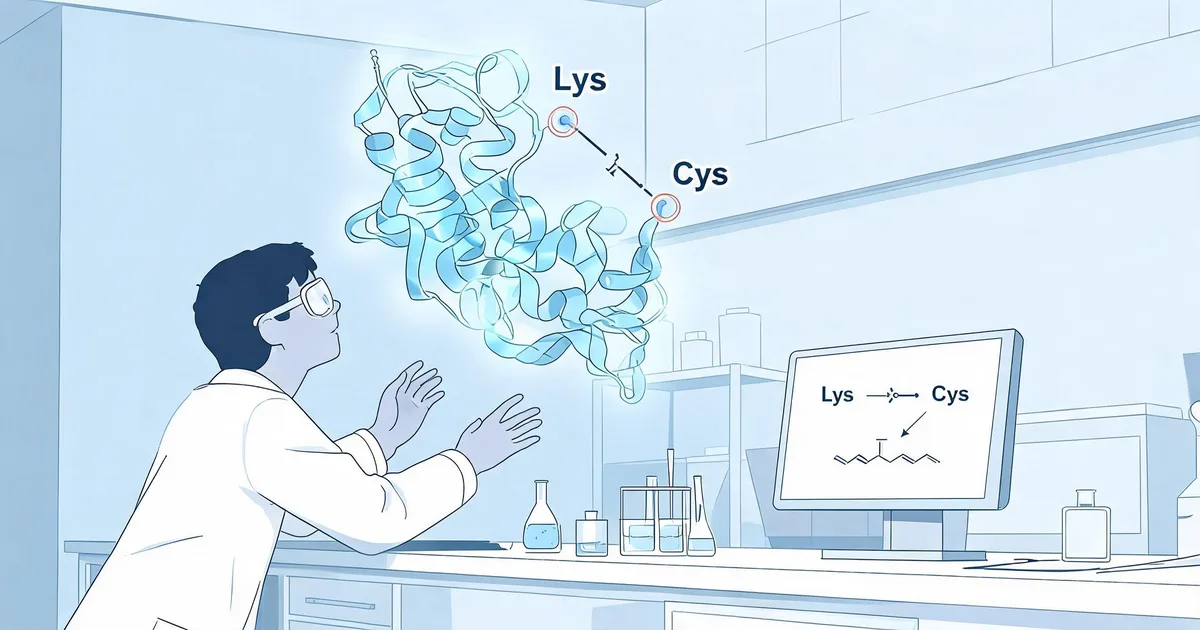
1. What Is Protein Covalent Crosslinking?
Protein covalent crosslinking is the formation of a stable, irreversible chemical bond between a protein and a second molecule — another protein, an enzyme, a hapten, a fluorophore, biotin, or a solid-phase particle — using a crosslinking reagent that reacts with specific functional groups on amino acid side chains. Unlike non-covalent binding (such as antibody-antigen recognition), a covalent conjugate does not dissociate under dilution, washing, or mild denaturing conditions, which is exactly why it's the method of choice for IVD reagents that must remain stable through storage and repeated assay cycles.
In IVD reagent development, covalent crosslinking underlies several everyday products:
- Antibody-enzyme conjugates (e.g., antibody-HRP) for ELISA and CLIA detection
- Antibody-biotin conjugates for streptavidin-based signal amplification
- Hapten-carrier protein conjugates (e.g., small-molecule hapten to BSA or KLH) used to raise immunogen-specific antibodies
- Antibody-particle conjugates, including colloidal gold and latex, for lateral flow assays — see our guide on colloidal gold conjugation mistakes in rapid tests for particle-specific pitfalls
Crosslinkers fall into three broad categories: homobifunctional (same reactive group on both ends, linking two identical functional groups), heterobifunctional (two different reactive groups, allowing sequential, more controlled conjugation), and zero-length crosslinkers like EDC, which form a direct bond between two native functional groups on the reacting molecules without adding any extra atoms to the linker itself.
2. Why Amino Acid Chemistry Determines Success
Every crosslinking reagent is only as useful as the functional group it targets — and that functional group belongs to a specific amino acid side chain. If that amino acid isn't present, isn't exposed, or isn't ionized correctly at your reaction pH, the crosslinker has nothing to react with, regardless of how much of it you add.
| Amino Acid | Reactive Group | Typical Crosslinker Chemistry | Approx. Side-Chain pKa |
|---|---|---|---|
| Lysine (K) | Primary amine (-NH2) | NHS ester, imidoester, isothiocyanate | ~10.5 |
| Cysteine (C) | Thiol (-SH) | Maleimide, haloacetyl, pyridyl disulfide | ~8.3 |
| Aspartate / Glutamate (D/E) | Carboxyl (-COOH) | EDC/NHS (carbodiimide) | ~3.9–4.1 |
| Tyrosine (Y) | Phenol (-OH) | Diazonium coupling, Bolton-Hunter reagent | ~10.1 |
| Histidine (H) | Imidazole | Metal chelation, click-type conjugation | ~6.0 |
The N-terminal alpha-amine of the protein (pKa ~8–9) is also a reaction site for amine-reactive crosslinkers, independent of any internal lysine residues — one more reason NHS-ester conjugation is rarely as "simple" as it looks on paper.
Critical Principle
A residue's intrinsic reactivity in free amino acid form is not the same as its reactivity within a folded protein. Local pKa shifts, hydrogen bonding, and burial inside the tertiary structure can make a "reactive" residue functionally inert — and vice versa.
3. Lysine and NHS-Ester Chemistry
Lysine is the default target for most protein conjugation chemistry because it's abundant — a typical IgG antibody carries 30–40 surface lysines — and its primary amine reacts efficiently with NHS esters (N-hydroxysuccinimide esters) at slightly alkaline pH (7.2–8.5), forming a stable amide bond.
3.1 Why Lysine Chemistry Is the Default — and the Problem
The abundance that makes lysine convenient also makes it imprecise. With 30–40 candidate sites on a single antibody, NHS-ester conjugation produces a heterogeneous population of conjugates labeled at different positions and different stoichiometries. Some of those lysines sit near or within the CDR loops that form the antigen-binding paratope, so a fraction of every batch is inevitably labeled at a site that interferes with binding.
3.2 Reaction Kinetics You Can't Ignore
- NHS esters hydrolyze in aqueous buffer with a half-life of roughly 10 minutes at pH 8.6, 25°C — the reaction is racing against its own decomposition.
- Primary-amine-containing buffers (Tris, glycine) compete directly with lysine for the crosslinker and will silently kill your labeling efficiency if not exchanged out beforehand.
- Reaction is typically run for 30 minutes to 2 hours; longer incubations rarely improve yield once the crosslinker has hydrolyzed.
Common Mistake
Using a large molar excess of NHS-activated crosslinker to "force" higher labeling. Past a certain point this doesn't increase conjugation — it increases the odds of labeling a lysine near the paratope, degrading binding activity while conjugation efficiency plateaus.
4. Cysteine and Maleimide Chemistry
Cysteine conjugation via maleimide chemistry is prized for its selectivity: because free, unpaired thiols are rare in native folded proteins (most cysteines are locked into structural disulfide bonds), a maleimide crosslinker reacts almost exclusively at whatever single free thiol is available — producing a far more homogeneous, site-defined conjugate than lysine chemistry.
4.1 The Catch: Most Cysteines Aren't Free
Antibodies, for example, contain interchain and intrachain disulfide bonds that are essential to structural stability. To generate a conjugation-ready thiol, developers typically use one of two strategies:
- Partial reduction with TCEP or DTT to selectively break the more accessible interchain hinge disulfides, exposing free thiols without fully unfolding the protein
- Engineered cysteine introduced by site-directed mutagenesis at a defined surface-exposed position, giving full control over the conjugation site — the basis of most site-specific antibody-drug conjugate platforms
4.2 Failure Modes Specific to Thiol Chemistry
- Over-reduction: excessive TCEP/DTT exposure breaks structural disulfides, causing partial unfolding, loss of activity, or aggregation.
- Maleimide hydrolysis: like NHS esters, maleimides degrade in aqueous buffer over time (faster at higher pH), so reagent freshness and reaction timing matter.
- Thiol scrambling: free cysteines can re-oxidize or exchange with other thiols in solution before conjugation, especially without an inert atmosphere or reducing agent present until the moment of reaction.
"Most failed crosslinking reactions aren't chemistry failures — they're accessibility failures: the reactive residue was never actually exposed to begin with."
5. Tyrosine, Aspartate, and Glutamate
Lysine and cysteine dominate the conjugation conversation, but several other residues quietly determine whether a crosslinking reaction succeeds, fails, or produces unwanted side reactions.
5.1 Tyrosine
Tyrosine's phenolic hydroxyl group can be targeted directly by diazonium coupling or Bolton-Hunter-type reagents, and it's the specific target of chloramine-T iodination chemistry used in radiolabeling and some detection chemistries. More importantly for routine conjugation, surface tyrosines can participate in unintended oxidative side reactions during HRP-catalyzed or peroxide-driven labeling steps, occasionally causing protein crosslinking or aggregation you didn't design for.
5.2 Aspartate and Glutamate
The carboxyl groups on aspartate and glutamate side chains (and the protein's C-terminus) are the targets of EDC/NHS carbodiimide chemistry — a zero-length crosslinking approach that couples a carboxyl group directly to a primary amine on a second molecule, without inserting an intervening spacer. This is the standard method for coupling small haptens to carrier proteins. Because EDC activates carboxyls transiently and non-selectively, uncontrolled reactions risk intramolecular or self-crosslinking, producing aggregated, poorly defined product if the EDC-to-protein ratio isn't tightly controlled.
5.3 Histidine — Worth a Mention
Histidine's imidazole side chain (pKa ~6.0) is less commonly used for standard bioconjugation but is central to metal-affinity chemistry (His-tag purification) and some click-chemistry-adjacent labeling strategies. It's rarely the primary conjugation target, but its presence near a designed reactive residue can shift local pH behavior and should be checked during site selection.
6. Accessibility and Reaction Conditions
Even a textbook-reactive residue will not react if it's inaccessible. Three factors determine real-world accessibility, and all three are checkable before you run the reaction, not after it fails.
6.1 Structural Accessibility
- Surface exposure: residues buried in the hydrophobic core or at a tightly packed domain interface are effectively unreactive, no matter their side-chain chemistry. Solvent-accessible surface area (SASA), calculated from a crystal structure or a homology model, is the standard way to check this before designing a conjugation strategy.
- Glycosylation shielding: N-linked or O-linked glycans near a candidate lysine or cysteine can sterically block crosslinker access even when the residue itself sits on the protein surface.
- Proximity to functional interfaces: residues near an antigen-binding site, active site, or protein-protein interaction surface may be exposed but functionally off-limits if labeling there destroys activity.
6.2 Reaction Conditions That Sabotage Otherwise Sound Chemistry
- Buffer choice: Tris, glycine, and other primary-amine-containing buffers directly compete with lysine for NHS-ester crosslinkers. Exchange into PBS or borate buffer before amine chemistry.
- pH control: reaction pH determines the ionization state (and hence reactivity) of the target side chain — too low and the nucleophile is protonated and unreactive; too high and hydrolysis of the crosslinker dominates.
- Molar ratio and reaction time: under-dosing leaves conjugation incomplete; over-dosing risks off-target labeling at low-abundance but functionally critical residues.
- Temperature: lower temperature (4°C) reduces hydrolysis competition for time-sensitive crosslinkers at the cost of slower reaction kinetics — a deliberate trade-off, not a default setting.
Pro Tip
Before scaling up a conjugation reaction, run a small-scale titration across 2–3 molar ratios and 2 pH conditions. The combination that gives the best signal-to-noise on a functional assay — not the highest raw labeling ratio — is usually the one worth scaling.
7. Diagnosing a Failed Crosslinking Reaction
When a conjugation batch underperforms, the symptom usually points to a specific amino acid or accessibility issue rather than a generic "bad reaction."
| Symptom | Likely Cause | Fix |
|---|---|---|
| Low conjugation yield | Hydrolyzed crosslinker; residue not exposed; amine-containing buffer present | Use fresh crosslinker; buffer-exchange into PBS/borate; check SASA of target residue |
| Loss of binding activity after conjugation | Labeling at or near a lysine within the CDR/paratope | Switch to site-directed cysteine or enzymatic conjugation away from the binding interface |
| Aggregation after conjugation | Over-crosslinking via excess EDC/NHS, or thiol scrambling | Reduce crosslinker molar ratio; add reaction quench step; verify free thiol status pre-reaction |
| Batch-to-batch inconsistency | Heterogeneous lysine distribution; uncontrolled reaction kinetics | Move to site-specific chemistry; add mass-spec-based labeling ratio QC to release testing |
For antibody conjugates specifically, confirming that recombinant antigens and antibody pairs were validated before conjugation — not just after — removes one major variable from the troubleshooting process. If the unconjugated antibody's binding activity wasn't characterized first, it's impossible to know whether conjugation caused the activity loss or the input material was already compromised.
8. Frequently Asked Questions — Protein Covalent Crosslinking
What is protein covalent crosslinking?
Protein covalent crosslinking is a chemical reaction that forms a stable, irreversible bond between a protein and a second molecule — an enzyme, hapten, carrier protein, fluorophore, or particle — through a crosslinking reagent that targets specific amino acid side chains, most commonly lysine, cysteine, or carboxyl-containing residues.
How long does a typical NHS-ester or maleimide conjugation reaction take?
NHS-ester reactions are typically run for 30 minutes to 2 hours at room temperature or 4°C, limited by the crosslinker's hydrolysis half-life in aqueous buffer. Maleimide-thiol reactions are usually complete within 30–90 minutes at pH 6.5–7.5, since the reaction is faster and more selective than amine chemistry.
Can I crosslink a protein that doesn't have a free cysteine?
Yes, but you need an alternative strategy: partial reduction of an existing disulfide bond with TCEP or DTT to expose a free thiol, site-directed mutagenesis to introduce an engineered cysteine at a defined position, or switching to lysine- or carboxyl-based chemistry if a native structural cysteine cannot be safely reduced.
What is the difference between lysine-based and cysteine-based conjugation chemistry?
Lysine-based NHS-ester chemistry reacts with the abundant primary amines on lysine side chains and the N-terminus, producing a heterogeneous mixture of conjugation sites. Cysteine-based maleimide chemistry reacts with a specific, usually rare, free thiol, producing a more homogeneous, site-defined conjugate — at the cost of requiring a free cysteine to exist or be engineered.
How do you check whether a crosslinking reaction has worked?
Confirm conjugation with SDS-PAGE or SEC to check for a mass shift and absence of unconjugated starting material, measure the labeling ratio by UV-Vis (for chromophore-labeled crosslinkers) or mass spectrometry, and run a functional assay — such as ELISA binding activity — to confirm the conjugate retains its intended activity.
Does Sekbio offer custom antibody conjugation or labeling services?
Sekbio supports custom antibody and antigen conjugation for IVD applications, including HRP, biotin, and hapten-carrier conjugates optimized for ELISA, CLIA, and lateral flow formats, with batch-to-batch consistency validated under ISO 13485. Visit our Antibody Development Services page to discuss your conjugation project.
9. Summary
Protein covalent crosslinking failures almost always trace back to amino acid chemistry that was assumed, not verified:
- Lysine: abundant and easy to target with NHS esters, but its abundance creates heterogeneous, sometimes activity-reducing conjugates.
- Cysteine: highly selective via maleimide chemistry, but usually requires reduction or engineering to expose a reactive thiol.
- Tyrosine, aspartate, glutamate: secondary targets that matter for specific chemistries (iodination, EDC coupling) and can cause unwanted side reactions if ignored.
- Accessibility: a residue's theoretical reactivity means nothing if it's buried, glycosylated, or positioned inside a folded domain.
- Reaction conditions: buffer choice, pH, molar ratio, and crosslinker freshness determine whether a sound chemical strategy actually executes as designed.
At Sekbio, our antibodies and recombinant antigens are characterized for structure and binding activity before they ever reach a conjugation bench, giving IVD developers a validated starting point for HRP, biotin, and hapten-carrier conjugation work. If your crosslinking reactions keep underperforming, the amino acid profile of your input protein — not just your crosslinker — is worth a second look.