Diagnosing low testosterone and monitoring a patient already on replacement therapy are two different measurement problems, even though both draws land on the same immunoassay. Diagnosis measures a patient's own endogenous production against a population reference range. Monitoring measures the response to an exogenous dose against a treatment target — and unlike endogenous production, that response depends heavily on when the sample is drawn relative to the last administration.
This guide is written for the follow-up side of that equation: the monitoring schedule, the trough-timing rules that differ by delivery route, the safety labs that matter as much as the testosterone value itself, and what that means for IVD panels built to support ongoing TRT management rather than initial diagnosis.
1. What Is TRT Monitoring, and How Is It Different From Diagnosis?
Testosterone replacement therapy monitoring is the structured re-testing of testosterone and related safety parameters after a patient has started exogenous testosterone, used to confirm the dose is achieving an effective and safe level rather than to establish whether treatment is needed in the first place. Diagnostic testing — covered in detail in our testosterone diagnosis and reference range guide — answers "does this patient have hypogonadism." Monitoring answers a different question entirely: "is this specific dose, on this specific patient, landing in the right place."
That distinction matters because a monitoring result is a function of two variables a diagnostic result doesn't have to account for: the delivery route (injection, gel, patch, or pellet) and the exact timing of the draw relative to the last dose. The same patient on the same weekly dose can show a total testosterone anywhere from mid-hypogonadal to supraphysiologic depending purely on which day of the injection cycle the blood was drawn — a source of variability that doesn't exist in a single endogenous-production measurement.
Critical Principle
A monitoring result without a documented draw time relative to the last dose is not clinically interpretable. The reference range used for diagnosis does not apply directly to a trough or peak monitoring value — the treatment target and the population reference range are different numbers answering different questions.
2. The Monitoring Schedule: Baseline Through Long-Term Follow-Up
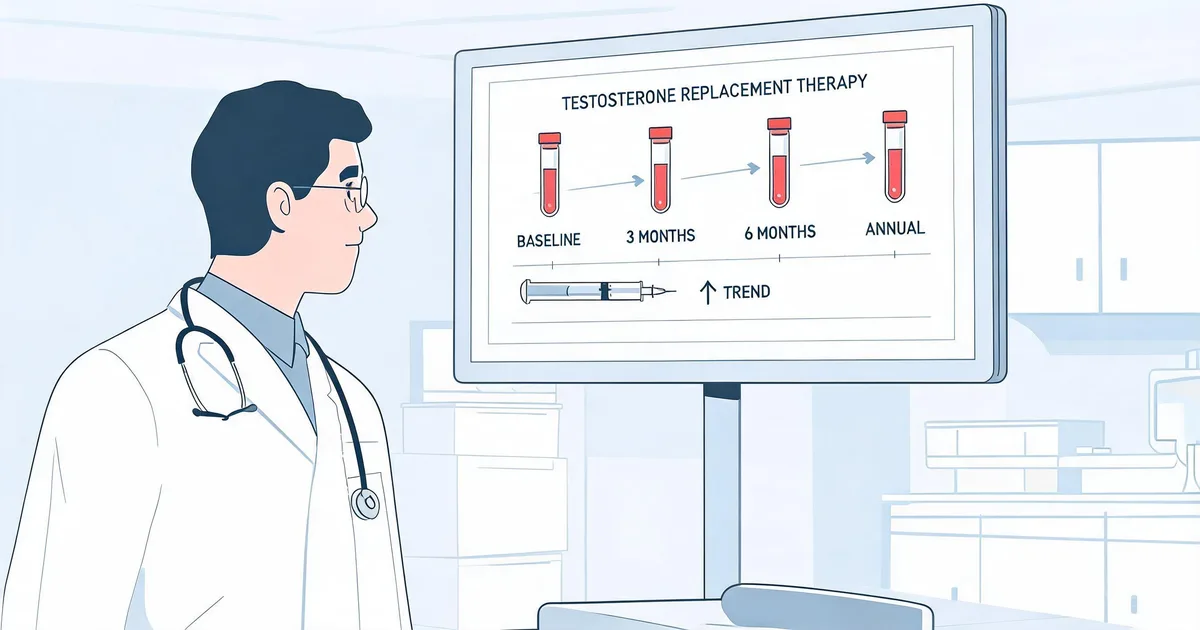
Most clinical protocols follow a consistent checkpoint structure regardless of delivery route, adjusting the interval as the dose stabilizes:
- Baseline: testosterone, hematocrit, and PSA (in men over 40) drawn before the first dose, establishing the pre-treatment reference point for every later comparison.
- 3 months: the first on-treatment check, timed to the delivery-route-specific trough or steady-state window (Section 3), used to confirm the starting dose is adequate or to trigger a dose adjustment.
- 6 months: a second on-treatment check, particularly important if the 3-month dose was adjusted, to confirm the revised dose has stabilized the level.
- Annually thereafter: once testosterone, hematocrit, and PSA have been stable across two consecutive checks, monitoring frequency drops to once yearly unless symptoms change or a dose adjustment is made.
Any dose change — route switch, interval change, or dose increase/decrease — resets the clock: the next check happens at 3 months post-change, not at the next scheduled annual date.
3. Trough Timing by Delivery Route
Because testosterone delivery routes produce very different pharmacokinetic curves, the correct draw time is route-specific:
| Delivery Route | Typical Interval | Correct Draw Timing |
|---|---|---|
| IM injection | Weekly to every 2 weeks | Trough — immediately before the next scheduled injection |
| Transdermal gel/patch | Daily application | Any time at steady state (after ~1 week of consistent daily use) |
| Subcutaneous pellets | Every 3–6 months | Midpoint between insertions, not immediately post-implant |
| Buccal/nasal | Multiple daily doses | Immediately before the next scheduled dose |
IM injection produces the widest peak-to-trough swing of any route — levels can rise several-fold in the days immediately after an injection before declining toward the next dose — which is exactly why trough timing is non-negotiable for this route: a level drawn even a day or two early can look falsely adequate. Daily transdermal gel, by contrast, reaches a comparatively flat steady state within about a week of consistent use, so exact timing matters less as long as the patient has been on a stable daily regimen. Pellets follow the opposite curve to injections — an early post-implant peak that gradually declines over months — so a midpoint draw at 10–12 weeks into a 12-week interval better represents the patient's typical exposure than a check taken immediately after insertion.
"For injectable TRT, the single most common cause of a confusing monitoring result isn't the assay — it's a sample drawn on the wrong day of the injection cycle."
4. Target Testosterone Levels During Treatment
The treatment target is not the same number as the diagnostic reference range ceiling. Most guidelines aim for a trough or steady-state total testosterone in the mid-normal range, roughly 450–600 ng/dL, rather than pushing toward the top of the reference interval. The clinical goal is symptom resolution — improved energy, libido, and mood — at the lowest dose that achieves it, not maximizing the lab number.
- Below target at trough: suggests the dose or interval is insufficient; options are increasing the dose, shortening the injection interval, or switching delivery route.
- Above target, especially with a supraphysiologic peak: increases erythrocytosis and cardiovascular risk without added symptomatic benefit; the response is dose reduction or interval extension, not necessarily discontinuation.
- Symptoms persisting despite an in-range trough: warrants checking free testosterone (Section 5) and reviewing draw timing before assuming the dose itself needs to change.
5. Total vs. Free Testosterone in Monitoring
Total testosterone remains the standard monitoring analyte for most patients, and it's what the checkpoint schedule in Section 2 is built around. Free or calculated free testosterone becomes clinically useful in a narrower set of circumstances: when sex hormone-binding globulin (SHBG) is itself abnormal, since SHBG determines what fraction of total testosterone is biologically available rather than protein-bound.
- Obesity: typically lowers SHBG, which can make total testosterone under-represent the free, active fraction.
- Aging and thyroid disease: both shift SHBG in ways that decouple total testosterone from clinical effect.
- Symptom-result mismatch: a patient reporting persistent hypogonadal symptoms despite an in-range total testosterone trough is the clearest clinical trigger for adding a free testosterone measurement to the panel.
For most stable patients on a consistent regimen, however, total testosterone alone — drawn at the correct trough or steady-state timing — is sufficient for routine follow-up, and adding free testosterone to every visit adds cost without changing management in the majority of cases.
6. Safety Monitoring Beyond Testosterone
A TRT monitoring panel is not testosterone alone — two safety parameters carry as much clinical weight as the hormone level itself:
| Parameter | Schedule | Action Threshold |
|---|---|---|
| Hematocrit | Baseline, 3–6 months, then annually | >54% — reduce dose, extend interval, or discontinue |
| PSA (men >40) | Baseline, then per screening guidelines | Rise >1.4 ng/mL within 12 months — urology referral |
Hematocrit is the more time-sensitive of the two: TRT stimulates erythropoiesis, and unmonitored erythrocytosis raises thrombotic risk in a way that can develop within the first few months of therapy, which is why it shares the 3- and 6-month checkpoints with testosterone itself rather than waiting for the annual review. PSA changes more slowly and is primarily a cancer-surveillance signal layered onto standard age-based prostate screening rather than a TRT-specific safety stop.
IVD Application Note
A TRT monitoring panel that pairs testosterone with hematocrit and PSA on a shared requisition reduces the number of separate blood draws needed to complete a single checkpoint visit, which matters for patient compliance with the 3-/6-month/annual schedule.
7. Assay & Panel Design Considerations
Building a monitoring-specific testosterone assay introduces a few requirements beyond what a diagnostic-only platform needs:
- Upper range extension: monitoring samples, especially IM injection peaks drawn off-schedule, can reach supraphysiologic concentrations well above the diagnostic reference range, so the assay's upper linear range needs headroom beyond what a purely diagnostic panel requires.
- Competitive format, same as diagnosis: testosterone's small molecular size means monitoring assays use the same competitive immunoassay format as diagnostic assays — no separate chemistry is needed, only a wider validated range.
- Result reporting with draw-time context: because a monitoring value is only interpretable alongside its draw timing relative to the last dose, LIS/EMR integration that captures and displays this context alongside the numeric result reduces misinterpretation at the point of care.
- Panel bundling: co-formatting testosterone with hematocrit and PSA on CLIA platforms serving andrology and endocrinology clinics matches how these tests are actually ordered together in practice.
8. Summary
TRT monitoring is a distinct measurement problem from diagnosis, built around a fixed schedule and route-specific timing rules:
- Schedule: baseline, 3 months, 6 months, then annually once stable — any dose change resets the clock.
- Trough timing: injections need a true pre-dose trough; gels reach steady state within about a week; pellets are best checked at the interval midpoint.
- Target: mid-normal trough (roughly 450–600 ng/dL), not the top of the reference range.
- Total vs. free: total testosterone for routine follow-up; free testosterone when SHBG is abnormal or symptoms don't match the total result.
- Safety labs: hematocrit on the same 3-/6-month/annual cadence as testosterone; PSA per standard screening guidelines with a defined referral trigger.
At Sekbio, we manufacture the competitive-format antibodies behind testosterone CLIA and LFA assays, validated across the dynamic range needed for both diagnostic and monitoring use cases. If you're building a TRT follow-up panel, our team can walk through reagent-level performance data for your specific platform.
Frequently Asked Questions — TRT Monitoring
How often should testosterone be checked after starting replacement therapy?
The standard schedule checks testosterone at baseline before starting therapy, again at 3 months and 6 months after initiation or any dose change, and then annually once the dose is stable. Hematocrit follows a similar cadence, checked at baseline, 3-6 months, and annually thereafter.
Why does trough timing matter for testosterone monitoring but less for diagnosis?
A diagnostic testosterone test measures a patient's own endogenous production, which follows a predictable morning-peak circadian rhythm regardless of when in the cycle it's drawn relative to any medication. A monitoring test measures the effect of an exogenous dose, so the result depends heavily on how much time has elapsed since the last administration - drawing at trough (just before the next dose) versus at peak can produce a two- to three-fold difference in the same patient on the same regimen.
What testosterone level should TRT be targeting?
Most guidelines target a trough or steady-state total testosterone in the mid-normal range, roughly 450-600 ng/dL, rather than the top of the reference range. The goal is symptom resolution at the lowest effective dose, not maximizing the number - supraphysiologic levels increase erythrocytosis and other risks without added clinical benefit.
Should free or total testosterone be used to monitor TRT?
Total testosterone is the standard monitoring analyte for most patients. Free or calculated free testosterone becomes useful specifically when SHBG is abnormal - obesity, aging, and thyroid disease all shift SHBG and can make total testosterone under- or over-represent the biologically active fraction, so a patient with symptoms inconsistent with their total testosterone result is a candidate for a free testosterone recheck.
What safety labs matter beyond testosterone itself during TRT?
Hematocrit is the primary safety parameter - TRT stimulates erythropoiesis, and a hematocrit above roughly 54% warrants dose reduction, injection interval extension, or discontinuation due to thrombotic risk. PSA is checked at baseline in men over 40 and monitored per standard prostate screening guidelines; a PSA rise of more than 1.4 ng/mL within 12 months of starting therapy warrants urology referral.
Does Sekbio supply antibodies for testosterone monitoring assay development?
Yes. Sekbio supplies sheep monoclonal antibodies (S01-T-1S and Testo-W251S) validated for competitive CLIA and LFA testosterone immunoassay development, covering the 0.1-15 ng/mL dynamic range needed for both diagnostic and monitoring use. Explore the datasheet or discuss a custom monitoring panel through our antibody development services.