Progesterone is one of the most frequently ordered — and most frequently misread — hormone tests in reproductive medicine. A single number can mean something entirely different depending on the day of the cycle it was drawn, whether the patient is pregnant, and what stage of life she is in. This guide sets out the normal progesterone ranges by menstrual cycle phase, pregnancy trimester, and menopause status, explains what low and high progesterone mean clinically, and clarifies how progesterone works together with estrogen.
What Is Progesterone?
Progesterone is a steroid hormone produced mainly by the corpus luteum — the temporary endocrine structure that forms in the ovary from the follicle after ovulation — and later by the placenta once pregnancy is established. Its central biological role is to prepare and maintain the endometrium (uterine lining) for embryo implantation and to sustain early pregnancy until the placenta takes over hormone production.
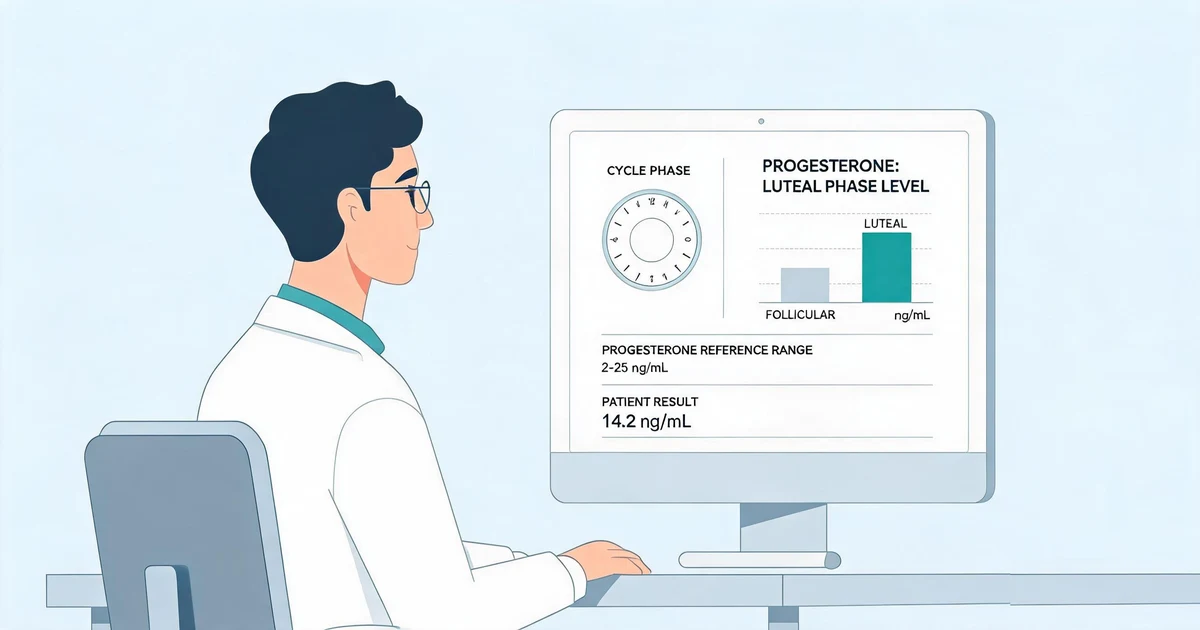
Across the menstrual cycle, progesterone follows a predictable pattern: it stays low and flat during the follicular phase (before ovulation), rises sharply within 24-48 hours after ovulation as the corpus luteum forms, peaks roughly a week later in the mid-luteal phase, and then falls again in the final days of the cycle if fertilization has not occurred — the drop that triggers menstruation. Small additional amounts of progesterone are produced by the adrenal glands in both women and men, where it mainly serves as a biochemical precursor for cortisol, aldosterone, and sex steroids rather than a reproductive signal. (Source: Taraborrelli, Acta Obstet Gynecol Scand 2015)
Units note: Progesterone is reported in ng/mL in the United States and nmol/L in much of Europe and Asia. To convert, multiply ng/mL by 3.18 to get nmol/L (e.g., 10 ng/mL ≈ 31.8 nmol/L). Confirm which unit your laboratory uses, and always interpret a result against the cycle day or gestational week it was drawn.
Progesterone vs. Progestin
The terms "progesterone" and "progestin" are often used interchangeably in casual conversation, but they are not the same thing. Progesterone refers specifically to the natural hormone the body produces, or a version manufactured to be molecularly identical to it. Progestin is a broader umbrella term for synthetic compounds that bind the progesterone receptor and mimic some of its effects — used, for example, in many hormonal contraceptives and some hormone therapies — but progestins can differ structurally from natural progesterone and may not replicate its full physiological profile. Laboratory progesterone blood tests measure natural progesterone, not progestin activity, which is why a patient taking a progestin-only contraceptive will still show a low, follicular-phase-like progesterone result on standard testing.
Do men produce progesterone? Yes. Progesterone is not exclusive to female physiology — men produce small amounts via the adrenal glands and testes, typically in the range of 0.2-1.4 ng/mL. In men, progesterone functions mainly as a biosynthetic precursor for testosterone and cortisol rather than as a reproductive signal, and it is rarely tested clinically outside of specific adrenal or steroidogenesis work-ups.
Normal Progesterone Levels
Because progesterone output depends entirely on whether — and when — ovulation has occurred, "normal" is defined separately for each cycle phase, each pregnancy trimester, and the postmenopausal state.
By Menstrual Cycle Phase
| Cycle Phase | Typical Progesterone | Clinical Note |
|---|---|---|
| Follicular phase (pre-ovulation) | 0.1-0.7 ng/mL | Low and stable; corpus luteum has not yet formed |
| Ovulation | 0.5-2.5 ng/mL | Beginning to rise as the follicle luteinizes |
| Mid-luteal phase (~7 days post-ovulation) | 5-20 ng/mL | >3 ng/mL generally confirms ovulation occurred |
| Late luteal phase (pre-menstrual) | 2-10 ng/mL | Declining unless implantation occurs |
By Pregnancy Trimester & Postmenopause
| Stage | Typical Progesterone | Clinical Note |
|---|---|---|
| First trimester (weeks 1-12) | 10-44 ng/mL | Corpus luteum, transitioning to placental production |
| Second trimester (weeks 13-27) | 19.5-82.5 ng/mL | Placenta is the dominant source |
| Third trimester (weeks 28-40+) | 65-290 ng/mL | Continues rising toward term |
| Postmenopausal | <0.5 ng/mL | Comparable to follicular-phase baseline; ovulation has stopped |
Individual results vary by several-fold even within the same phase or trimester, and reference intervals differ meaningfully between assay platforms (ELISA, CLIA, ECLIA). A result should always be interpreted using the reporting laboratory's own range and cycle-day or gestational-week context — not compared directly against a generic chart.
Low Progesterone — Symptoms & Causes
Low progesterone most commonly results from anovulation — a menstrual cycle in which an egg is not released — because progesterone is produced in meaningful quantities only after ovulation, by the corpus luteum.
Common Causes of Low Progesterone
- Anovulatory cycles: The single most common cause; no corpus luteum forms, so progesterone stays at follicular-phase levels throughout the cycle
- Polycystic ovary syndrome (PCOS): Irregular or absent ovulation leads to chronically low progesterone
- Luteal phase defect: The corpus luteum forms but produces insufficient progesterone or regresses prematurely
- Perimenopause: Ovulation becomes inconsistent years before menstrual cycles stop entirely
- Excessive exercise or low body weight: Can suppress the hypothalamic-pituitary-ovarian axis and disrupt ovulation
- Chronic stress: Elevated cortisol production can divert shared steroid precursors away from progesterone synthesis
- Thyroid dysfunction: Both hypothyroidism and hyperthyroidism can disrupt normal ovulatory cycles
Symptoms associated with low progesterone in women include irregular or unusually short menstrual cycles, spotting in the days before a period, breast tenderness, difficulty conceiving, early pregnancy loss, and mood changes or anxiety in the premenstrual window. Because these symptoms overlap with many other conditions, a documented low progesterone result — ideally a mid-luteal blood draw — is used to confirm the pattern rather than symptoms alone.
When patients ask how to raise low progesterone, the short answer is that management depends on the underlying cause and reproductive goals, and can range from addressing anovulation directly to progesterone supplementation options guided by a clinician.
High Progesterone — What It Means
Outside of pregnancy, high progesterone is uncommon and is usually one of three things: a normal mid-luteal peak, confirmation that ovulation has occurred, or the expected effect of progesterone supplementation. Less commonly, elevated progesterone in women who are not pregnant can be associated with certain ovarian cysts, congenital adrenal hyperplasia, or — rarely — an adrenal or ovarian tumor that secretes progesterone.
During pregnancy, rising progesterone is expected and healthy, increasing steadily toward term as the placenta matures. Unusually high progesterone in pregnancy can occur with a multiple pregnancy (twins or more), since additional placental tissue produces additional hormone. High progesterone — whether physiological or supplemented — commonly causes bloating, breast tenderness, fatigue, and mood changes that overlap closely with premenstrual symptoms, since these effects are mediated by the same hormone.
Progesterone is rarely interpreted alone — most fertility work-ups pair it with a broader estradiol and progesterone hormone panel to assess the full luteal phase picture.
Progesterone in Early Pregnancy
In early pregnancy, progesterone is produced by the corpus luteum until roughly 8-10 weeks' gestation, after which the placenta gradually takes over — a transition known as the luteal-placental shift. Typical first-trimester progesterone levels fall in the range of approximately 10-44 ng/mL, though this varies by assay and gestational week.
Unlike hCG, which is expected to roughly double every 48-72 hours in early viable pregnancy, progesterone does not follow a doubling pattern and instead stays relatively stable through the first trimester — which is why clinicians typically evaluate a single progesterone value rather than a trend. In symptomatic first-trimester patients (those with bleeding or pain), a progesterone level below approximately 10 ng/mL is associated with a substantially higher likelihood of a non-viable pregnancy, while higher values are reassuring — though progesterone alone cannot confirm viability and is always interpreted alongside hCG trends and ultrasound findings. (Source: Systematic review and meta-analysis, Fertil Steril / Hum Reprod 2022)
Clinical rule: Progesterone is a supportive test, not a stand-alone diagnostic one, in early pregnancy evaluation. A low value in a symptomatic patient raises concern but does not by itself confirm miscarriage or ectopic pregnancy — serial hCG and ultrasound remain the primary diagnostic tools.
Progesterone and Menopause
Progesterone typically begins to decline during perimenopause, often years before estrogen falls significantly, because ovulation becomes irregular before it stops altogether — and progesterone is produced only in cycles where ovulation occurs. This timing mismatch, where estrogen remains relatively higher for longer while progesterone drops earlier, is often described as relative estrogen dominance and is a major contributor to perimenopausal symptoms such as heavy or irregular bleeding, breast tenderness, and mood changes.
After menopause, once ovulation has stopped entirely, progesterone settles at a consistently low postmenopausal baseline — generally under 0.5 ng/mL, similar to the follicular-phase level seen throughout reproductive life. Postmenopausal progesterone levels are not expected to fluctuate, unlike the cyclical pattern seen before menopause.
Estrogen and Progesterone Balance
Estrogen and progesterone act as a coordinated pair across the menstrual cycle rather than as independent, unrelated hormones. Estrogen dominates the follicular phase, stimulating growth of the uterine lining; progesterone dominates the luteal phase, stabilizing that lining, converting it into a form receptive to implantation, and counterbalancing estrogen's proliferative effect on endometrial tissue.
- Balanced cycle: Ovulation triggers progesterone production, which appropriately offsets ongoing estrogen activity
- High estrogen, low progesterone: Occurs when ovulation does not happen (or is delayed) — estrogen continues acting on the endometrium without progesterone's stabilizing counterbalance, which can contribute to heavy or irregular bleeding, breast tenderness, and mood symptoms
- PCOS pattern: Chronic anovulation in PCOS frequently produces this same high-estrogen, low-progesterone pattern over many cycles
This estrogen-progesterone relationship is also why the two hormones are typically measured together in a fertility or menstrual irregularity work-up rather than in isolation — a single progesterone value is most clinically meaningful when interpreted alongside estradiol and the cycle-day context. For a broader look at reproductive hormone testing, see our guide to fertility hormone testing, covering AMH and ovarian reserve assessment.
Progesterone Antibody for Fertility IVD Manufacturing
Sekbio supplies anti-progesterone monoclonal antibodies for CLIA and lateral flow fertility assay development — ISO 13485 certified, validated across the full clinical progesterone range from follicular baseline through third-trimester levels.
Developing your own progesterone assay? See our progesterone antibody pair design guide for the competitive-format requirements and 17-OH-progesterone cross-reactivity control this class of assay demands.
Frequently Asked Questions About Progesterone
What is progesterone?
Progesterone is a steroid hormone produced mainly by the corpus luteum after ovulation, and later by the placenta during pregnancy. Its primary role is to prepare and maintain the uterine lining for implantation and to sustain early pregnancy.
Levels are low and stable during the follicular phase, rise sharply after ovulation, and fall again before menstruation if pregnancy does not occur.
What are normal progesterone levels?
Normal progesterone varies by cycle phase and life stage: 0.1-0.7 ng/mL in the follicular phase, 5-20 ng/mL in the mid-luteal phase (values above 3 ng/mL generally confirm ovulation), roughly 10-44 ng/mL in the first trimester of pregnancy rising to 65-290 ng/mL in the third trimester, and under 0.5 ng/mL after menopause.
Always interpret a result against your lab's own reference range and the cycle day or gestational week it was drawn.
What causes low progesterone in women?
Low progesterone most commonly results from anovulation. Common causes include PCOS, luteal phase defect, perimenopause, excessive exercise or low body weight, chronic stress, and thyroid dysfunction. Symptoms can include irregular or short cycles, premenstrual spotting, difficulty conceiving, and early pregnancy loss.
What does high progesterone mean?
Outside pregnancy, high progesterone is usually just a normal mid-luteal peak or a sign of supplementation. During pregnancy it is expected and rises toward term, with unusually high levels sometimes seen in multiple pregnancy. High progesterone can cause bloating, breast tenderness, fatigue, and mood changes.
What are normal progesterone levels in early pregnancy?
First-trimester progesterone typically ranges from roughly 10-44 ng/mL. A single value below approximately 10 ng/mL in a symptomatic patient (bleeding or pain) is associated with a higher likelihood of non-viable pregnancy, though it is always interpreted alongside hCG trends and ultrasound rather than in isolation.
How does progesterone change with menopause?
Progesterone declines during perimenopause as ovulation becomes irregular, often before estrogen falls significantly. After menopause, once ovulation has stopped, progesterone remains consistently low — generally under 0.5 ng/mL — similar to the follicular-phase baseline.