Antibiotic overuse in suspected bacterial infection is one of the most persistent problems in acute care — clinicians often cannot distinguish bacterial from viral or non-infectious inflammation quickly enough to justify withholding treatment, so antibiotics get started "just in case" and continued longer than necessary. Procalcitonin (PCT)-guided algorithms give that decision a quantitative anchor, translating a biomarker trend into explicit start/continue/stop rules.
This guide walks through the four-step PCT algorithm used in landmark antibiotic stewardship trials, the cutoff values behind each decision point, and where the approach has held up — and where it hasn't — across different clinical settings.
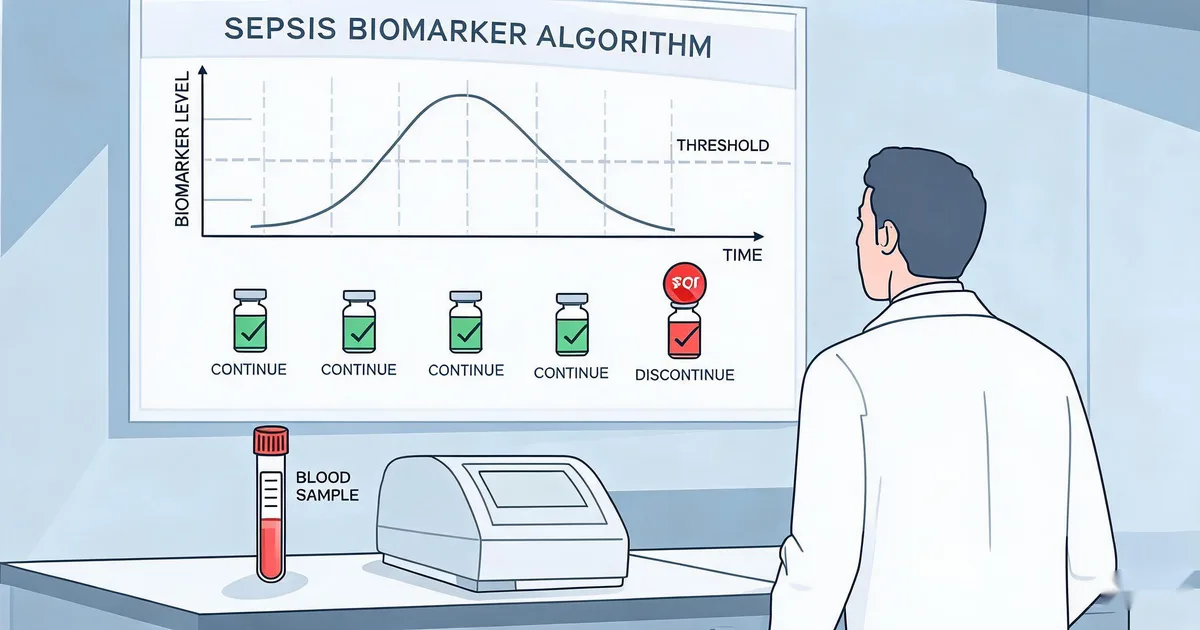
1. What Is Procalcitonin-Guided Antibiotic Stewardship?
Procalcitonin-guided antibiotic stewardship is a protocol that uses serial PCT measurements — rather than clinical judgment alone — to decide whether to start, continue, or stop antibiotic therapy in patients with suspected bacterial infection or sepsis. PCT is a propeptide of calcitonin that is normally confined to thyroid C-cells, but under bacterial endotoxin and pro-inflammatory cytokine stimulation, extrathyroidal tissues throughout the body release it into circulation.
What makes PCT clinically useful for this purpose is its kinetic profile relative to other inflammatory markers. It rises within 2–4 hours of bacterial stimulus, roughly doubles every 24 hours if the infection is untreated, and has a plasma half-life of about 24 hours — fast enough to detect acute bacterial infection early, and stable enough to support meaningful day-over-day trending. By contrast, CRP rises more slowly (6–8 hours, peaking near 48 hours) and responds to viral infection, autoimmune disease, and tissue injury as well as bacterial infection, making it a less specific gate for the antibiotic decision.
Critical Principle
PCT-guided algorithms are decision-support tools, not stand-alone diagnostic rules. Every published protocol pairs the PCT cutoff with a clinical override: patients who are hemodynamically unstable or have an unequivocal source of bacterial infection start antibiotics regardless of PCT value.
2. Step 1: Baseline PCT Measurement at Suspected Infection Onset
The algorithm begins with a baseline blood draw as soon as bacterial infection or sepsis is clinically suspected — ideally before or at the time the first antibiotic dose is given, so the result reflects the untreated inflammatory state rather than a partially treated one.
- Sample type: serum or plasma, processed the same way across all algorithm timepoints for a given patient to keep trend values comparable.
- Timing relative to symptom onset: PCT may still be rising in the first 2–4 hours after infection onset, so a low value very early in the clinical course does not exclude bacterial infection as reliably as a value drawn 6+ hours in.
- Baseline serves double duty: it both feeds the initiation decision (Step 2) and becomes the peak-value reference point for the later discontinuation decision (Step 4).
3. Step 2: PCT Cutoff Thresholds for Antibiotic Initiation
The Christ-Crain/Schuetz four-tier cutoff scale, validated in the trials discussed below, translates the baseline PCT value into a graded recommendation rather than a binary yes/no:
| PCT Level | Bacterial Infection Likelihood | Antibiotic Recommendation |
|---|---|---|
| < 0.1 ng/mL | Highly unlikely | Strongly discouraged |
| 0.1 – 0.25 ng/mL | Unlikely | Discouraged unless clinically unstable |
| 0.25 – 0.5 ng/mL | Likely | Encouraged |
| > 0.5 ng/mL | Very likely | Strongly encouraged |
In critical care, a second, sepsis-severity-oriented cutoff scale is used alongside this one: PCT above 2 ng/mL indicates probable sepsis, and above 10 ng/mL indicates severe sepsis or septic shock. The two scales serve different questions — the four-tier scale asks "is this bacterial," the severity scale asks "how sick is this patient" — and both are described in more analytical detail on the PCT antibody pair datasheet.
4. Step 3: Serial Monitoring at 24–48 Hour Intervals
A single PCT value only answers the initiation question. Once antibiotics are started, the algorithm shifts to tracking the trend: re-measuring PCT every 24–48 hours to distinguish a patient who is responding to treatment from one who is not.
- Responding patients: PCT typically declines by more than 50% per day once effective antibiotic therapy controls the source of infection.
- Non-responding or worsening patients: a PCT plateau or continued rise despite 48–72 hours of therapy should prompt source control review, culture reassessment, or an antibiotic regimen change — the algorithm flags the problem without dictating the specific clinical action.
- Assay precision matters here: because the decision depends on the size of a day-over-day change rather than a single absolute value, an assay with within-run CV above roughly 10% can obscure a real clinical trend in analytical noise.
5. Step 4: Relative PCT Change Criteria for Antibiotic Discontinuation
The discontinuation decision — arguably the algorithm's biggest stewardship impact, since over-treatment duration is where most avoidable antibiotic exposure accumulates — uses a relative-change rule layered on top of the absolute cutoffs from Step 2:
- Stop antibiotics when PCT has fallen by 80% or more from its peak value, provided the patient is clinically stable.
- Alternatively, stop when PCT falls below the 0.25–0.5 ng/mL absolute discontinuation threshold, even if the relative decline has not yet reached 80%.
- Neither criterion overrides clinical judgment — ongoing signs of infection (fever, hemodynamic instability, positive cultures) keep the patient on therapy regardless of the PCT trend.
"The discontinuation rule, not the initiation rule, is where PCT-guided algorithms save the most antibiotic-days — most published stewardship benefit comes from stopping therapy sooner in patients who are already improving, not from withholding it at the outset."
6. Clinical Trial Evidence & Limitations
The algorithm above is not a theoretical construct — it was built and refined across several multicenter randomized controlled trials, with mixed but instructive results:
| Trial | Setting | Key Finding |
|---|---|---|
| ProHOSP (2009) | ED, lower respiratory tract infection, Switzerland | PCT-guided algorithm reduced antibiotic exposure by roughly one-third without increasing treatment failure or mortality. |
| PRORATA (2010) | ICU, mixed infections, France | PCT-guided discontinuation shortened mean antibiotic-treatment duration without increasing 28-day mortality. |
| SAPS (2016) | ICU, critically ill patients, Netherlands | PCT-guided discontinuation reduced antibiotic exposure and was associated with lower mortality versus standard care. |
| ProACT (2018) | ED & inpatient, lower respiratory infection, United States | No significant reduction in antibiotic use versus usual care — benefit was context-dependent on baseline prescribing habits. |
The ProACT result is the important caveat: in a U.S. practice environment where clinicians were already relatively conservative about antibiotic duration, adding a PCT algorithm produced little additional stewardship benefit. The clearest gains appear in settings with a higher baseline rate of prolonged or unnecessary antibiotic courses, which is consistent with PCT-guided stewardship being an adjunct to — not a replacement for — local antimicrobial stewardship practice. For source literature, see ProHOSP on PubMed, PRORATA on PubMed, SAPS on PubMed, and ProACT on PubMed.
7. Assay Format Considerations for PCT-Guided Protocols
Implementing this algorithm on an IVD platform imposes specific analytical requirements that differ from a general-purpose infection marker assay:
- Low-end precision: the 0.1–0.5 ng/mL decision zone sits near the bottom of the assay's working range, so a clinical limit of detection around 0.02 ng/mL and within-run CV of ≤2–3% are needed to reliably separate adjacent cutoff tiers.
- Wide linear range without dilution: critically ill patients can present anywhere from <0.1 ng/mL to >90 ng/mL, so a single-dilution linear range spanning that full spread simplifies workflow for STAT testing.
- Format choice: CLIA analyzers suit centralized labs running serial trends on hospitalized patients; FIA/POCT lateral-flow formats suit emergency departments and lower-resource settings where a same-visit initiation decision is needed.
- Batch-to-batch consistency: because the discontinuation decision depends on comparing today's value to a value drawn 1–2 days earlier, lot-to-lot reagent drift below roughly 10% deviation is necessary so a apparent "improvement" isn't actually a calibration artifact.
IVD Application Note
Sekbio's PCT antibody pair is validated across a 0.27–94.95 ng/mL linear range with a 0.02 ng/mL clinical LoD and CV ≤2.0% (n=20), covering the full initiation-to-discontinuation decision range described above without sample dilution for most clinical presentations.
8. Summary
Procalcitonin-guided antibiotic stewardship reduces this to a repeatable, four-step process:
- Baseline measurement: draw PCT at suspected infection onset, before or at first antibiotic dose.
- Initiation cutoffs: use the four-tier 0.1/0.25/0.5 ng/mL scale as a decision-support layer on top of clinical judgment.
- Serial monitoring: re-measure every 24–48 hours to track treatment response as a trend, not a single value.
- Discontinuation rule: stop when PCT falls ≥80% from peak or below the 0.25–0.5 ng/mL threshold in a stable patient — this is where most of the antibiotic-day savings occur.
- Evidence base: ProHOSP, PRORATA, and SAPS support meaningful reductions in antibiotic exposure; ProACT shows the benefit is smaller where baseline prescribing is already conservative.
At Sekbio, we manufacture the monoclonal antibody pairs that make this kind of low-end precision possible in CLIA and FIA sandwich immunoassay formats. If you are developing a sepsis panel or a stand-alone PCT assay and need reagent-level performance data to support your validation file, our team can walk through the datasheet with you.
Frequently Asked Questions — Procalcitonin-Guided Antibiotic Stewardship
What is procalcitonin (PCT) and why is it used to guide antibiotic therapy?
Procalcitonin is a peptide released by extrathyroidal tissues in response to bacterial endotoxin and pro-inflammatory cytokines. Unlike CRP or white cell count, PCT rises specifically with systemic bacterial infection and stays comparatively low in viral illness, which is why it is used as a decision-support biomarker for starting, withholding, or stopping antibiotics.
How long does it take for PCT levels to rise after a bacterial infection?
PCT begins rising within 2–4 hours of bacterial stimulus, roughly doubles every 24 hours if infection is untreated, and typically peaks between 6 and 24 hours. Its plasma half-life of about 24 hours makes daily serial measurement clinically meaningful for tracking treatment response.
Can PCT-guided algorithms be used for viral infections or COVID-19?
PCT-guided algorithms are designed for bacterial infection and sepsis, not viral illness. In uncomplicated viral infections, including most COVID-19 cases without bacterial superinfection, PCT typically remains low. A rising PCT in a patient with a viral diagnosis should prompt evaluation for secondary bacterial infection rather than being used to justify withholding antibiotics on viral grounds alone.
What is the difference between PCT and CRP for infection monitoring?
PCT rises faster (2–4 hours) and is more specific to bacterial infection than CRP, which rises more slowly (6–8 hours, peaking around 48 hours) and is also elevated in viral infection, autoimmune flares, and general tissue injury. PCT is generally preferred for antibiotic initiation and discontinuation decisions, while CRP remains useful as a complementary marker of overall inflammatory burden.
How is the PCT discontinuation cutoff validated in clinical trials?
The 80% relative-decrease-from-peak and sub-0.25–0.5 ng/mL absolute cutoffs were validated in multicenter randomized controlled trials including ProHOSP, PRORATA, and the SAPS ICU trial, which compared PCT-guided antibiotic discontinuation against standard-duration therapy and found shorter antibiotic courses without increased treatment failure.
Does Sekbio offer a PCT antibody pair for antibiotic stewardship assay development?
Yes. Sekbio supplies a validated PCT monoclonal antibody pair for CLIA and FIA sandwich immunoassay development, with a 0.02 ng/mL clinical limit of detection and CV ≤2.0% (n=20), precise enough to resolve the 0.1–0.5 ng/mL antibiotic-decision zone. See the PCT antibody pair datasheet or explore our full antibody development services for custom sepsis panel projects.