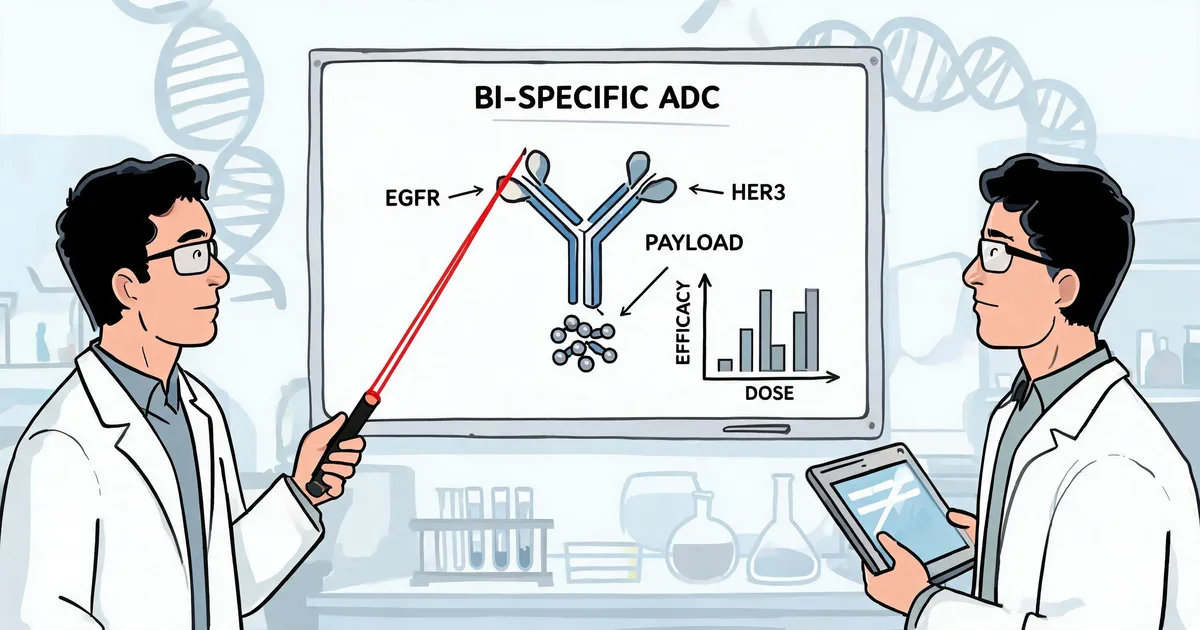
On June 22, 2026, China's National Medical Products Administration (NMPA) approved izalontamab brengitecan (iza-bren, developed under the code BL-B01D1 by Baili Pharmaceuticals) for adults with recurrent or metastatic nasopharyngeal carcinoma who had progressed after at least two lines of chemotherapy and a PD-1/PD-L1 inhibitor. It is the world's first approved bispecific antibody-drug conjugate — a molecule that binds two different tumor antigens, EGFR and HER3, and delivers a cytotoxic payload through that dual engagement.
The clinical headline is significant on its own. But for antibody developers, the more durable story is what iza-bren represents structurally: a bispecific IgG-format molecule manufactured at commercial scale and regulatory-grade consistency — something the field has spent two decades trying to make routine. This article breaks down what a bispecific ADC actually is, why bispecific antibodies are structurally harder to express than conventional monoclonal antibodies, and what a recombinant expression platform needs to solve the chain-mispairing problem that sits at the center of that difficulty.
1. What Is a Bispecific ADC?
A bispecific ADC (antibody-drug conjugate) is a therapeutic that fuses two engineering disciplines: bispecific antibody design and ADC chemistry. A conventional ADC conjugates a cytotoxic small-molecule payload to a monoclonal antibody that binds one target. A bispecific ADC instead builds the payload onto a bispecific antibody backbone — a single molecule engineered to bind two different antigens, or two distinct epitopes on the same antigen, at once.
The dual-targeting design is the point. By requiring simultaneous or cooperative engagement of two tumor-associated antigens, a bispecific ADC can be engineered for:
- Higher tumor selectivity: co-expression of both targets is rarer on normal tissue than either target alone, narrowing the toxicity window.
- Broader tumor coverage: tumors with heterogeneous antigen expression are more likely to be hit if the antibody can engage either target.
- Enhanced internalization: dual binding can drive faster receptor clustering and endocytosis, increasing intracellular payload delivery per binding event.
Pro Tip
Not every "bispecific ADC" is built the same way. Some formats use a full IgG-like scaffold with two different Fab arms (iza-bren's design); others use fragment-based scaffolds (scFv, Fab, VHH) fused to a common backbone. The manufacturing challenges described in this article apply most directly to IgG-format bispecifics, where heavy and light chain pairing is combinatorial.
2. Inside Iza-Bren: EGFR×HER3 Targeting and Precision Payload Delivery
Iza-bren's approval was built on the PANKU-NPC01 trial, the first global confirmatory Phase III study in later-line nasopharyngeal carcinoma, with results presented as a Late-Breaking Abstract at ESMO 2025 and published in The Lancet. The molecule is also in Phase I–II development across non-small cell lung cancer, small cell lung cancer, breast cancer, and ovarian cancer, reflecting the broad relevance of EGFR and HER3 co-expression across solid tumors.
Structurally, iza-bren is an EGFR×HER3 bispecific antibody conjugated to a proprietary topoisomerase I inhibitor payload (designated Ed-04) through a stable, tetrapeptide-based cleavable linker. EGFR and HER3 are both members of the ErbB receptor family, frequently co-expressed in epithelial tumors and implicated in resistance to single-target EGFR therapies. Binding both receptors on the same cell increases the antibody's avidity and internalization rate compared to a monospecific antibody against either target alone.
In December 2023, Baili Pharmaceuticals licensed ex-China rights to iza-bren to Bristol Myers Squibb in a deal worth up to $8.4 billion — the largest single-asset ADC licensing deal recorded to date. That commercial bet reflects confidence not just in the clinical data, but in the underlying manufacturing platform's ability to reproduce a structurally complex molecule at scale.
"The clinical breakthrough of a bispecific ADC is inseparable from a manufacturing breakthrough — you cannot dose a molecule you cannot reproducibly make."
3. Why Bispecific and Multispecific Antibodies Are Hard to Manufacture
A conventional monoclonal IgG is built from two identical heavy chains and two identical light chains, all encoded by a single pair of DNA sequences. Expressed in CHO or HEK293 cells, the chains assemble correctly essentially by default, because there is only one heavy chain sequence and one light chain sequence to combine.
A bispecific IgG-format antibody breaks that symmetry. To bind two different targets, it needs two different heavy chains (one per antigen-binding arm) and, in many designs, two different light chains as well. Co-expressing four distinct polypeptide chains — HC-A, LC-A, HC-B, LC-B — in a single cell does not automatically produce the one combination you want. It produces a population of molecules assembled from whichever chains happened to associate during folding and secretion.
This is on top of the ADC-specific complexity of conjugation chemistry, drug-to-antibody ratio (DAR) control, and linker stability — challenges that already make conventional single-target ADCs harder to manufacture than unconjugated monoclonal antibodies. A bispecific ADC compounds both problem sets at once: the antibody backbone must assemble correctly before conjugation chemistry is even relevant.
4. The Chain-Mispairing Problem: Why One Cell Can Make Ten Different Antibodies
The classic illustration of this problem dates to Milstein and Cuello's early 1980s work on quadroma cells — hybrid hybridomas engineered to secrete two different antibodies simultaneously. When two heavy chains and two light chains are co-expressed without any pairing bias, they combine combinatorially. The commonly cited result: as few as 1 in 10 of the resulting antibody species is the correctly paired bispecific molecule — the rest are homodimers, half-antibodies, and mispaired heavy-light combinations with the wrong specificity or no functional binding at all.
- Heavy-heavy mispairing: without engineering, two different heavy chains can homodimerize with themselves (HC-A/HC-A, HC-B/HC-B) as readily as they heterodimerize (HC-A/HC-B) — only the heterodimer is the desired bispecific core.
- Heavy-light mispairing: each heavy chain can associate with either light chain, not just its intended partner, multiplying the number of possible byproduct species.
- Downstream cost: every mispaired species is either inactive, mono-specific, or potentially immunogenic — and each must be removed by additional purification steps that reduce yield and add cost.
Common Mistake
Treating a bispecific antibody as "two monoclonal antibodies expressed in the same flask" almost always underdelivers. Without format-level engineering built into the sequence design, purification teams end up trying to separate near-identical mispaired byproducts from the target molecule downstream — a slower and more expensive fix than designing the pairing bias in from the start.
5. Engineering Solutions: Knob-into-Holes, Common Light Chain, and Beyond
The antibody engineering field has developed several complementary strategies to force correct pairing at the sequence level, before expression even begins. Each addresses either heavy-heavy pairing, heavy-light pairing, or both.
| Approach | Mechanism | Solves HC/HC Mispairing | Solves HC/LC Mispairing |
|---|---|---|---|
| Knob-into-Holes (KiH) | Complementary "knob" and "hole" mutations engineered into the CH3 domain interface bias heavy chains toward heterodimerization | Yes | No |
| Common light chain | Both antigen-binding arms are designed to pair with a single shared light chain sequence, eliminating light chain choice entirely | No (paired with KiH) | Yes |
| CrossMab | CH1/CL domains are swapped on one arm so each light chain can only assemble correctly with its matched heavy chain | No (paired with KiH) | Yes |
| Electrostatic steering | Charged residue mutations at the CH3 interface make heterodimer formation more thermodynamically favorable than homodimers | Yes | No |
| Controlled Fab-arm exchange | Two separately expressed parental antibodies are combined post-production under controlled redox conditions to exchange half-molecules | Yes | Yes (avoided via separate expression) |
In practice, most clinical-stage bispecific IgGs combine two of these strategies — typically a heavy-chain pairing fix (knob-into-holes or electrostatic steering) with a light-chain solution (common light chain or CrossMab) — to drive the correctly paired species toward the overwhelming majority of expressed product before purification even begins.
6. From DNA to Purified Bispecific: What a High-Throughput Expression Platform Needs
Engineering the right format on paper is necessary but not sufficient. Turning a bispecific sequence design into characterized, purified protein requires an expression and analytical workflow built for multi-chain complexity, not adapted from a standard monoclonal antibody pipeline.
- Multi-plasmid co-transfection control: unlike a monoclonal antibody's single heavy/light chain ratio, a bispecific requires optimizing the transfection ratio across up to four constructs to favor the desired heterodimer.
- Pairing verification, not just titer: a high expression titer means little if half the product is mispaired. Intact-mass LC-MS, native PAGE, and analytical SEC are needed to quantify the fraction of correctly assembled molecule before committing to downstream development.
- Format-aware sequence design: AI-assisted construct design should evaluate CH3 interface mutations, light chain compatibility, and developability liabilities specific to bispecific formats — not just codon optimization.
- A path to stable cell lines: once a format is validated by transient expression, moving to CHO stable cell line development for larger-scale, batch-consistent material is what makes a bispecific candidate manufacturable, not just expressible.
Sekbio's bispecific antibody engineering capability was built around exactly this workflow: CHO and HEK293 co-expression for bispecific and multispecific candidates, format design support, and a route from transient screening to stable CHO cell line development once a pairing-optimized candidate is confirmed. The goal is the same one iza-bren's manufacturing team had to solve at commercial scale — getting from a good idea on paper to a reproducible, correctly assembled molecule.
IVD Application Note
The chain-mispairing challenge is not unique to therapeutic bispecific ADCs — it applies equally to bispecific and multispecific antibody reagents used in diagnostic development, including dual-labeled detection reagents and engineered capture antibodies for complex immunoassay formats.
7. Frequently Asked Questions — Bispecific ADCs and Chain Mispairing
What is a bispecific ADC?
A bispecific ADC (antibody-drug conjugate) is a therapeutic molecule that combines a bispecific antibody — one that binds two different antigens or two epitopes at once — with a cytotoxic payload attached through a chemical linker. Unlike a conventional ADC built on a single-target monoclonal antibody, a bispecific ADC directs its cell-killing payload using dual-antigen engagement, which can improve tumor selectivity and reduce on-target, off-tumor toxicity.
How long does bispecific antibody expression take before a candidate is ready for conjugation?
A transient CHO or HEK293 expression and purification round for a bispecific candidate typically takes 2–3 weeks, yielding enough correctly paired material for early bioreactivity and analytical characterization. Moving from a validated bispecific format to a stable, high-yield CHO cell line for larger-scale material generally takes an additional 3–5 weeks with an optimized platform, versus the industry-typical 3–8 months.
Can a bispecific antibody be expressed in a standard CHO transient system, or does it require special engineering?
A bispecific antibody can be transiently expressed in standard CHO or HEK293 systems, but without chain-pairing engineering built into the antibody sequence itself, co-transfection of two heavy chains and light chains produces a mixture of correctly and incorrectly paired species. Format engineering — such as knob-into-holes or a common light chain — is applied at the sequence-design stage, before expression, so the expression system itself does not need to be specialized.
What is the difference between a bispecific antibody and a biparatopic antibody?
A bispecific antibody binds two different antigens (for example, EGFR and HER3), while a biparatopic antibody binds two distinct epitopes on the same antigen. Both formats face similar heavy-light chain pairing challenges during expression when built as full-length IgG-like molecules from two different antigen-binding arms.
How do you verify correct heavy-light chain pairing in a bispecific antibody?
Correct pairing is typically verified with intact-mass LC-MS, which resolves the mass differences between the desired heterodimer and mispaired homodimer or half-antibody species, complemented by native PAGE or analytical size-exclusion chromatography to detect aggregates and mispaired byproducts. Charge-based methods such as isoelectric focusing can also separate species when the two arms differ in isoelectric point.
Does Sekbio offer bispecific antibody expression and engineering services?
Yes. Sekbio expresses bispecific and multispecific antibodies in CHO and HEK293 systems, supporting format engineering, transient expression screening, pairing verification, and CHO stable cell line development for validated candidates. Visit our bispecific antibody engineering services page to discuss a specific format or target.
8. Summary
Iza-bren's approval is a milestone for a molecular class, not just a single drug:
- First-in-class validation: iza-bren is the world's first approved bispecific ADC, proving that IgG-format bispecific antibody-drug conjugates can be manufactured to regulatory-grade consistency at commercial scale.
- Dual targeting, dual complexity: the EGFR×HER3 mechanism that gives iza-bren its selectivity is the same structural feature — two different antigen-binding arms — that makes bispecific antibodies harder to express than conventional monoclonal antibodies.
- Chain mispairing is the core problem: without format-level engineering, co-expressing two heavy chains and two light chains yields mostly mispaired byproducts, historically estimated at only about 1 in 10 correct molecules.
- Engineering solves it at the sequence level: knob-into-holes, common light chain, CrossMab, and electrostatic steering — often combined — bias expression toward the correctly paired heterodimer before purification begins.
- Platform readiness matters: multi-plasmid transfection control, pairing verification by LC-MS and native PAGE, and a defined path to stable CHO cell line development are what turn a bispecific design into manufacturable material.
At Sekbio, we express and purify bispecific and multispecific antibodies in CHO and HEK293 systems for developers working on the next generation of dual-targeting biologics and IVD reagents. If your program involves a bispecific format and you need a partner who understands chain-pairing verification from the first transient expression round, let's talk.