Twelve months ago, a pitch deck full of confident structure predictions and a slick antibody-design algorithm was often enough to raise a Series A. That is changing fast. Pharma partners, CRO customers, and increasingly investors are asking a harder question — not "can your model generate a binder," but "can you prove it binds, expresses, and behaves like a real candidate, and how fast can you do that at scale?" Pure-algorithm antibody design companies that stop at the prediction step are finding that question increasingly difficult to answer.
This article looks at why the industry is consolidating around a "dry-wet closed loop" — AI-generated candidates validated by in-house robotic wet-lab automation, with the resulting data feeding straight back into the model — and what that shift means for pharma sponsors, CROs, and the antibody-production partners, including Sekbio, that make rapid wet-lab validation possible.
1. What Is the Dry-Wet Closed Loop in Antibody Discovery?
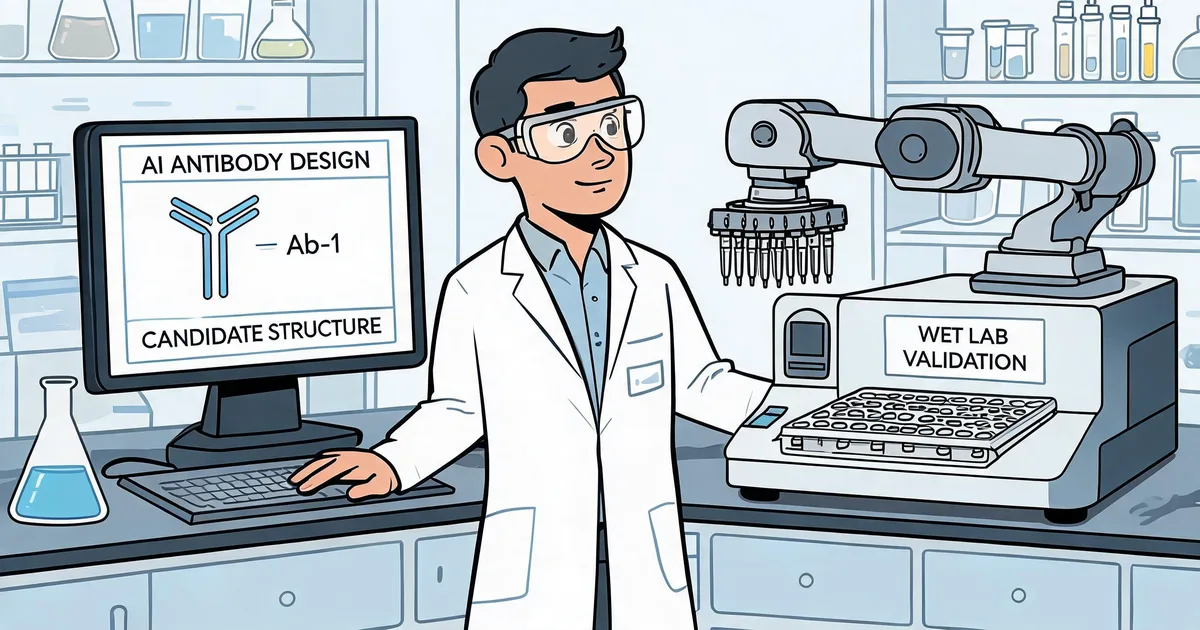
The dry-wet closed loop is an antibody discovery workflow in which computational ("dry") candidate generation and automated experimental ("wet") validation run as one continuous, self-improving cycle rather than two departments connected by an email handoff. A generative model proposes candidate sequences or structures; a robotic wet lab expresses, purifies, and functionally tests a batch of those candidates within days; the resulting binding, expression, and stability data is fed straight back into the model to refine the next generation of candidates. The loop only counts as "closed" when wet-lab results reach the model automatically enough to influence the next design cycle — not once a quarter, but continuously.
- Generate — a language- or diffusion-based model proposes candidate sequences or structures against a target epitope.
- Express and purify — an automated small-scale expression platform produces each candidate in parallel, typically in mammalian (CHO/HEK293) or microbial hosts.
- Screen — high-throughput binding and functional assays (SPR, BLI, cell-based reporter assays) rank candidates on real biophysical performance, not predicted score alone.
- Feed back — expression titer, binding affinity, and developability data return to the model as training signal for the next generation.
Companies that stop at the first step — publishing a predicted structure or an in-silico affinity score — are, by this definition, running an open loop. Their only feedback signal is whatever wet-lab data a paying partner chooses to share back, on that partner's timeline, not their own.
2. Why Pure-Algorithm AI Antibody Companies Are Losing Ground
Two structural problems have caught up with the compute-only model. First, a predicted binder is not a product: every pharma buyer still has to run its own wet-lab confirmation before a candidate enters IND-enabling work, so an algorithm-only vendor is effectively selling a hypothesis, not a validated asset, and gets paid — and trusted — accordingly. Second, and more consequential over time, wet-lab data is the raw material that actually improves a generative model. A company with no lab of its own has to license, buy, or wait for that data from someone else, while a dry-wet integrated competitor generates its own proprietary training signal every week, compounding an advantage the algorithm-only team cannot close from the outside.
Common Mistake
Treating wet-lab validation as a downstream service to outsource once a model looks good on a held-out test set. By the time a purely computational team goes looking for lab partners, dry-wet competitors have already run several feedback cycles and improved their model on real binding data the algorithm-only team has never seen.
3. The Rise of Self-Built Robotic Lab Automation
In response, well-funded AI antibody and protein-design companies are building — or acquiring — their own automated wet-lab infrastructure rather than relying on external CROs for every validation cycle. A typical setup pairs liquid-handling robots for parallel small-scale expression and purification with automated plate-based binding assays (SPR, BLI, or ELISA-format screens) and a laboratory information system that routes results straight back into the model-training pipeline. The goal is not to replace specialist CDMOs for GMP manufacturing, but to compress the generate-test-learn cycle for early discovery-stage candidates from months to days.
"The moat in AI antibody design is no longer the model architecture — every serious team can license or build a competent one. The moat is how fast, and how cheaply, a company can turn a computational guess into a measured wet-lab fact."
4. How the Loop Actually Runs, Stage by Stage
The table below breaks the loop into its working stages, showing which side — dry or wet — carries each task and what data flows back to close the cycle.
| Stage | Dry-Side Task | Wet-Side Task | Feedback Signal Returned |
|---|---|---|---|
| Candidate generation | Model proposes sequences/structures against a target epitope | — | Structural plausibility score |
| Expression | Top sequences selected for synthesis | Automated small-scale CHO/HEK293 or E. coli expression | Titer, expression yield |
| Purification & QC | — | Automated affinity/SEC purification, aggregate check | Purity, aggregation % |
| Functional screening | — | High-throughput SPR/BLI binding, cell-based assay | Binding affinity (KD), specificity |
| Model retraining | Data ingested to refine next design generation | — | Updated candidate ranking |
The stage most often underestimated by teams new to this workflow is expression — not because it is scientifically hard in isolation, but because it is where a slow, inconsistent supplier turns a five-day design cycle back into a five-week one. A robotic liquid handler can dispense a 96-well transfection plate in minutes; if the resulting proteins take a month to express, purify, and characterize at usable titer, the automation upstream buys nothing.
IVD Application Note
The same expression-turnaround bottleneck shows up in diagnostic antibody development: a screening panel is only as fast as the slowest link in getting each candidate expressed at usable titer. Sekbio's CHO and HEK293 expression platform was built around exactly this constraint, delivering initial CHO expression in as little as 7 days.
5. What This Shift Means for Pharma, CRO, and Antibody Suppliers
For pharma business-development teams evaluating an AI antibody partner, wet-lab capability — whether in-house or through a fast, proven expression partner — has become a standard diligence question, not a nice-to-have. A vendor that can only show computational metrics is now a harder sell than one that can show a validated, expressed, functionally characterized panel of candidates within weeks of a target being nominated.
For CROs and CDMOs, the practical effect is rising demand for exactly the kind of fast, high-fidelity expression, purification, and characterization services that used to sit quietly in the middle of a much slower pipeline. As more discovery programs adopt design-build-test-learn cycles measured in days rather than months, the antibody-production partners that can keep pace — reliable titer, fast turnaround, clean analytical data — become part of the critical path rather than a background vendor.
- Pharma sponsors now score AI vendors on demonstrated wet-lab validation throughput, not model benchmarks alone.
- CROs and CDMOs see rising demand for rapid small-scale expression and characterization slotted into iterative design cycles.
- Antibody suppliers that can turn around expression and purity data in days, not months, become structural partners in the loop rather than interchangeable vendors.
6. Where Sekbio Fits in the Dry-Wet Loop
Sekbio doesn't run generative AI models or robotic screening arms — that's the domain of the AI antibody-design companies driving this shift. What Sekbio provides is the wet-lab expression backbone a dry-wet loop depends on to actually move at the speed its automation promises: a CHO and HEK293 expression platform built for fast, reliable turnaround rather than only large, long-lead manufacturing runs.
- CHO expression — initial expression in as little as 7 days, titers up to 2.4 g/L, across 800+ completed projects.
- HEK293 expression — more than 1,000 proteins expressed, scaling from 40 mL research volumes to 20 L.
- Recombinant antibody development — sequence through stable cell line construction, delivered end to end in 8–12 weeks.
For teams running an iterative design-build-test-learn cycle, this kind of predictable, fast expression turnaround is what keeps the wet side of the loop from becoming its bottleneck. Whether the need is a single high-priority candidate expressed and purified for confirmatory binding data, or a panel of AI-generated variants screened in parallel, the same expression discipline behind Sekbio's recombinant antibody products for diagnostic use applies directly to discovery-stage validation work.
7. Frequently Asked Questions — Dry-Wet Closed Loop & AI Antibody Design
What is the dry-wet closed loop in antibody drug discovery?
The dry-wet closed loop is a discovery workflow that pairs computational ("dry") antibody design with automated experimental ("wet") validation in one continuous, self-improving cycle. A model proposes candidate sequences, a robotic lab expresses and tests them, and the resulting binding and expression data feeds straight back into the model to guide the next design round — rather than sitting in a separate department on a slower, manual handoff.
How long does it take to go from an AI-generated candidate to a validated wet-lab result?
Timelines vary by target and organization, but a well-built dry-wet loop typically compresses this from months to days or a few weeks: candidate generation is near-instant, small-scale expression can return usable protein in about a week with a fast platform, and high-throughput binding assays can screen dozens of candidates in parallel once expressed material is in hand.
Can a small biotech without its own robotic lab still participate in a dry-wet loop?
Yes. A company does not need to own robotic screening hardware to run a dry-wet cycle — it needs a fast, reliable wet-lab partner for the expression and validation steps. Outsourcing expression to a specialist platform with short turnaround, such as Sekbio's CHO/HEK293 expression services, lets a small team run design-build-test-learn cycles on a comparable timeline to an in-house automated lab, without the capital cost of building one.
What is the difference between a pure computational (dry-only) AI antibody company and a dry-wet integrated one?
A dry-only company stops at generating and ranking candidates computationally, relying on partners or customers to run wet-lab confirmation on their own timeline. A dry-wet integrated company runs its own (or a tightly coupled partner's) wet-lab validation as part of the same workflow, so every design cycle produces real binding and expression data that retrains the model — building a proprietary data advantage a dry-only competitor cannot replicate from outside.
How do you verify that an AI-predicted antibody actually binds and expresses as designed?
Verification happens at the wet-lab stage: the candidate sequence is expressed (commonly in CHO or HEK293 cells), purified, and checked by SEC-HPLC for aggregation and by mass spectrometry for sequence identity, then tested by SPR or BLI for binding affinity and specificity against the intended target. Only candidates that clear expression, purity, and functional binding thresholds move forward — a computational confidence score alone is not considered validation.
Does Sekbio offer wet-lab expression support for AI-designed antibody candidates?
Yes. Sekbio's CHO and HEK293 expression platform provides fast small- to mid-scale expression and purification — including initial CHO expression in as little as 7 days — suited to validating AI-generated antibody candidates within a design-build-test-learn cycle, alongside Sekbio's core recombinant antibody development work for IVD applications.
8. Summary
- The dry-wet closed loop pairs AI candidate generation with automated wet-lab validation in one continuous, self-improving cycle — not two separately-timed departments.
- Pure-algorithm antibody companies are losing ground because a predicted binder is not a validated asset, and because they lack the proprietary wet-lab data needed to keep improving their own models.
- Self-built robotic automation — parallel expression, high-throughput binding assays, automated data feedback — is becoming the real competitive moat, not model architecture alone.
- Expression turnaround is the most common hidden bottleneck in an otherwise automated loop; slow protein production quietly erases the speed gained from computation and robotics.
- Pharma sponsors, CROs, and antibody suppliers are all recalibrating around wet-lab validation speed as the new differentiator.
Whatever side of the loop a team sits on, the practical bottleneck is rarely the algorithm anymore — it's how fast a candidate can be turned into real, measured protein. Sekbio's CHO and HEK293 expression platform exists to answer exactly that need, giving AI-driven and traditional antibody discovery programs alike a fast, reliable wet-lab partner for the validation step the loop depends on.