One of the most common mistakes IVD developers make when building a dengue reagent kit is using the wrong recombinant antigen for the assay format. Coating a plate with NS1 to catch patient IgM/IgG antibodies, or trying to build a double-antibody sandwich around E protein, both produce assays that fail validation — not because the antibodies are poor, but because the antigen choice doesn't match the biology of what's being measured.
This guide breaks down exactly which dengue antigen to use for which test format, why the biology forces that choice, and the development details — serotyping, cross-reactivity, and combination strategies — that determine whether your dengue reagent performs in the field.
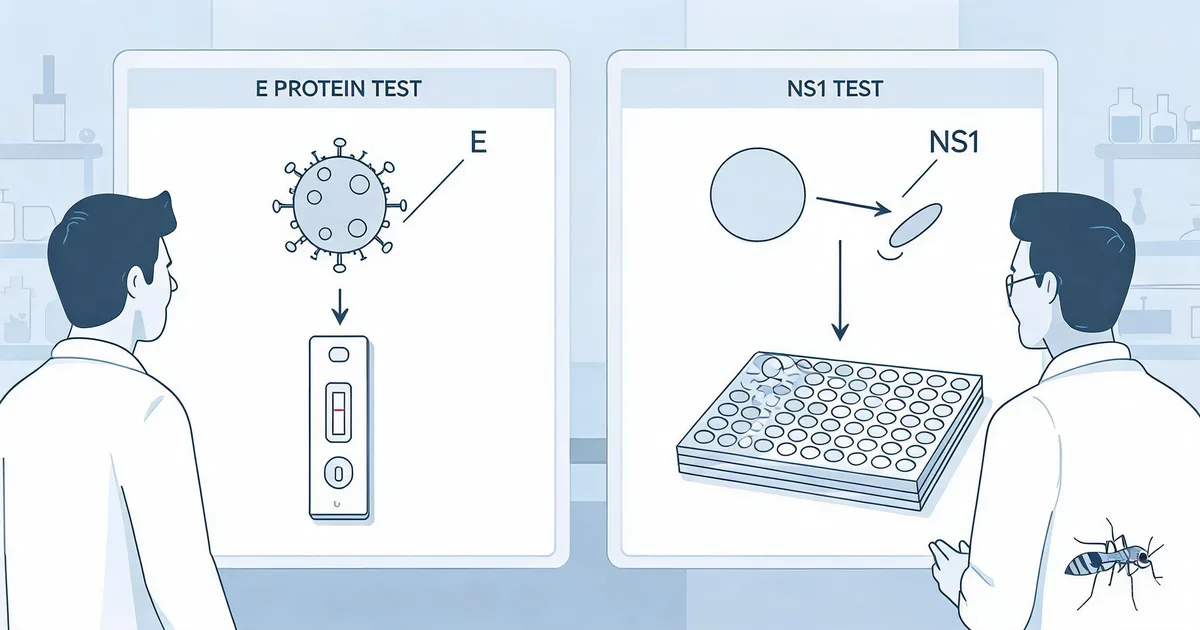
1. Two Dengue Test Scenarios, Two Different Antigens
What is dengue antigen selection? It is the decision of which dengue viral protein to use as the reagent target — recombinant antigen for antibody-detection assays, or a matched monoclonal antibody pair for antigen-detection assays — based on which assay format the kit is built around. Dengue virus (DENV) diagnostic reagents split into two fundamentally different testing scenarios, and each one calls for a different protein target:
- Antibody detection (indirect ELISA / MAC-ELISA): The plate is coated with dengue antigen, and the assay detects antibodies (IgM/IgG) in patient serum. The correct antigen here is E protein (Envelope protein).
- Antigen detection (double-antibody sandwich): The plate or strip is coated with a capture antibody, and the assay detects viral antigen circulating in the patient sample. The correct target here is NS1 (Non-structural protein 1).
Critical Principle
Never confuse "which protein to coat" with "which protein to detect." In antibody ELISA, E protein is the coating reagent and the patient's antibody is the analyte. In sandwich antigen tests, an anti-NS1 antibody pair is the reagent and NS1 is the analyte. Mixing up these two roles is the single most common cause of failed dengue assay development.
2. Why E Protein Is Right for Antibody Detection
E protein is the dengue virus's immunodominant structural antigen. After natural infection, the human immune system mounts its strongest and most durable IgM and IgG response against E protein, which is why virtually every commercial dengue IgM/IgG indirect ELISA kit on the market uses recombinant E antigen as the coating reagent.
2.1 Why E Protein Works for Serology
- Immunodominance: Patients generate large quantities of anti-E IgM (acute phase) and IgG (convalescent/past infection) — far more than against any other dengue protein.
- Pan-serotype epitopes: E protein carries conserved epitopes shared across DENV-1 through DENV-4, making it suitable for broad-spectrum ("pan-dengue") antibody detection.
- Market standard: Nearly all commercial indirect-format dengue IgM/IgG kits use recombinant E antigen — it is the de facto industry benchmark.
2.2 The Trade-Off: Zika Cross-Reactivity
E protein's biggest limitation is serological cross-reactivity with Zika virus and other flaviviruses, since E protein is structurally conserved across the flavivirus family. Developers working in Zika-endemic regions need to account for this in their specificity validation and, where possible, consider domain-restricted constructs (see Section 5).
"NS1 is not used for antibody detection — the human antibody response against NS1 is far weaker than against E protein, and coating with NS1 for serum antibody testing invites false negatives."
2.3 Why NS1 Is Not Used for Antibody Testing
NS1 is a non-structural protein, and the antibody titer patients raise against it is substantially lower than the titer raised against E protein. If NS1 is coated on a plate to capture serum IgM/IgG (an indirect-format approach), the resulting assay suffers from poor sensitivity and a real risk of false negatives — it does not meet clinical performance expectations. This is why NS1-coated indirect antibody kits are essentially absent from the commercial market and are used, at most, in limited research settings.
3. Why NS1 Is Right for Antigen Detection
For double-antibody sandwich formats — where the goal is to detect the virus itself in a patient sample rather than the patient's antibody response — the global commercial standard target is unanimous: NS1.
3.1 Secretion and Solubility
The reason comes down to where each protein physically sits during infection:
- NS1 is actively secreted by infected cells as a soluble hexameric protein directly into the bloodstream, reaching high concentrations during the acute phase — ideal for capture by a sandwich pair.
- E protein remains largely anchored to the lipid envelope of intact virions. Free, soluble E protein circulating in serum is present at very low concentration and is difficult to capture reliably in a sandwich format.
3.2 Detection Window
NS1 antigen is typically detectable from day 0 of fever onset and remains positive for roughly one week, making it the preferred marker for early-stage screening (days 0–7). As the immune response matures and IgM antibodies accumulate, they form immune complexes with circulating NS1, progressively reducing the amount of free NS1 available for detection — which is why NS1 antigen tests tend to convert to negative as the antibody-based window opens up.
3.3 Commercial Reality
Every rapid lateral flow and enzyme immunoassay dengue antigen kit currently on the market uses a double-antibody sandwich format with matched anti-NS1 monoclonal capture and detection antibodies. There is no established commercial double-antibody sandwich kit built around E protein — the biology simply doesn't support it.
IVD Application Note
When screening anti-NS1 antibody pairs for a sandwich format, prioritize broad-spectrum clones that recognize NS1 across DENV-1 through DENV-4. NS1 sequence varies enough between serotypes that a pair optimized against one serotype can under-perform against another if broad reactivity isn't confirmed during development.
4. E Protein vs NS1: Side-by-Side Comparison
The table below summarizes the two antigens across the variables that matter most for reagent development decisions:
| Variable | E Protein | NS1 Antigen |
|---|---|---|
| Assay format | Indirect / MAC-ELISA (antibody detection) | Double-antibody sandwich (antigen detection) |
| What it measures | Patient's IgM/IgG antibody response | Circulating viral antigen in the sample |
| Protein role | Coated reagent (analyte is patient antibody) | Analyte captured by anti-NS1 antibody pair |
| Serum concentration | Low (virion-bound, rarely free) | High during days 0–7 (actively secreted) |
| Detection window | IgM: ~day 4 onward; IgG: convalescent/past infection | Day 0 to ~day 7 (acute phase) |
| Serotype coverage | Conserved epitopes support pan-DENV1–4 detection | Broad-spectrum anti-NS1 pairs needed for DENV1–4 |
| Main specificity risk | Cross-reactivity with Zika virus | Cross-reactivity with Zika NS1 |
| Commercial adoption | Standard for nearly all IgM/IgG kits | Standard for all antigen rapid tests and EIAs |
5. Advanced Antigen Selection: Serotyping, EDIII, and Combination Coating
Beyond the basic E-vs-NS1 decision, several development-stage refinements affect assay performance:
5.1 Serotype-Specific Detection
If the goal is to distinguish which of the four DENV serotypes (DENV-1, -2, -3, -4) a patient is infected with, use the type-specific recombinant E protein for each serotype rather than a single pan-reactive construct. Pooled or cross-reactive E antigens are appropriate for broad screening, but not for serotype discrimination.
5.2 Envelope Domain III (EDIII) for Reduced Cross-Reactivity
Full-length E protein carries flavivirus-conserved regions responsible for Zika cross-reactivity. Envelope Domain III (EDIII) is a smaller, more DENV-specific fragment of E protein that retains strong immunoreactivity while reducing the shared epitopes that cause cross-reaction with Zika. EDIII-based constructs are a practical middle ground when developers need both broad DENV coverage and improved specificity.
5.3 Combination (E + NS1) Coating
A small number of specialized assays combine E and NS1 antigens on the same coating surface to improve detection of weak or borderline-positive samples. This approach is uncommon and is not the mainstream commercial strategy — most developers should default to a single-antigen format matched cleanly to their assay type unless there is a specific clinical performance gap to close.
6. Common Mistakes to Avoid
- Coating NS1 for an indirect antibody ELISA — produces poor sensitivity and false negatives; use E protein instead.
- Trying to build a sandwich antigen test around E protein — free E protein concentration in serum is too low; use NS1-specific antibody pairs.
- Ignoring Zika cross-reactivity during specificity validation — both E protein and NS1 have flavivirus cross-reactive regions; run Zika cross-reactivity panels during assay validation regardless of which antigen is used.
- Using a single-serotype NS1 antibody pair for a "pan-dengue" antigen test — confirm broad DENV-1–4 reactivity during pair screening, not after launch.
7. Frequently Asked Questions — Dengue Antigen Selection
What is the difference between dengue E protein and NS1 antigen?
E protein (Envelope protein) is a structural protein on the dengue virion's surface and the immunodominant target of the human antibody response, so it is used to coat plates for IgM/IgG antibody detection. NS1 (Non-structural protein 1) is a non-structural protein secreted in soluble form into the bloodstream during acute infection, making it the target for double-antibody sandwich antigen detection, not antibody testing.
Can NS1 antigen be used to detect dengue IgM/IgG antibodies?
It is not recommended. The human antibody response against NS1 is much weaker than against E protein, so coating plates with NS1 for indirect or MAC-ELISA antibody detection produces poor sensitivity and a high risk of false negatives. Commercial dengue IgM/IgG kits almost universally use recombinant E protein instead.
Why can't E protein be used in a double-antibody sandwich test for dengue antigen?
E protein remains anchored to the virion's lipid envelope and circulates at very low free concentration in serum, which makes it a poor target for sandwich-format capture. NS1, by contrast, is actively secreted as a soluble hexamer at high concentration during days 0–7 of infection, giving a reliable, abundant target for double-antibody sandwich antigen tests.
What is the detection window for dengue NS1 antigen testing?
NS1 antigen is typically detectable from day 0 of fever onset and remains positive for about one week. As IgM antibodies rise and form immune complexes with circulating NS1, free NS1 becomes harder to detect and the antigen test tends to turn negative, which is why NS1 tests are used for early-stage screening rather than later-stage diagnosis.
How do I choose an antigen for dengue serotype-specific IgM/IgG testing?
For serotype-specific (DENV-1 to DENV-4) antibody detection, use the type-specific recombinant E protein of each serotype rather than a pan-reactive construct. For broad-spectrum detection with reduced cross-reactivity to Zika, Envelope Domain III (EDIII) is a common alternative because it retains DENV-specific epitopes while reducing flavivirus cross-reactive regions found in the full-length E protein.
Does a commercial dengue E protein double-antibody sandwich kit exist?
No. Because free E protein circulates at very low concentration in serum and remains largely virion-bound, there is no established commercial double-antibody sandwich kit using E protein as the capture target. All commercial dengue antigen tests on the market use NS1-specific monoclonal antibody pairs.
Does Sekbio supply dengue NS1 antigen and antibody pairs for IVD development?
Yes. Sekbio provides recombinant dengue NS1 antigen and matched capture/detection monoclonal antibody pairs validated for lateral flow and ELISA sandwich formats, along with recombinant E protein for IgM/IgG serology development. See the Dengue NS1 Antibody Pair product page or visit our Antibody Development Services for custom pairing and validation support.
8. Summary
- Antibody detection (IgM/IgG): Coat with recombinant E protein — it is the immunodominant antigen and the industry standard for indirect/MAC-ELISA dengue serology.
- Antigen detection (double-antibody sandwich): Use NS1-specific capture and detection antibody pairs — NS1 is abundant, soluble, and detectable from day 0 of fever.
- Never swap the two: NS1 gives poor sensitivity for antibody ELISA; E protein is unsuitable for sandwich antigen capture.
- Serotyping and specificity: Use type-specific E protein for serotype discrimination, and consider EDIII to reduce Zika cross-reactivity in broad-spectrum antibody assays.
- Combination coating (E + NS1): A niche technique for boosting weak-positive detection — not the mainstream commercial approach.
At Sekbio, we manufacture recombinant dengue NS1 antigen, E protein, and pre-validated monoclonal antibody pairs specifically matched to each assay format under ISO 13485 quality systems. If you're developing a dengue IgM/IgG ELISA or an NS1 antigen rapid test and need reagents validated for your specific format, our team can help you select and screen the right antigen from day one.