A CA125, AFP, and CEA panel looks, at a glance, like a single "cancer screen" — three numbers on one requisition, ordered together, reported together. Interpreted that way, it's misleading. These are three organ-specific markers, validated in three separate cancers, grouped onto one panel purely for testing convenience, not because they measure the same underlying disease process or because an elevation in one says anything about the other two.
This guide walks through what each marker actually surveils, the specific clinical context each one is validated for, and — the part most reference material skips — how to read a panel where only one of the three comes back elevated, which is the far more common and more confusing result than a clean "all normal" or "all elevated" panel.
1. What Is a Combined CA125, AFP & CEA Panel?
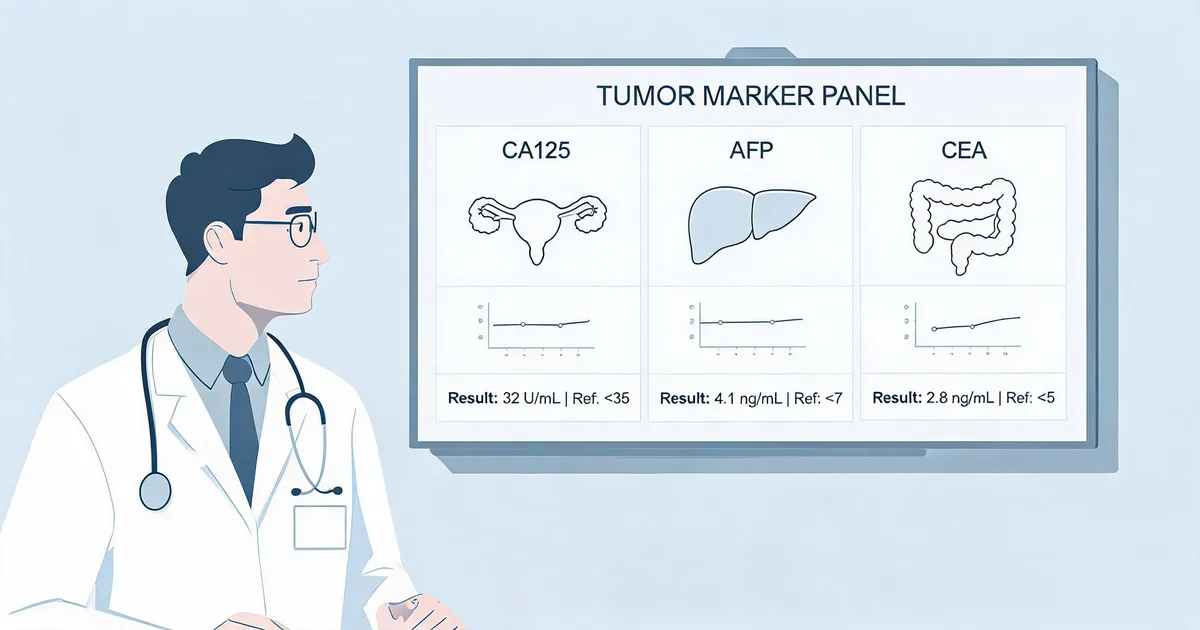
A combined CA125, AFP, and CEA panel is a single blood draw that reports three independently validated tumor marker results together: CA125 for gynecologic/peritoneal epithelium, AFP for hepatocellular tissue, and CEA for colorectal and several other epithelial tissues. It is a testing convenience, not a unified assay — each marker is measured by its own separate immunoassay, against its own separate reference range, validated in its own separate cancer.
For the assay-development side of each individual marker — antibody pairs, epitope domains, and dynamic range — see the oncology marker antibody products overview. This article covers the clinical interpretation layer: what a lab or referring clinician does with three numbers that arrive on the same report.
2. Why These Three Markers Are Grouped Together
The three markers end up on the same panel for practical reasons rather than biological ones. They're all glycoprotein tumor markers measurable by standard sandwich immunoassay on the same CLIA platforms, all commonly available on hospital analyzers, and all frequently relevant in overlapping clinical scenarios — evaluating an abdominal or pelvic mass, working up a cancer of unknown primary, or establishing a baseline panel before treatment when a patient has risk factors spanning more than one organ system.
Critical Principle
CA125, AFP, and CEA are structurally unrelated proteins with independently established cutoffs. There is no composite "panel score" — each result is read on its own reference range, in the context of that specific marker's validated clinical use, not combined into a single risk number.
3. CA125: Ovarian and Pelvic Mass Context
CA125 (MUC16) is shed from the peritoneal, pleural, and gynecologic epithelium and is elevated in roughly 80% of advanced-stage epithelial ovarian cancer. Its primary clinical role is evaluating an already-identified pelvic mass, not screening asymptomatic women — the reference cutoff (35 U/mL postmenopausal, up to 200 U/mL premenopausal) reflects this context-dependent use, since benign conditions common in premenopausal women, particularly endometriosis and menstruation, routinely elevate CA125 without any malignancy present.
In a combined panel, an elevated CA125 is interpreted alongside imaging findings (typically via the Risk of Malignancy Index, which combines CA125 with ultrasound features and menopausal status) — a CA125 result read in isolation from imaging, especially in a premenopausal patient, is not a reliable standalone signal.
4. AFP: Hepatocellular Carcinoma Surveillance Context
AFP is a fetal-liver glycoprotein, normally near-undetectable in adults, that rises with hepatocellular carcinoma (HCC) and, to a lesser extent, non-seminomatous germ cell tumors. Its validated use is surveillance in a known risk population — patients with cirrhosis or chronic hepatitis B/C — rather than general screening, since AFP alone misses a meaningful fraction of HCC cases and its sensitivity is guideline-recommended to be paired with liver ultrasound rather than used alone.
A rising AFP trend in a cirrhotic patient under surveillance (values above roughly 20 ng/mL triggering imaging, above 200–400 ng/mL considered highly suggestive of HCC in the appropriate clinical context) carries very different weight than the same absolute value appearing incidentally in a combined panel ordered for an unrelated reason, where active hepatitis, pregnancy, or germ cell pathology are more likely explanations.
5. CEA: Colorectal Recurrence Context
CEA is a cell-adhesion glycoprotein most useful after a colorectal cancer diagnosis has already been made — its primary validated role is post-surgical recurrence surveillance, where a rising trend (particularly a doubling from nadir, even within the normal range) triggers imaging work-up. Pre-diagnosis, CEA has too many common benign causes of mild elevation — smoking, inflammatory bowel disease, cirrhosis — to function as a reliable standalone diagnostic marker.
Because smoking status shifts the reference range itself (roughly <5 ng/mL for non-smokers vs. <10 ng/mL for smokers), an isolated mildly elevated CEA appearing in a combined panel is frequently explained by smoking history alone, and this should be checked before treating the result as a colorectal cancer signal.
"None of these three markers is validated to detect cancer in an asymptomatic person with no relevant risk factors — each one answers a narrower question: is this specific known mass, this specific at-risk liver, or this specific post-surgical patient showing a concerning trend."
6. Interpreting a Discordant Panel Result
The most common real-world result from a combined panel is discordant — one marker elevated, the other two normal — and this is where interpretation errors happen most often. A single elevated marker should be read against that marker's own specific benign causes and clinical context, not treated as a generalized "something is wrong" signal:
| Isolated Elevation | Common Benign Explanations | Next Step |
|---|---|---|
| CA125 only | Endometriosis, menstruation, fibroids, peritonitis | Correlate with pelvic imaging and menopausal status |
| AFP only | Active hepatitis, pregnancy, liver regeneration | Correlate with liver function tests and imaging |
| CEA only | Smoking, IBD, cirrhosis, mild gastritis | Confirm smoking status; repeat trend over time |
A markedly elevated single marker, or any marker trending upward across repeat testing rather than a one-off mild elevation, carries more clinical weight than an isolated moderate value — trend and magnitude matter more than the simple presence of an out-of-range flag on a single draw.
IVD Application Note
Because CA125, AFP, and CEA circulate across very different concentration scales and units, a combined CLIA panel needs independently calibrated channels for each marker rather than a shared calibration curve — see our CA125, AFP, and CEA antibody pair datasheets for the individual dynamic ranges.
7. When a Combined Panel Is Clinically Appropriate
Guideline bodies including ASCO and NCCN do not recommend any of these three markers for unselected population screening. A combined panel is clinically appropriate in a narrower set of scenarios:
- Cancer of unknown primary work-up: when a patient presents with metastatic disease and no clear primary site, a broad panel helps narrow the differential across organ systems simultaneously.
- An incidentally found mass of unclear origin: imaging findings that don't clearly localize to one organ system can justify testing markers across more than one relevant tissue type.
- Multiple independent risk factors: a patient with both cirrhosis and a family history of ovarian cancer, for example, may have a clinical rationale for baseline testing across markers rather than a single one.
- Not appropriate: as a routine "cancer check" panel in an asymptomatic patient with no risk factors or findings — this is where false positives from the benign causes above are most likely to generate unnecessary anxiety and downstream work-up.
8. Summary
Reading a CA125, AFP, and CEA panel correctly starts with treating it as three separate results, not one combined score:
- CA125: ovarian/pelvic mass context, always read alongside imaging, not a standalone screening test.
- AFP: HCC surveillance in known cirrhosis/hepatitis risk populations, paired with liver ultrasound.
- CEA: primarily a post-colorectal-cancer recurrence trend marker, confounded by smoking status pre-diagnosis.
- Discordant results (the most common pattern) should be interpreted against each marker's own specific benign causes, not as a generalized cancer signal.
- Population screening use is not supported by major guidelines for any of the three — combined panels are appropriate for specific clinical scenarios, not routine check-ups.
At Sekbio, we manufacture independently validated antibody pairs for CA125, AFP, CEA, and the broader oncology marker panel. If you're developing a combined tumor marker CLIA panel, our team can walk through the dynamic range and cross-reactivity data for each individual marker.
Frequently Asked Questions — CA125, AFP & CEA Panel
What does each marker in a CA125, AFP, and CEA panel actually surveil?
CA125 surveils the peritoneal and gynecologic epithelium and is used primarily for ovarian mass evaluation and monitoring. AFP surveils the liver and is used for hepatocellular carcinoma surveillance in cirrhotic and chronic hepatitis patients. CEA surveils colorectal and several other epithelial tissues and is used mainly for colorectal cancer post-treatment recurrence monitoring. They are three organ-specific markers grouped together for testing convenience, not three views of the same disease process.
Is CA125, AFP, and CEA testing recommended as general population cancer screening?
No. Major oncology guideline bodies do not recommend any of these three markers for unselected general-population screening because of insufficient sensitivity and specificity at the population level - all three are elevated by common benign conditions. Their validated clinical use is in specific contexts: known risk factors (cirrhosis for AFP), post-surgical recurrence surveillance (CEA after colorectal cancer), or a mass or symptom already under investigation (CA125 with a pelvic mass).
What does it mean if only one marker in the panel is elevated?
An isolated elevation in one of the three markers should be interpreted in the context of that marker's specific organ system and the patient's clinical presentation, not treated as a red flag for cancer generally. Each marker has well-documented benign causes of elevation - CA125 in endometriosis or menstruation, AFP in active liver inflammation or pregnancy, CEA in smoking or inflammatory bowel disease - and an isolated mild elevation without a corresponding clinical finding often reflects one of these rather than malignancy.
When is a combined CA125, AFP, and CEA panel clinically appropriate?
A combined panel is appropriate when the clinical picture doesn't point to a single organ system - for example, an incidentally found mass of unclear origin, a cancer of unknown primary work-up, or baseline testing before treatment when multiple risk factors are present. It is not appropriate as a routine screening panel in an asymptomatic patient with no relevant risk factors or findings.
Why do CA125, AFP, and CEA have such different reference range units and cutoffs?
The three markers are structurally and biologically unrelated proteins - CA125 is a mucin glycoprotein, AFP is a fetal-liver glycoprotein, and CEA is a cell-adhesion glycoprotein - each with independently established clinical cutoffs from separate validation studies in their respective cancers. There is no shared biological scale between them, which is why panel results are read as three independent values rather than combined into a single composite score.
Does Sekbio supply antibody pairs for CA125, AFP, and CEA panel development?
Yes. Sekbio supplies independently validated antibody pairs for CA125, AFP, and CEA, each characterized for CLIA, ELISA, and (for CEA) LFA sandwich immunoassay development. Explore the individual datasheets or discuss a combined oncology panel through our antibody development services.