Every rapid test manufacturer's datasheet claims high sensitivity. What is much harder to fabricate is a farm technician's own test cassette, hand-labeled in marker and sent back without being asked for it. That is the kind of evidence behind this article — two batches of real, customer-run bovine PAG rapid test results, submitted as routine feedback rather than a formal study.
This article walks through what those cassettes show, explains the specific technical challenge behind reading them correctly — a positive T line that has to stay visible even at low antigen concentration — and lays out how Sekbio's underlying antibody pair is engineered to hold up under exactly this kind of everyday field use.

1. What Is a Bovine PAG Rapid Test?
A bovine PAG rapid test is a colloidal gold lateral flow immunoassay (LFA) that detects Pregnancy-Associated Glycoprotein (PAG) in cattle blood serum. PAG is secreted exclusively by binucleate cells of the bovine placenta, so its presence in maternal blood above the assay's detection threshold is a specific, reliable marker of active pregnancy — unlike rectal palpation, which depends entirely on operator skill and timing.
Sekbio's version of the test uses an anti-bovine-PAG monoclonal capture and detection antibody pair conjugated to colloidal gold nanoparticles. A single drop of serum runs across the strip; if PAG is present above the limit of detection, a pink-to-red T (test) line forms next to the C (control) line within 15–20 minutes. Key specifications from Sekbio's independent 3-batch validation (n=219 clinical serum samples):
- Analytical sensitivity (LOD): 2.0 ng/mL PAG
- Clinical sensitivity / specificity: 97.5% / 96.9%
- Overall accuracy vs. ultrasound reference: 97.3%
- Earliest reliable detection: ≥28 days post-breeding
Full performance data and specifications are on the Bovine PAG Rapid Test product page. The rest of this article looks at what happens when that assay leaves the validation lab and gets run, unsupervised, on a working farm.
2. Why Customer Feedback Is the Real Benchmark for Rapid Test Quality
Formal validation studies answer one question: does the test work under controlled conditions, with trained technicians and known reference samples? Customer feedback answers a different, arguably more important one: does it still work when a farm hand is running it between other chores, under ordinary barn lighting, on serum that was drawn and stored under real-world conditions rather than laboratory ones?
"A datasheet says a test works. A customer sending back dozens of hand-labeled cassettes, unprompted, says it works in their hands, on their farm, with their technique."
That is why the photos in the next two sections matter more than they might first appear. They were not staged for marketing — they are a customer's own quality record, complete with sample IDs and a plus or minus call written directly on each cassette. Reviewing them the way the customer did, line by line, is a useful way to see whether an assay's stated analytical sensitivity actually translates into correct calls outside the validation lab.
3. Field Results: 22 Customer-Run Cassettes
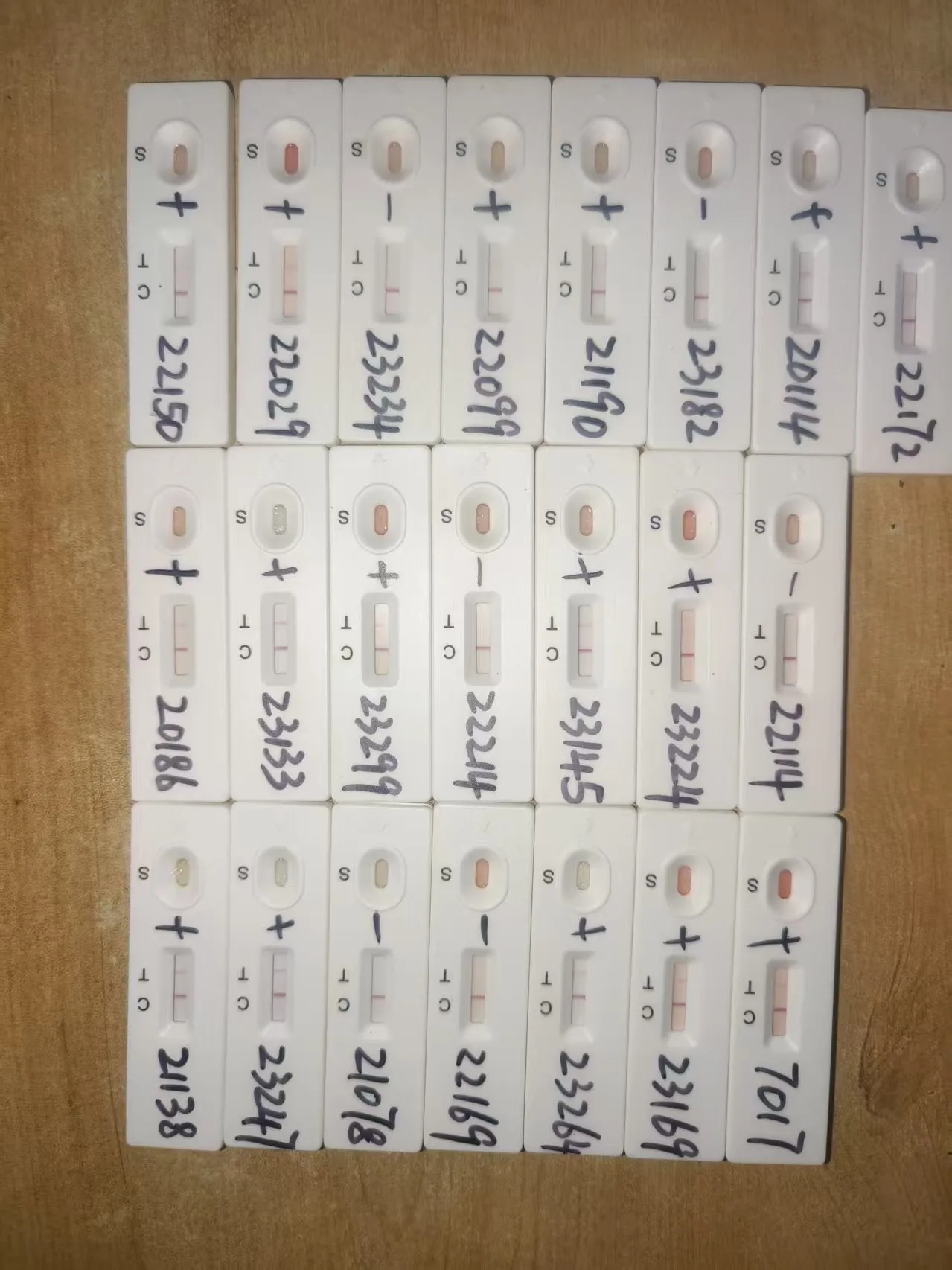
The first batch of feedback photos shows 22 individually labeled bovine PAG rapid test cassettes, arranged in rows and each marked by hand with a sample ID and a "+" or "−" call. Of the 22, 16 were called positive and 6 negative. Reading across the strips, the T line intensity varies considerably — some cassettes show a strong, saturated red T line, while several others show a T line that is only a shade darker than the background, distinctly fainter than the C line next to it.
What matters for this article is that the faint cases were still called positive, correctly. A test that only produces a legible line at high antigen concentrations would force an operator to either guess on borderline cassettes or default to a false negative — neither of which shows up in this photo.
4. A Second Submission: 7 More Consistent Calls
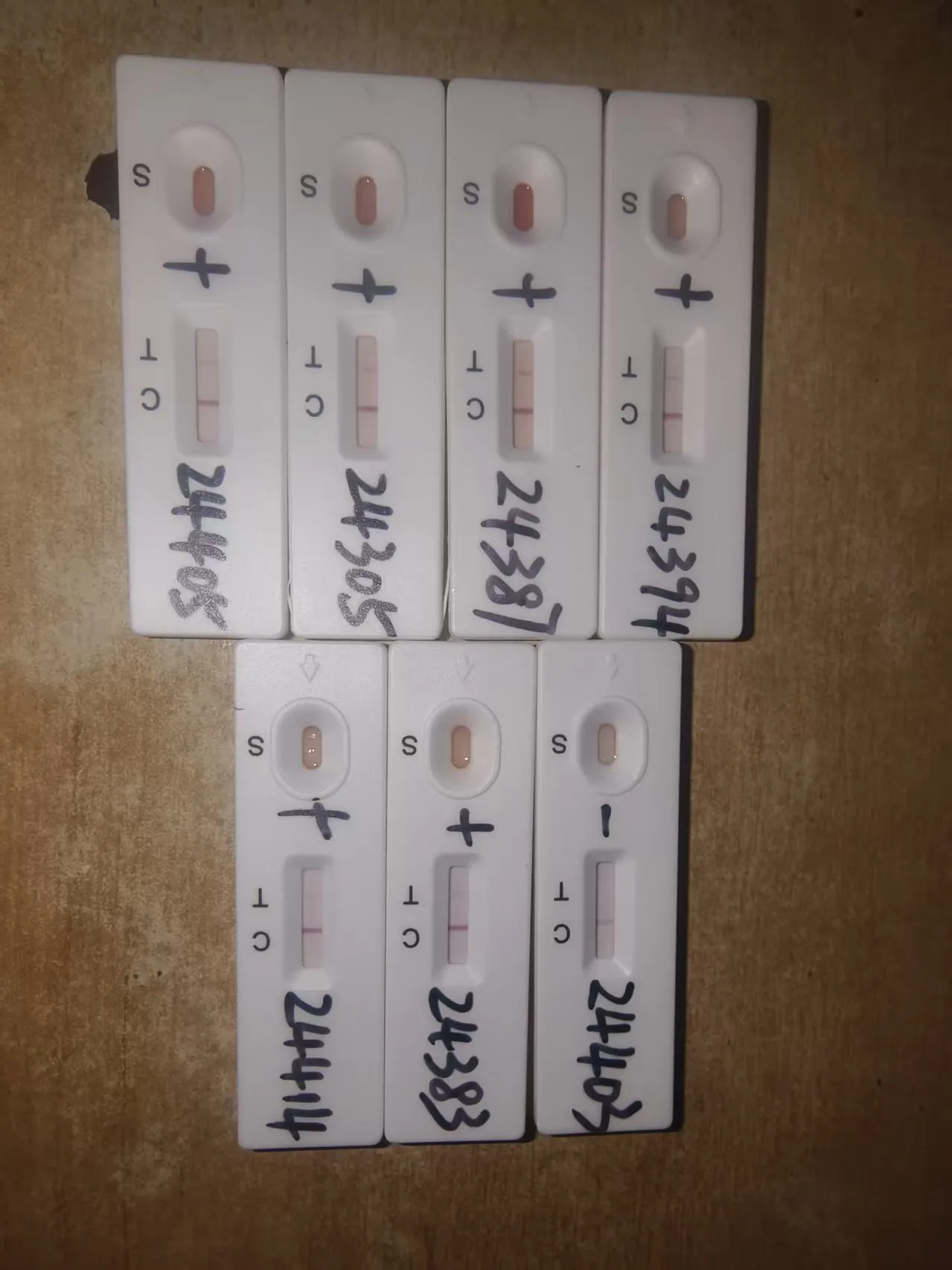
A second photo from the same feedback round shows 7 additional cassettes, again individually labeled with sample IDs and a handwritten call — 6 positive and 1 negative. The pattern from the first batch repeats here: most T lines are clearly visible, but at least one is noticeably weaker than the control line and was still read correctly as positive.
Two batches of unsolicited feedback are obviously not a statistically powered study — that role belongs to Sekbio's formal 219-sample validation cited above. What these photos add is something a validation report cannot: direct, dated evidence of the assay holding up to real operator judgment across multiple sample sets, with consistent line quality from one submission to the next.
IVD Application Note
Across both batches combined, 29 cassettes were reviewed: 22 positive, 7 negative. None of the handwritten calls required guessing at an ambiguous line — the practical definition of an assay whose analytical sensitivity is matched to the concentration range it will actually see in the field.
5. The Hard Part: Why a Faint T Line Still Has to Be Right
The reason some T lines in the photos above look faint is not inconsistent manufacturing — it is biology. PAG concentration in maternal serum rises gradually after implantation, so samples collected close to the ≥28-day detection window, or from animals with naturally lower PAG output, will sit closer to the assay's limit of detection (LOD) than samples collected later in gestation. A faint T line is often exactly what a true-positive, low-concentration sample is supposed to look like.
The engineering problem is that "faint but real" and "background noise" have to remain visually distinguishable at the exact concentration where they are hardest to tell apart. Sekbio's 3-batch dose-response validation quantifies where that line sits:
| PAG Concentration | Batch 230422 | Batch 231026 | Batch 231214 |
|---|---|---|---|
| 1.0 ng/mL | 0% (0/20) | 0% (0/20) | 0% (0/20) |
| 1.4 ng/mL | 15% (3/20) | 10% (2/20) | 20% (4/20) |
| 1.6 ng/mL | 75% (15/20) | 75% (15/20) | 80% (16/20) |
| 1.8 ng/mL | 90% (18/20) | 95% (19/20) | 95% (19/20) |
| 2.0 ng/mL (LOD) | 100% (20/20) | 100% (20/20) | 100% (20/20) |
| 4.0–14.0 ng/mL | 100% (20/20) | 100% (20/20) | 100% (20/20) |
Data source: Sekbio 3-batch analytical sensitivity validation, 20 replicates per concentration per batch. See full methodology on the Bovine PAG Rapid Test page.
Between 1.4 and 1.8 ng/mL, detection rate climbs steeply across all three batches — that narrow window is precisely where a faint-but-correct T line has to be readable. Below 1.4 ng/mL, the assay is designed to stay negative rather than force a false call. This is the analytical sensitivity behavior that the customer photos in Sections 3 and 4 are, in effect, independently confirming under field conditions.
6. How Sekbio Engineers the Antibody Pair for Low-Concentration Detection
Analytical sensitivity at the low end of a dose-response curve is not achieved by a single component — it is the outcome of several design decisions made together, before a single cassette is manufactured.
6.1 Epitope Selection and Affinity
The capture and detection antibodies target non-overlapping, conserved epitopes shared across bovine PAG family members (PAG-1, PAG-2, and related isoforms). Detection antibody affinity is prioritized for maximum signal generation per bound antigen molecule, since at low PAG concentrations there are simply fewer molecules available to produce color.
6.2 Colloidal Gold Conjugation
Gold nanoparticle size and antibody-to-particle conjugation ratio directly determine how much color each bound antigen molecule produces. Under-conjugated or poorly sized particles can pass a strong-positive sample but fail to generate a visible line at low concentrations — exactly the failure mode that would turn faint-but-real T lines into missed positives.
Critical Principle
Sensitivity tuning has a ceiling set by specificity. Pushing conjugation and antibody concentration higher to chase a lower LOD increases background staining and cross-reactivity risk. Sekbio validates each production batch against both ends of that trade-off — sensitivity down to 2.0 ng/mL and specificity of 96.9% — rather than optimizing one at the expense of the other.
6.3 Batch-to-Batch Reproducibility
A sensitive antibody pair is only useful if every manufactured lot performs the same way. The dose-response table in Section 5 is reported across three separate production batches specifically because a single-batch result cannot rule out lot-to-lot drift. Consistent detection rates across all three at every concentration level is what makes the customer photos in Sections 3 and 4 — drawn from ordinary field stock, not validation samples — a meaningful confirmation rather than a coincidence.
7. Reading Weak-Positive Results Correctly in the Field
Even a well-engineered antibody pair can be misread if operators are not looking for faint lines correctly. A few practical points apply directly to the cassettes shown earlier in this article:
- Read within the window: 15–20 minutes after sample application. Reading too early can miss a weak line that has not finished developing; reading too late risks background staining that makes a real faint line harder to distinguish from noise.
- Compare against the C line, not against memory: any visible T line, however light, next to a clear C line is a valid positive. Comparing to how a strong-positive cassette looked earlier that day is not a reliable reference point.
- Use consistent, adequate lighting: the hand-lit, angled reading shown in this article's opening illustration is a realistic representation of how faint lines are actually caught — direct, even light with the cassette held at an angle to reduce glare.
Pro Tip
When training new operators on any PAG or hormone rapid test, deliberately include a few near-LOD cassettes in the training set rather than only strong positives and clean negatives. Learning to call a faint-but-real line correctly is the skill that actually determines field accuracy.
Frequently Asked Questions — Bovine PAG Rapid Test Sensitivity
What is a bovine PAG rapid test?
A bovine PAG rapid test is a colloidal gold lateral flow immunoassay that detects Pregnancy-Associated Glycoprotein (PAG) in cattle blood serum. PAG is secreted by the placenta, so its presence above the assay's detection threshold confirms active pregnancy. Sekbio's version uses an anti-bovine-PAG monoclonal antibody pair with an LOD of 2.0 ng/mL and produces a visible result in 15-20 minutes without lab equipment. See the full Bovine PAG Rapid Test specifications.
How long does it take to read a bovine PAG rapid test result?
Results should be read between 15 and 20 minutes after sample application. Reading too early can miss a genuine weak-positive T line that has not fully developed; reading much later risks background staining that makes faint lines harder to distinguish from noise. The customer photos in this article were all read within that window.
Can a faint T line still be read as a valid positive result?
Yes. Any visible T line, even one noticeably lighter than the C line, indicates PAG above the assay's limit of detection and should be called positive. Several cassettes in the customer feedback batches shown here have faint, low-intensity T lines that were still hand-marked positive by the operator, which is the correct call and the reason analytical sensitivity is engineered into the antibody pair rather than left to chance.
What is the difference between analytical sensitivity and clinical sensitivity in a rapid test?
Analytical sensitivity is the lowest antigen concentration the test can physically detect — for the Sekbio bovine PAG test, an LOD of 2.0 ng/mL confirmed across three production batches. Clinical sensitivity is the percentage of true-pregnant animals the test correctly identifies in the field — 97.5% in Sekbio's 219-sample validation. A test can only achieve high clinical sensitivity if its analytical sensitivity is low enough to catch samples with naturally lower PAG concentrations, such as early-gestation animals.
How do you validate the analytical sensitivity of a lateral flow rapid test?
Analytical sensitivity is validated with a dilution series of purified antigen tested repeatedly (typically 20 or more replicates per concentration) across multiple production batches. The concentration at which detection reaches 100% across all batches is reported as the LOD. Sekbio's bovine PAG test was validated this way at 1.0–14.0 ng/mL across three batches, confirming a 2.0 ng/mL LOD with 100% detection at and above that level.
Does Sekbio offer OEM antibody pairs for bovine PAG rapid test manufacturing?
Yes. Sekbio supplies the anti-bovine-PAG monoclonal capture and detection antibody pair used in its own validated rapid test as an OEM raw material, including colloidal-gold-conjugation-ready formats. IVD manufacturers can build branded cow pregnancy test kits on components with documented analytical and clinical performance data. Learn more about our antibody development and OEM services.
8. Summary
Real customer feedback on the bovine PAG rapid test lines up closely with what the formal validation data predicts:
- 29 field cassettes across two customer submissions: 22 positive, 7 negative, with every handwritten call matching a visible line pattern — including several distinctly faint T lines.
- Faint T lines are expected, not a defect: PAG concentration rises gradually after implantation, so early or low-output samples naturally produce weaker lines.
- Analytical sensitivity is validated at 2.0 ng/mL LOD across three production batches, with detection climbing sharply between 1.4 and 1.8 ng/mL — exactly the range where faint-but-real lines occur.
- Sensitivity is engineered, not incidental: epitope selection, antibody affinity, and colloidal gold conjugation are balanced together against specificity to keep faint positives readable without inflating background.
At Sekbio, we manufacture the anti-bovine-PAG monoclonal antibody pair behind this test under ISO 13485, with published analytical and clinical validation data and OEM supply available for IVD manufacturers building their own bovine pregnancy test kits. Explore the full Bovine PAG Rapid Test specifications or talk to our team about antibody pair licensing.