For a decade, "ADC" meant one thing: an antibody carrying a cytotoxic small-molecule payload to a tumor cell. WuXi XDC's first-half 2026 interim results suggest that era is ending. The company disclosed that it explored more than 3,100 bioconjugate molecules in H1 2026 alone — and a growing share of that pipeline is no longer classic ADC at all, but AOC, DAC, APC, and bispecific formats built on the same antibody scaffold.
This article breaks down what the numbers actually say, defines the alphabet soup of AOC/DAC/APC/bispecific ADC, and explains why this shift raises the bar on one thing every one of these modalities depends on: a precisely engineered, conjugation-ready antibody.
1. What Is XDC? From Single-Payload ADC to Multi-Modality Bioconjugates
XDC ("X-Drug Conjugate") is the umbrella term the industry has adopted for antibody-based bioconjugate therapeutics in which the payload attached to the antibody is no longer limited to a cytotoxic small molecule. The "X" is now a variable: it can be an oligonucleotide, a targeted protein degrader, a peptide, or even a second antibody paratope. The antibody-drug conjugate (ADC) is simply the founding member of this broader XDC family.
According to WuXi XDC's own H1 2026 disclosure, the modalities explored across its 3,100+ molecules span:
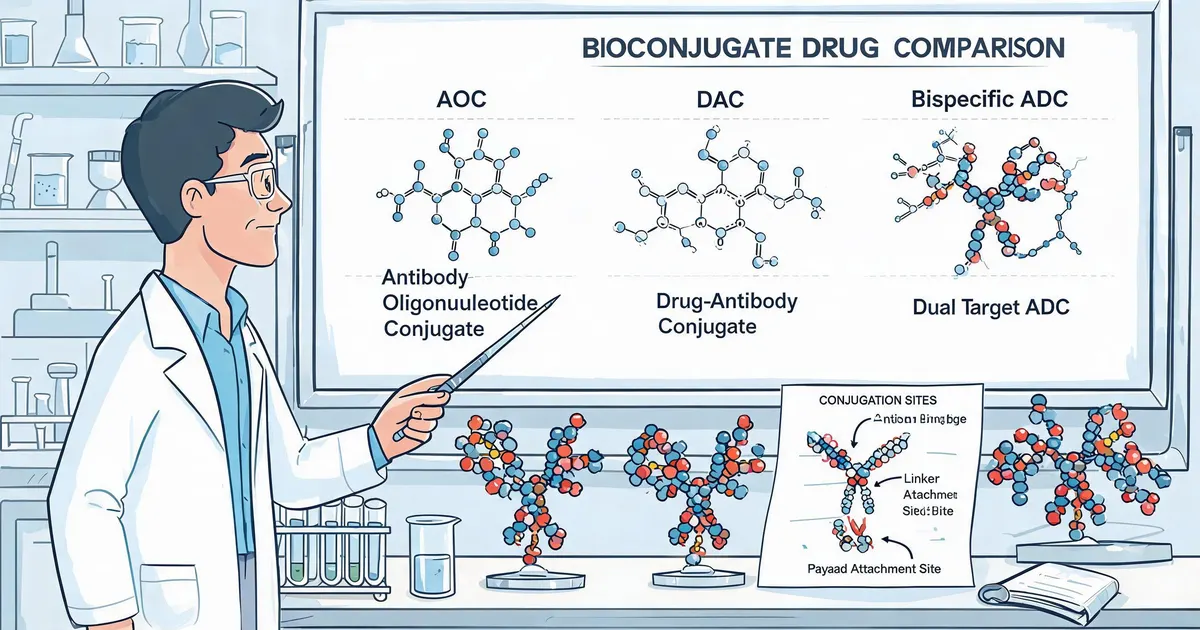
- Bispecific ADCs — dual-targeting antibodies still carrying a cytotoxic payload
- Dual-payload ADCs — one antibody, two distinct cytotoxic mechanisms
- DAC (Degrader-Antibody Conjugate) — antibody-delivered targeted protein degraders
- AOC (Antibody-Oligonucleotide Conjugate) — antibody-delivered silencing or splice-modulating oligonucleotides
- APC (Antibody-Peptide Conjugate) — antibody-delivered functional peptides
What unites all five is the same underlying engineering problem: a targeting antibody has to carry a non-native payload without losing binding, stability, or manufacturability — and, increasingly, without the drug-antibody-ratio (DAR) heterogeneity that has dogged first-generation ADCs.
2. WuXi XDC's H1 2026 Numbers: 3,100+ Molecules, Record Backlog
WuXi XDC (HKEX: 2268), the ADC/XDC-focused CRDMO spun out of WuXi Biologics, reported first-half 2026 revenue of RMB 3,701.4 million, up 37.0% year-over-year, with gross profit of RMB 1,371.3 million (37.0% margin) and adjusted net profit of RMB 1,027.3 million, up 37.4%. Service backlog reached roughly US$2.0 billion (up 50.4%), or about US$2.2 billion including milestone payments — a 62.2% increase.
Behind those financial figures sits the pipeline data most relevant to this article: the company served 814 customers across 328 total iCMC projects (51 newly signed in H1 2026 alone), 286 integrated ADC projects, 42 integrated XDC projects, 21 PPQ projects, and 2 commercial-stage projects. Early discovery activity — the stage where new antibody-payload combinations are first explored — reached over 3,100 molecules explored in H1 2026, contributing to a cumulative total of more than 22,000 ADC/XDC molecules explored to date.
IVD Application Note
These are therapeutic-stage bioconjugate figures, not diagnostic ones — but the underlying engineering discipline (defined conjugation sites, homogeneous DAR, documented purity) is directly transferable to any IVD or research antibody that needs a labeled or conjugated format, from CLIA detection antibodies to lateral flow conjugates.
3. AOC, DAC, APC, and Bispecific ADC: How the Four Modalities Differ
Each XDC modality asks something different of the antibody it's built on. The table below summarizes the core mechanism and the conjugation-engineering demand each format places on the scaffold.
| Modality | Payload | Mechanism | Key Conjugation Demand |
|---|---|---|---|
| ADC | Cytotoxic small molecule | Cell-killing payload released after internalization | Controlled DAR (typically 2–4); stable linker chemistry |
| AOC | Oligonucleotide (siRNA/ASO) | Gene silencing or splice modulation in the target cell | Charge-neutral, sterically defined attachment to avoid off-target electrostatic binding |
| DAC | Targeted protein degrader | Intracellular degradation of a disease-driving protein | Precise release kinetics; site placement away from CDR loops |
| APC | Functional peptide | Peptide-mediated signaling, immune modulation, or targeting | Site-specific attachment preserving peptide conformation |
| Bispecific ADC | Cytotoxic small molecule | Dual-antigen binding for higher tumor selectivity | Correct heavy/light chain pairing plus homogeneous conjugation on a non-native scaffold |
Note the common thread in the rightmost column: every modality depends on knowing — and controlling — exactly where the payload attaches to the antibody. That single requirement is the real engineering story behind the pipeline growth.
4. Why This Shift Matters for Biotech Sponsors
The move from single-payload ADC to multi-modality XDC isn't a branding exercise — it changes what antibody-based therapeutics can address. A cytotoxic ADC payload is inherently limited to killing the cell it enters. An AOC can silence a gene without killing the cell at all, opening antibody-based delivery to non-oncology indications. A DAC can degrade a target that has no accessible small-molecule binding pocket — the "undruggable" proteome. An APC can deliver an immunomodulatory or signaling peptide with cell-type precision that a free peptide, cleared in minutes, could never achieve on its own.
For sponsors, this means the addressable target list for antibody-based delivery has expanded well beyond oncology's classic cytotoxic-payload playbook. It also means CRDMO capacity — and the antibody-engineering expertise that feeds it — is becoming a genuine bottleneck. WuXi XDC's 51 newly signed iCMC projects in a single half-year, against 328 total, signals demand growing faster than most CRDMOs can add capacity.
"The shift from single ADC to multi-modality XDC doesn't just add new payload chemistries — it moves the hardest engineering problem earlier, from the conjugation lab back to the antibody sequence itself."
5. The Hidden Bottleneck: Site-Specific Conjugation Demands on the Antibody
Traditional ADC conjugation attaches payloads to native lysine residues or interchain cysteines exposed by partial reduction. Both approaches produce a mixture of DAR species — some antibody molecules carry zero payload, others carry six or more, at different positions across the molecule. For a cytotoxic small molecule, this heterogeneity is already a well-documented manufacturing and regulatory headache. For AOC and DAC, it's worse: an oligonucleotide or degrader payload attached near a CDR loop can silently reduce binding affinity, and inconsistent placement makes release kinetics — and therefore efficacy and safety — unpredictable batch to batch.
This is why XDC programs increasingly start with an antibody engineered for a defined, solvent-accessible conjugation site — an introduced cysteine at a specific framework position, a C-terminal peptide tag, or a format conversion to a smaller scaffold (Fab, scFv, or VHH) with fewer competing reactive residues. The payoff is a narrow, reproducible DAR distribution and a conjugate that behaves the same way from lot to lot.
Common Mistake
Sponsors sometimes select an antibody purely on binding affinity and only address conjugation chemistry afterward. By then, the antibody's native lysine and cysteine distribution is fixed, and any conjugation-site engineering requires reworking the sequence — costing months versus building it in from the start.
6. How Sekbio Supports XDC-Ready Antibody Engineering
Sekbio doesn't run bioconjugation chemistry — that's the domain of ADC/XDC CRDMOs like WuXi XDC. What Sekbio does is the step that determines whether that downstream chemistry produces a clean, homogeneous conjugate or a heterogeneous mixture: engineering the antibody itself into a defined, conjugation-ready format before it ever reaches a linker-payload reaction.
Through Sekbio's antibody engineering platform, this covers format conversion (IgG to Fab, scFv, or VHH) to reduce competing reactive residues, humanization and affinity maturation to preserve target binding once a conjugation site is introduced, and bispecific engineering with correct heavy/light chain pairing for dual-paratope formats. Every engineered antibody intermediate is characterized by SEC-HPLC for aggregate content and mass spectrometry to confirm the intended sequence and site — the same purity discipline Sekbio applies to its recombinant antibody products for diagnostic use, extended to the higher-stakes context of a conjugation-ready therapeutic scaffold.
If your program is moving from a validated binder toward an AOC, DAC, APC, or bispecific ADC format, the antibody-engineering step is where DAR heterogeneity gets solved — or built in permanently.
7. Frequently Asked Questions — XDC, AOC, DAC & Bispecific ADC
What is XDC (bioconjugates)?
XDC stands for X-Drug Conjugate — the umbrella term for antibody-based bioconjugate therapeutics that pair a targeting antibody with a functional payload beyond a classic cytotoxic small molecule. The "X" can be an oligonucleotide (AOC), a targeted protein degrader (DAC), a peptide (APC), or a second antibody arm as in bispecific and dual-payload ADCs. XDC captures the industry's shift from a single conjugation chemistry to a multi-modality toolkit built on shared antibody-engineering and bioconjugation infrastructure.
How long does antibody engineering for a conjugation-ready scaffold take?
Timelines depend on the starting antibody and the target conjugation strategy. Converting a native antibody into a defined, conjugation-ready format — through site-directed cysteine variants, C-terminal tags, or format conversion to Fab/scFv — typically starts with a sequence and developability review before a project-specific timeline is scoped. Sekbio's antibody engineering team assesses feasibility per project rather than quoting a single fixed window.
Can a standard IgG antibody be used directly for AOC or DAC conjugation?
Not reliably at production scale. A wild-type IgG has multiple solvent-accessible lysines and native interchain cysteines, so conventional conjugation chemistry attaches payloads at many different sites and stoichiometries, producing a heterogeneous mixture of drug-antibody-ratio (DAR) species. For AOC and DAC programs, where payload placement affects release kinetics and off-target charge interactions, sponsors generally need an antibody engineered with defined, controlled conjugation sites rather than a native, unmodified IgG.
What is the difference between AOC, DAC, and a bispecific ADC?
AOC (Antibody-Oligonucleotide Conjugate) delivers a silencing or splice-modulating oligonucleotide to a specific cell type using an antibody as the targeting vehicle. DAC (Degrader-Antibody Conjugate) delivers a targeted protein degrader payload that triggers intracellular degradation of a disease-driving protein. A bispecific ADC keeps a cytotoxic small-molecule payload but replaces the single-target antibody with a dual-paratope antibody that binds two antigens, improving tumor selectivity and reducing on-target, off-tumor toxicity.
How do you verify structural homogeneity of a site-specifically conjugated antibody?
Homogeneity is verified before conjugation even begins, at the antibody-engineering stage, using SEC-HPLC for aggregate content, mass spectrometry (intact and reduced) to confirm the engineered conjugation site is present at the expected position with no unintended free cysteines or sequence variants, and peptide mapping to confirm no unwanted post-translational modifications near the conjugation site. A clean, single-species antibody intermediate is what allows downstream conjugation chemistry to produce a narrow, well-defined DAR distribution.
Does Sekbio offer antibody engineering services for XDC and bioconjugate programs?
Yes. Sekbio's antibody engineering platform supports format conversion (IgG to Fab, scFv, or VHH), humanization, affinity maturation, and bispecific engineering — capabilities that XDC programs draw on to build conjugation-ready antibody scaffolds with defined, solvent-accessible attachment sites and documented purity. Visit our antibody engineering platform page to discuss project-specific conjugation-site requirements.
8. Summary
WuXi XDC's H1 2026 report is a data point worth paying attention to beyond the headline financials:
- 3,100+ molecules explored in H1 2026 alone across ADC, AOC, DAC, APC, and bispecific/dual-payload formats — a signal that XDC, not single-payload ADC, is now the working definition of the field.
- AOC, DAC, and APC extend antibody-based delivery beyond cytotoxic payloads, into gene silencing, targeted degradation, and peptide-mediated signaling.
- Bispecific ADCs keep the cytotoxic payload but improve selectivity through dual-antigen targeting.
- Every modality shares one requirement: a conjugation-ready antibody with a defined, controlled attachment site — not a native IgG conjugated by default chemistry.
- Antibody engineering, not conjugation chemistry, is where DAR heterogeneity gets solved — or permanently built in, if skipped.
If your program is heading toward an XDC format, the earliest and highest-leverage engineering decision is the antibody scaffold itself. Sekbio supports that step through recombinant antibody engineering — format conversion, humanization, affinity maturation, and bispecific engineering — producing the defined, high-purity antibody intermediates that conjugation-ready programs are built on.