On August 19, 2026, Moderna and Merck announced that intismeran autogene (mRNA-4157/V940), an individualized neoantigen cancer therapy, combined with pembrolizumab (Keytruda) met both its primary endpoint (recurrence-free survival) and a key secondary endpoint (distant metastasis-free survival) versus Keytruda alone in resected stage IIB-IV melanoma. It is the first positive Phase 3 readout ever recorded for an individualized neoantigen therapy — and for any mRNA-based cancer treatment. Moderna shares closed up 176.97% that day, their largest single-day gain on record, and Merck climbed more than 12% to a new high.
The clinical and market headlines are the story everyone is covering. The quieter story, and the one that matters for reagent and assay developers, is structural: a therapy manufactured individually for every single patient just cleared the highest evidentiary bar in oncology drug development. That N=1 manufacturing model — sequence, predict, synthesize, dose, repeat for each patient — depends on a chain of biomarker and immunoassay reagents at every step, from confirming a batch expresses the right protein to tracking whether a patient's T cells actually respond. This article walks through what intismeran autogene is, what the trial showed, how the individualized manufacturing pipeline works, where it sits against competing platforms, and what it signals for developers building the oncology biomarker and companion diagnostic assays this class of therapy depends on.
1. What Is a Personalized Neoantigen Cancer Vaccine?
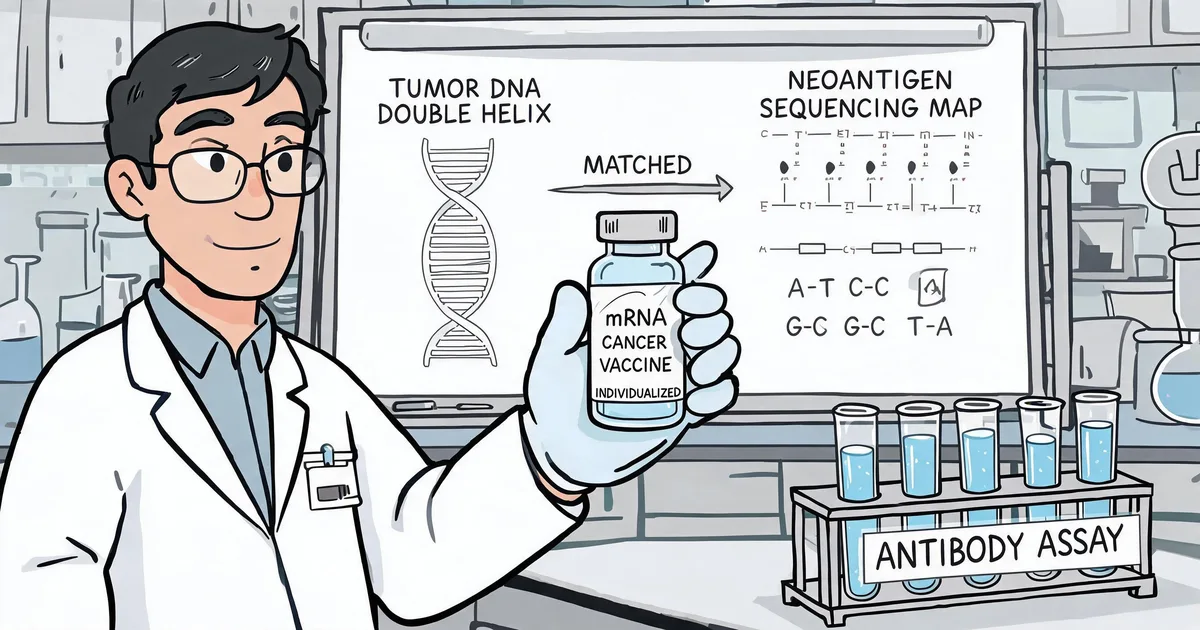
A personalized neoantigen cancer vaccine is a cancer immunotherapy manufactured individually for each patient from the specific mutations found in that patient's own tumor, rather than from antigens shared across patients with the same cancer type. Neoantigens are mutated proteins that arise only in tumor cells and are absent from healthy tissue, which makes them attractive immune targets: because the immune system has never been tolerized to them, a vaccine that presents them can, in principle, prime a highly tumor-specific T-cell response with less risk of attacking normal tissue.
The individualized model breaks from two more familiar vaccine formats:
- Off-the-shelf ("shared antigen") vaccines encode a fixed set of tumor-associated antigens common across many patients with a given cancer type — for example, BioNTech's FixVac candidates — and can be manufactured in standard, large batches ahead of demand.
- Individualized neoantigen therapies, including intismeran autogene and BioNTech/Genentech's autogene cevumeran, are sequenced and manufactured separately for every patient, trading manufacturing simplicity for a therapy matched to that patient's unique mutational profile.
Pro Tip
Individualized neoantigen therapies are almost always dosed alongside a checkpoint inhibitor such as pembrolizumab. The vaccine primes tumor-specific T cells; the checkpoint inhibitor removes the PD-1/PD-L1 brake so those primed T cells can act. Reading trial data for either component in isolation misses how the combination is designed to work.
2. The August 19, 2026 Readout: A First for mRNA Oncology
INTerpath-001 (NCT05933577) is a randomized, double-blind, active-comparator Phase 3 trial in 1,137 patients with high-risk (stage IIB-IV) resected cutaneous melanoma who had not received prior systemic therapy. Patients were randomized 2:1 to intismeran autogene (up to 34 patient-specific neoantigens, administered intramuscularly every 3 weeks for up to 9 doses) plus pembrolizumab, versus pembrolizumab alone. The primary endpoint was recurrence-free survival (RFS); distant metastasis-free survival (DMFS) and overall survival (OS) were key secondary endpoints.
At a pre-specified interim analysis, the combination significantly improved both RFS and DMFS versus pembrolizumab alone, with no new safety signals. Overall survival data are not yet mature and the study continues. Notably, the companies did not disclose hazard ratios or effect sizes in the topline release — the single largest open question for this readout. As a benchmark, the earlier Phase 2b trial that supported this program, KEYNOTE-942, showed at its 5-year (60.3-month) follow-up a 49% reduction in risk of recurrence or death (HR=0.51) and a 59% reduction in risk of distant metastasis or death (HR=0.41) for the combination versus pembrolizumab alone.
"A therapy that is manufactured differently for every patient just met the same evidentiary bar as a conventional, off-the-shelf oncology drug — that is the structural story behind the headline."
3. From Tumor Biopsy to Individualized Dose: How Intismeran Autogene Is Made
Every dose of intismeran autogene is manufactured through the same computational and biomanufacturing pipeline, repeated per patient:
- Sequencing: tumor and matched normal tissue undergo whole-exome sequencing, and the tumor additionally undergoes RNA sequencing.
- Mutation calling: somatic mutations are identified by comparing the tumor and normal sequences.
- Neoantigen prediction and ranking: a bioinformatics pipeline ranks candidate mutations by variant allele frequency, RNA expression level, and predicted MHC-binding affinity, using peptide-MHC binding prediction tools such as NetMHCpan alongside HLA-typing tools.
- Selection: an automated algorithm selects up to 34 neoantigens to encode as a single concatenated mRNA sequence.
- Manufacturing: the mRNA is synthesized, encapsulated in a lipid nanoparticle, quality-controlled, and released as a single-patient (N=1) dose.
The reported end-to-end biopsy-to-dose timeline is roughly 6-8 weeks. That timeline is only achievable because every step — sequencing capacity, computational antigen selection, GMP mRNA synthesis, lipid nanoparticle formulation, and quality control — has to run as a parallel, per-patient workflow rather than a single large campaign. This is fundamentally different from Moderna's standard large-batch mRNA vaccine manufacturing, and it is why analysts view manufacturing scalability, not just clinical efficacy, as central to whether this therapeutic class can reach its addressable population.
4. The Competitive Landscape: Who Else Is Building Neoantigen Vaccines
Intismeran autogene is the furthest along, but it is not the only individualized or shared-antigen cancer vaccine program in clinical development. Platforms differ meaningfully in delivery technology, neoantigen count, and stage:
| Developer | Lead Candidate | Delivery Platform | Lead Indication / Stage |
|---|---|---|---|
| Moderna / Merck | Intismeran autogene (mRNA-4157/V940) | Modified-nucleoside mRNA-LNP, intramuscular, up to 34 neoantigens | Melanoma, adjuvant — Phase 3 positive (Aug 2026) |
| BioNTech / Genentech | Autogene cevumeran (BNT122) | Uridine mRNA-lipoplex, intravenous, dendritic-cell targeted, up to 20 neoantigens | Melanoma (PFS miss) / pancreatic cancer — Phase 2 |
| Transgene | TG4050 | MVA viral vector, AI-selected antigens (myvac platform) | Head and neck cancer (HNSCC) — Phase 1/2 |
| Stemirna Therapeutics | SW1115C3 and related candidates | Proprietary LPP (lipopolyplex) core-shell delivery, SmartNEO prediction algorithm | Advanced solid tumors — early clinical |
| Abogen Biosciences | ABO2102 | mRNA-LNP, KRAS-focused neoantigen design | Solid tumors, with Ruijin Hospital — early clinical |
The delivery-platform differences matter beyond mechanism of action. A modified-nucleoside LNP delivered intramuscularly (Moderna's approach), a lipoplex delivered intravenously and targeted to dendritic cells (BioNTech's approach), and a lipopolyplex core-shell particle (Stemirna's approach) each carry different formulation, cold-chain, and manufacturing-QC requirements — which in turn shape what potency and release-testing reagents each program needs.
5. Why This Matters for IVD and Biomarker Developers
A Phase 3 win for one individualized neoantigen program does not just validate one drug — it validates a manufacturing and monitoring model that a growing list of programs, across melanoma, non-small cell lung cancer, bladder cancer, and renal cell carcinoma, are now racing to replicate. Every one of those programs needs the same categories of biomarker and immunoassay infrastructure, independent of which company or delivery platform wins:
- Batch potency and identity testing: because each dose is a unique, single-patient lot, there is no way to lean on "the same batch passed QC last time." Every individualized lot needs its own antigen-expression confirmation before release.
- Immune-response monitoring: trials and, eventually, clinical use need a reliable read on whether a patient's T cells are actually responding — commonly via IFN-gamma ELISpot and cytokine immunoassay panels.
- Patient selection and recurrence monitoring: adjuvant oncology programs like INTerpath-001 sit inside a broader monitoring workflow that already leans on established tumor-marker panels for staging, eligibility, and recurrence surveillance.
IVD Application Note
None of these assay layers are unique to melanoma. As INTerpath's NSCLC, bladder, and renal cell carcinoma programs advance, the same potency, immune-monitoring, and tumor-marker assay categories apply — just built around different biomarker panels for each indication.
6. The Immunoassay Reagent Bottleneck Behind Personalized Oncology
Individualized manufacturing solves the "one drug per patient" problem at the therapeutic level, but it pushes the burden downstream to assay developers: every added indication and every added trial site multiplies the number of potency, immune-monitoring, and companion-diagnostic assays that need pre-validated, batch-consistent antibody reagents behind them. Two recurring pain points show up across the IVD and bioanalytical labs building this infrastructure:
Skip the Screening. Start Building.
Assay developers working against a trial timeline do not have 3-6 months to spend screening and pairing antibody candidates for a new biomarker panel. Every Sekbio antibody pair is pre-validated on the platform it is actually used on — LFA, ELISA, or CLIA — so a team building an immune-monitoring or tumor-marker assay can go from catalog to working assay in days, not months.
One Validation. Consistent Performance. Every Batch.
Multi-site, multi-year oncology trials cannot afford to requalify their assay every time a reagent lot changes. Sekbio antibodies are manufactured at industrial scale with tight lot-to-lot CV and full ISO 13485-certified traceability, so a biomarker assay validated once keeps performing the same way through every subsequent batch.
Sekbio's own antibody development platform — CHO and HEK293 recombinant expression, monoclonal antibody development, and pre-validated antibody pairs — supports exactly this class of oncology biomarker work, including established tumor-marker panels such as the CA125 antibody pair, AFP antibody pair, and CEA antibody pair already used across companion diagnostic and recurrence-monitoring workflows. As the neoantigen vaccine field's clinical pipeline widens, the reagent supply chain behind it needs the same combination of speed and batch-to-batch consistency the drug programs themselves are being held to.
7. Frequently Asked Questions — mRNA Neoantigen Cancer Vaccines
What is a personalized neoantigen cancer vaccine?
A personalized neoantigen cancer vaccine is a therapy manufactured individually for each patient from mutations unique to that patient's own tumor. After surgery, the tumor and matched normal tissue are sequenced to identify somatic mutations, a bioinformatics pipeline ranks and selects the mutations most likely to be recognized by the immune system (neoantigens), and a bespoke vaccine encoding those neoantigens is synthesized and administered, typically alongside a checkpoint inhibitor, to train the patient's own T cells to attack tumor cells carrying those specific mutations.
What did the INTerpath-001 Phase 3 trial show?
INTerpath-001 (NCT05933577) is a Phase 3 trial of 1,137 patients with resected stage IIB-IV melanoma. On August 19, 2026, Moderna and Merck reported that intismeran autogene (mRNA-4157/V940) plus pembrolizumab met its primary endpoint of recurrence-free survival and its key secondary endpoint of distant metastasis-free survival versus pembrolizumab alone, with no new safety signals. It is the first Phase 3 readout for any individualized neoantigen therapy and any mRNA-based cancer treatment. Hazard ratios and overall survival data were not disclosed in the topline release and remain pending.
How is intismeran autogene manufactured for each patient?
After tumor resection, whole-exome sequencing of tumor and matched normal tissue plus tumor RNA sequencing identify somatic mutations. A computational pipeline ranks mutations by variant allele frequency, expression, and predicted MHC-binding affinity using tools such as NetMHCpan, then selects up to 34 neoantigens. A single synthetic mRNA encoding those neoantigens is manufactured, encapsulated in a lipid nanoparticle, and released as an individualized dose. The end-to-end biopsy-to-dose timeline is roughly 6-8 weeks, with every batch produced as a single-patient (N=1) lot rather than a standard large-batch run.
How does an individualized neoantigen vaccine differ from an off-the-shelf cancer vaccine?
An off-the-shelf cancer vaccine, such as BioNTech's BNT111, encodes a fixed set of tumor-associated antigens shared across patients with a given cancer type and can be manufactured in standard large batches. An individualized neoantigen vaccine, such as intismeran autogene or BioNTech's autogene cevumeran, is sequenced and manufactured separately for every patient from mutations unique to their own tumor, trading manufacturing simplicity for a therapy tailored to each patient's specific mutational profile.
What biomarker and immunoassay reagents does neoantigen vaccine development depend on?
Neoantigen vaccine programs depend on antibody pairs and recombinant antigens for several assay layers: potency and release testing to confirm each individualized mRNA-LNP batch expresses the intended protein, immune-monitoring immunoassays such as IFN-gamma ELISpot and cytokine panels to track T-cell response, and companion tumor-marker panels used for patient eligibility screening and recurrence monitoring in the same oncology workflow. Each layer requires antibody reagents that are pre-validated on the assay platform and consistent from batch to batch.
Does Sekbio supply antibody reagents for immuno-oncology and companion diagnostic assays?
Yes. Sekbio develops pre-validated antibody pairs and recombinant antigens for ELISA, CLIA, and lateral flow immunoassay formats, including oncology tumor-marker panels such as the CA125 antibody pair, AFP antibody pair, and CEA antibody pair, produced under ISO 13485 with documented lot-to-lot consistency. Visit our antibody development platform page to discuss a specific oncology biomarker or immune-monitoring assay target.
8. Summary
Intismeran autogene's August 19, 2026 Phase 3 win is a milestone worth reading at two levels:
- Clinical first: the first positive Phase 3 readout for any individualized neoantigen therapy and any mRNA-based cancer treatment, built on a combination with pembrolizumab in resected high-risk melanoma.
- Manufacturing validation: proof that a therapy sequenced and manufactured separately for every patient, on a roughly 6-8 week biopsy-to-dose timeline, can be produced to the consistency needed to clear a Phase 3 trial.
- A widening competitive field: BioNTech/Genentech, Transgene, Stemirna, and Abogen are pursuing related but technically distinct neoantigen platforms, each with its own delivery chemistry and manufacturing-QC needs.
- A downstream reagent demand signal: every program in this class depends on batch potency testing, immune-monitoring immunoassays, and companion tumor-marker panels — all of which require pre-validated, batch-consistent antibody reagents.
At Sekbio, we develop pre-validated antibody pairs and recombinant antigens for the oncology biomarker and immunoassay workflows this next generation of cancer therapies depends on. If your lab is building a potency, immune-monitoring, or companion diagnostic assay around an immuno-oncology program, let's talk.