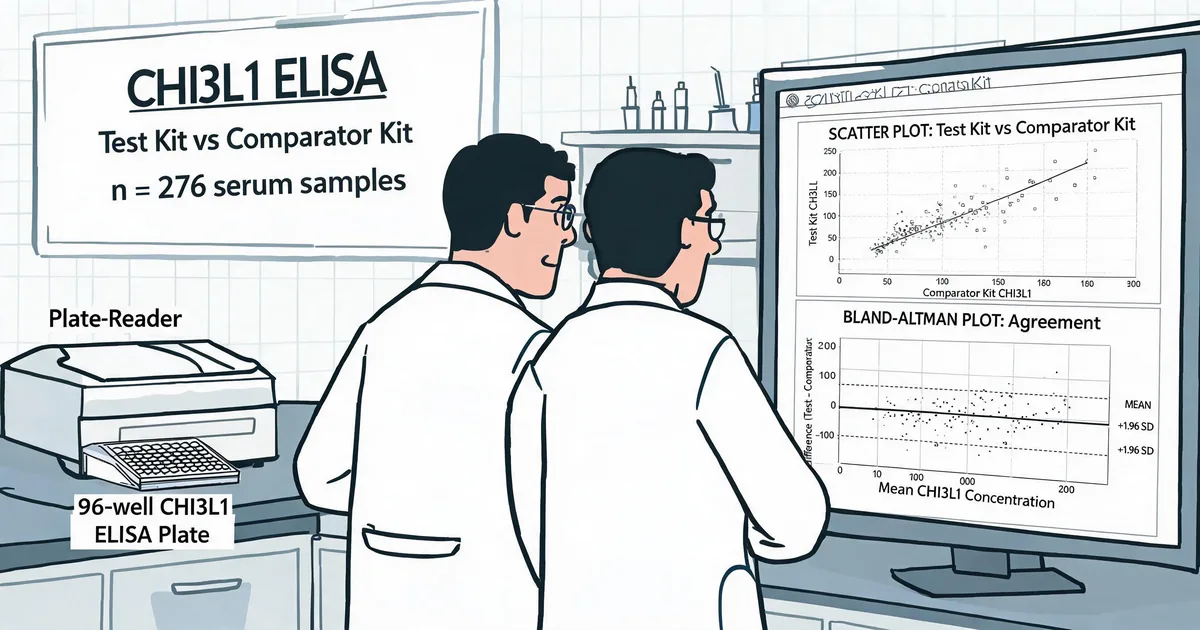
Three out of 276. That is how many serum samples a new CHI3L1 ELISA kit classified differently from a registered comparator kit in a two-hospital study that ran from September 2024 to February 2025.
We developed this kit from scratch for a client: the antibodies, the complete ELISA kit, formulation and process optimization, and production. The client then ran the clinical evaluation, and every number below comes from its report. A method-comparison study tests the same patient samples on a new kit and on a marketed one, then asks whether the two agree closely enough to be treated as equivalent. The analyte here is CHI3L1, chitinase-3-like protein 1, also called YKL-40.
With three outliers set aside, every pre-set target was met. With them kept in, the correlation target was missed and the limits of agreement sat on the edge of the ±20% band. We show both views.
Why serum CHI3L1 is measured in liver disease
CHI3L1 (YKL-40) is a secreted, glycosylated protein of 383 amino acids and about 42.6 kDa. In the liver it comes mainly from liver macrophages and hepatic stellate cells. It activates stellate cells and pushes them toward a myofibroblast state, which increases extracellular matrix deposition, the process behind fibrosis. Cohort studies report serum CHI3L1 rising with fibrosis stage in chronic hepatitis B and in non-alcoholic fatty liver disease.
Liver biopsy is still the reference for staging cirrhosis, but it is invasive and depends on the reader. A blood test is the obvious alternative. The kit in this study is a quantitative sandwich ELISA for human serum, intended as an aid in diagnosing cirrhosis in patients who have it or are suspected of having it (for example with ascites or fibrosis). Serum CHI3L1 is captured on an antibody-coated plate, detected with an HRP-labeled anti-CHI3L1 antibody, developed with TMB and read at 450 nm against a 630 nm reference.
Biology, clinical cutoffs and assay formats are covered in our CHI3L1 (YKL-40) biomarker guide.
Study design and the 276-sample set
The report follows NMPA's 2021 technical guidance for IVD reagents that can be evaluated without a full clinical trial (Notice No. 74), which lets a new kit be compared with an already registered product. The design was blinded and paired:
- The same residual serum sample from each patient was run on the new kit and on the registered comparator, with sample codes blinded.
- Two hospital sites took part. Each ran both kits on its own microplate reader.
- One reagent lot of each kit was used.
- Sera were stored at −20 °C, with freeze–thaw limited to 3 cycles.
- Low and high quality controls were run before every experiment at both sites and stayed within their target ranges.
Sample size was calculated twice, in line with CLSI EP09 practice. Qualitative agreement needed 78 positive and 109 negative samples, 187 in all, or 208 with a 10% dropout allowance. Showing a correlation of at least 0.975 when 0.982 is expected needed 227, or 254 with dropout. The protocol therefore set a floor of 254 samples, at least 127 per site, with confirmed cirrhosis making up at least 30%.
The 276 samples came from 214 men (77.5%) and 62 women (22.5%), aged 19 to 91 (mean 48.06 ± 12.58, median 49). By clinical diagnosis:
- Hepatitis: 131 samples (47.5%)
- Compensated cirrhosis: 62 (22.5%)
- Decompensated cirrhosis: 61 (22.1%)
- Liver fibrosis: 22 (8.0%)
Cirrhosis accounted for 123 samples, 44.6%, well above the 30% floor. A further 26 samples (9.42%) came from patients with mild hemolysis or raised cholesterol, bilirubin or triglycerides (up to 9.22 mmol/L, 56.8 µmol/L and 6.18 mmol/L). On the new kit the set ran from 11.57 to 573.59 ng/mL with a median of 68.46 ng/mL, and 127 of 276 samples (46%) were positive on the comparator.
Qualitative agreement: 273 of 276 samples matched
A sample was called positive when the new kit read above 78 ng/mL, and when the comparator read 79 ng/mL or higher.
| New kit result | Comparator positive | Comparator negative | Total |
|---|---|---|---|
| Positive | 126 | 2 | 128 |
| Negative | 1 | 147 | 148 |
| Total | 127 | 149 | 276 |
| Metric | Result | 95% CI | Pre-set target |
|---|---|---|---|
| Positive agreement | 99.21% (126/127) | 95.67–99.86% | lower bound ≥ 85% |
| Negative agreement | 98.66% (147/149) | 95.24–99.63% | lower bound ≥ 90% |
| Overall agreement | 98.91% (273/276) | 96.85–99.63% | lower bound ≥ 88% |
| Kappa | 0.9781 | 0.9535–1.0000 | ≥ 0.75 |
All four targets were met. Adding the participant who withdrew after testing (277 samples) changed almost nothing: overall agreement 98.92%, kappa 0.9782.
The three samples the kits disagreed on
Every discordant sample read between 55 and 89 ng/mL on one kit or the other, near the 78 ng/mL cutoff.
| Sample | New kit | Comparator | Clinical diagnosis | Report's reading |
|---|---|---|---|---|
| 1 | 81.88 ng/mL (positive) | 76.40 ng/mL (negative) | Hepatitis B cirrhosis | Value sits at the decision level, within allowable deviation; positive fits the diagnosis |
| 2 | 88.43 ng/mL (positive) | 64.47 ng/mL (negative) | Hepatitis B decompensated cirrhosis (CTP class C) | Attributed to antibody-source differences between kits; positive fits the diagnosis |
| 3 | 55.09 ng/mL (negative) | 82.82 ng/mL (positive) | Liver fibrosis | Attributed to antibody-source differences; the comparator fits the diagnosis better |
The new kit matched the recorded diagnosis in two of the three, the comparator in one. Three samples cannot rank either kit, and the report presents no histology reference for them. We read them as ordinary scatter at a cutoff.
Quantitative agreement across the measuring range
In the quantitative analysis the new kit is Y and the comparator is X. The report ran every analysis twice, once with outliers removed (N = 273) and once with all 276 samples. A sample counted as an outlier when its absolute and relative differences both exceeded four times the mean difference. Three samples met that rule, 1.1% of the set against a 2.5% ceiling.
| Measure | Target | Outliers removed (N = 273) | All samples (N = 276) |
|---|---|---|---|
| Pearson r (95% CI) | ≥ 0.975 | 0.9965 (0.9955–0.9972) | 0.9704 (0.9624–0.9765) |
| Regression slope | close to 1 | 0.97 (0.96–0.98) | 0.88 (0.86–0.91) |
| Regression intercept (ng/mL) | close to 0 | 1.20 (−0.91 to 3.31) | 11.46 (5.46 to 17.46) |
| R² | none set | 0.9930 | 0.9416 |
| Mean ratio, new kit / comparator | none set | 0.9954 (0.9853–1.0054) | 0.9902 (0.9786–1.0017) |
| Ratio limits of agreement | within ±20% | 0.8296–1.1612 | 0.7984–1.1819 |
| Mean difference (ng/mL) | none set | −2.72 (−4.28 to −1.15) | −6.83 (−11.71 to −1.94) |
| Difference limits of agreement (ng/mL) | none set | −28.59 to 23.16 | −88.03 to 74.37 |
| Bias at 78 ng/mL (ng/mL) | within ±11.70 (15%) | −0.83 (−2.49 to 0.84) | 2.42 (−2.40 to 7.25) |
With the outliers removed, every target is met. The ratio limits of agreement run from 0.83 to 1.16, which is −17% to +16%. The mean difference of −2.72 ng/mL has an interval that excludes zero, so the new kit reads slightly lower on average. At the decision level the predicted bias is only −0.83 ng/mL, and its interval spans zero. Thirteen samples (4.8%) fell outside the ratio limits and ten (3.7%) outside the difference limits, about what 95% limits predict.
The three outliers
All three were high-concentration samples. On the highest of them the comparator read 876.38 ng/mL and the new kit read about half of that. The largest absolute gap was 389.59 ng/mL.
Keeping them in lowers r to 0.9704, under the 0.975 target, and drops the slope to 0.88. The lower ratio limit (0.7984) also touches the 0.80 line. Still, all three sit far above the 78 ng/mL cutoff on both kits, so the qualitative call is the same, and bias at 78 ng/mL stays inside ±11.70 ng/mL. The report does not say why the kits diverge at that level, or whether those samples were diluted and repeated.
What the study does not show
- One lot per kit. There is no lot-to-lot data here. See our note on antibody batch consistency in IVD manufacturing for how that is usually tested.
- Agreement is not accuracy. The study shows equivalence to a registered kit, not sensitivity and specificity against a histology reference.
- Two sites, one population. The set was 77.5% male and 47.5% hepatitis. Do not assume the same numbers elsewhere.
- No stand-alone interference study. The 26 samples with hemolysis or raised lipids and bilirubin were analyzed with the rest, and the summary does not break out their agreement.
- Cause of the outliers not investigated. A gap like that is normally checked by repeating the samples at a higher dilution on both kits.
- Registration status is out of scope. This is a performance comparison, not a statement about any approval.
Planning a comparison study for your own CHI3L1 kit
The acceptance criteria in this report make a usable template. Whatever your regulator expects, write the targets down before the first sample is run:
- Qualitative: lower 95% CI bounds of at least 85% (positive), 90% (negative) and 88% (overall), with kappa at or above 0.75.
- Quantitative: r ≥ 0.975, ratio limits of agreement inside ±20%, slope near 1 and intercept near 0, outliers at no more than 2.5% of samples, and bias within ±15% at the decision level.
- Sample mix: at least 30% confirmed positives, and enough samples near the cutoff to test the decision point. Here 46% were comparator-positive.
- Outlier rule: fix it in advance, and report the analysis both ways.
Sekbio takes immunoassay kits from concept to production. In this project that meant antibody R&D and preparation, kit design, formulation and process optimization, and manufacturing. If you are building a CHI3L1 assay, start from the YKL-40 / CHI3L1 ELISA antibody pair or our sandwich ELISA development guide. Other development projects are on our antibody validation case studies page.
Frequently Asked Questions
What is a method-comparison study for an IVD kit?
It is a study in which the same patient samples are tested on a new kit and on an already marketed kit, and the results are compared for agreement. Qualitative results are judged by positive, negative and overall agreement plus kappa. Quantitative results are judged by correlation, regression and Bland–Altman bias. The CLSI EP09 guideline covers the quantitative design.
How many samples does a CHI3L1 ELISA comparison study need?
In this study the minimum was 254. Qualitative agreement needed 187 samples (78 positive, 109 negative), and a correlation of at least 0.975 against an expected 0.982 needed 227. Both figures were raised for a 10% dropout allowance. The study enrolled 285 and analyzed 276. Your own number depends on your acceptance criteria and regulator.
What correlation should two ELISA kits reach?
The target here was a Pearson r of at least 0.975. The new kit reached 0.9965 with three outliers removed and 0.9704 with them kept. A high r alone does not prove agreement, so the study also checked slope and intercept, Bland–Altman limits within ±20%, and bias within ±15% at the decision level.
What cutoff did the CHI3L1 kit use?
78 ng/mL. The new kit called a sample positive above 78 ng/mL, and the comparator called it positive at 79 ng/mL or higher. The same 78 ng/mL was the medical decision level for the bias analysis. Treat it as specific to this kit's validation, not as a universal clinical threshold.
Why did the kits disagree on three samples?
All three read close to the cutoff, between 55 and 89 ng/mL across the two kits. The report puts one down to a value sitting at the decision level and two to differences in the antibodies each kit uses. Samples near a cutoff are where two methods most often split.
Did the study test interference from hemolysis, lipids or bilirubin?
Only indirectly. It was not an interference study. It included 26 samples (9.42%) with mild hemolysis or raised cholesterol, bilirubin or triglycerides, but the summary does not show their agreement separately. A full answer needs a dedicated spiked-sample test, such as CLSI EP07.
Can Sekbio help develop a CHI3L1 ELISA kit?
Yes. We developed this kit from scratch for a client, covering antibody R&D and preparation, kit design, formulation and process optimization, and production. For teams building their own assay, Sekbio also supplies a YKL-40 / CHI3L1 antibody pair. See the YKL-40 / CHI3L1 ELISA antibody pair page and our immunoassay development platforms, or contact the team with your target format.
Bottom Line: Close Agreement, With One Caveat
Across 276 serum samples, the new CHI3L1 ELISA matched a registered comparator on 273 qualitative calls (kappa 0.9781) and met every quantitative target once three high-concentration outliers were set aside. Kept in, those three pull r down to 0.9704, below the 0.975 target, which is why the report shows both analyses.
If you are planning a comparison for your own CHI3L1 kit, write the targets and the outlier rule down before the first sample is run. Our team can talk through the design: see our immunoassay development platforms or contact Sekbio.